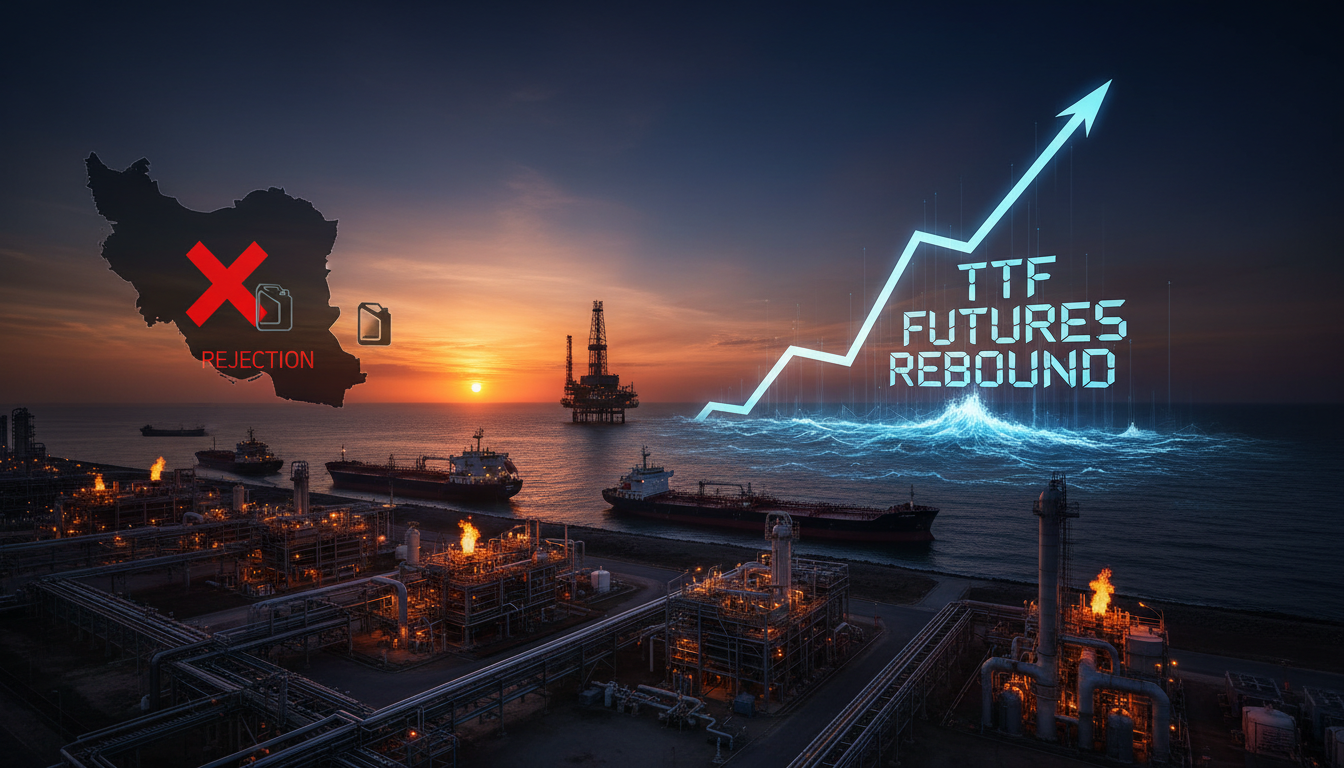
European natural gas markets opened Monday with notable volatility, quickly reversing an early dip to register significant gains as investors grappled with escalating geopolitical tensions in the Strait of Hormuz. The critical maritime chokepoint, already a source of immense apprehension, once again became the focal point of energy traders as a standoff between the U.S. and Iran intensified, threatening global liquefied natural gas (LNG) supplies.
Strait of Hormuz Tensions Fuel Price Swings
The front-month contract for Dutch TTF Natural Gas Futures, widely regarded as Europe’s benchmark for natural gas trading, initially fell by nearly 3% at Monday’s open. This decline followed an announcement by U.S. authorities indicating a plan to guide commercial vessels through the Strait of Hormuz. However, the market sentiment rapidly shifted. Following a stern warning from Iran, cautioning the U.S. against any attempts to approach or enter the strait, the futures contract not only erased its earlier losses but surged, closing the morning trading session up by 1.3% at $39.67 (46.48 euros) per megawatt-hour (MWh).
This dramatic swing underscores the market’s acute sensitivity to potential disruptions in a region vital for international energy flows. Investors are keenly watching how any proposed vessel guidance strategy might be implemented, or whether it even materializes in a way that truly assures safe passage without further provocation. Analysts from ING, for instance, have expressed skepticism, noting that initial reports suggest a guidance plan may not involve direct U.S. Navy escorts for commercial vessels. While such a scenario might offer temporary relief for vessels exiting the Persian Gulf, it is unlikely to incentivize inbound traffic, leading to a potential bottleneck of floating storage rather than a resolution to supply concerns.
Strategic Chokepoint and LNG Supply Vulnerability
The Strait of Hormuz is more than just a shipping lane; it is a strategic chokepoint through which approximately 20% of the world’s daily LNG flows. Any significant disruption or closure of this narrow passage would immediately impede all LNG shipments originating from Qatar and the United Arab Emirates. For global energy markets, and particularly for Europe which relies heavily on LNG imports to diversify its gas supply, the implications are severe. The mere threat of a closure, or even increased transit risk, injects a substantial geopolitical risk premium into commodity prices, impacting investor confidence and long-term planning.
Beyond the immediate anxieties surrounding the Strait, the LNG market faces another formidable challenge: the significant damage sustained by Qatar’s Ras Laffan liquefaction complex. This facility, the largest of its kind globally, suffered extensive damage during an Iranian missile strike in mid-March. The severity of the damage has forced Qatar, a major global LNG exporter, to shut in production. Preliminary assessments suggest that repairs to this crucial infrastructure could take up to five years to complete, a timeline that introduces a prolonged and substantial constraint on global LNG supply. This long-term outage further tightens an already taut market, leaving major importing regions like Europe highly exposed to price volatility and supply insecurity.
Europe’s Challenging Refill Season Ahead
For European economies, these combined factors paint a challenging picture for the upcoming natural gas storage refilling season. With winter demand behind them, nations typically work diligently to replenish their underground storage facilities during the warmer months, preparing for the next heating season. However, the current confluence of geopolitical instability in the Middle East and significant supply disruptions from a key LNG producer means that this year’s refilling efforts will likely be both more difficult and substantially more expensive.
While TTF futures prices have retreated from the peak levels observed in March following the initial missile strike, they remain approximately 40% higher than their pre-conflict benchmarks. This persistent elevated pricing environment underscores the deep-seated market apprehension and the inherent risk premiums now embedded in natural gas contracts. Investors in the energy sector must account for this heightened risk profile, recognizing that fundamental supply-demand dynamics are increasingly overshadowed by unpredictable geopolitical events. The ongoing situation in the Middle East serves as a stark reminder of the interconnectedness of global energy markets and the outsized influence of regional conflicts on international commodity prices and investor returns.
As the standoff in the Strait of Hormuz continues and the full extent of the Ras Laffan outage is understood, European gas markets are set to remain highly volatile. Investors should prepare for sustained price swings and the potential for further upside as the continent navigates a period of acute supply uncertainty and geopolitical tension, all while striving to secure its energy needs for the coming winter.