The recent missile strike on Qatar’s Ras Laffan Industrial City has sent fresh tremors through global energy markets, underscoring the escalating geopolitical risks in key producing regions. This direct attack on crucial liquefied natural gas (LNG) infrastructure, a facility paramount to global gas exports, immediately raises concerns about supply stability, particularly for major importers like India. For oil and gas investors, this incident demands a re-evaluation of risk premiums across the energy complex, from the immediate impact on natural gas to the broader implications for crude oil prices and global supply chains.
Escalating Geopolitical Risk Disrupts LNG Supply Chains
The attack on Qatar’s Ras Laffan Industrial City inflicted significant damage to multiple LNG facilities, leading to substantial fires and extensive disruption. As a cornerstone of global gas supply, Qatar’s role is indispensable, and any hit to its export capabilities reverberates worldwide. India, for instance, faces immediate energy security challenges, as it sources approximately 40% of its LNG needs from Qatar. This reliance is further cemented by a long-term agreement signed earlier this year between PetronLNG Ltd and QatarEnergy, a monumental $78 billion deal ensuring 7.5 million tonnes per annum of LNG imports through 2048. The vulnerability of such critical infrastructure highlights the fragility of global energy security and the potential for rapid price surges in natural gas markets, impacting industrial users and consumers globally.
Crude Markets React Cautiously Amidst Broader Trends
While the immediate focus of the attack is on natural gas, the broader energy complex is not immune to the heightened geopolitical tension. As of today, Brent crude trades at $92.1 per barrel, marking a 1.22% decline, with WTI crude following a similar trajectory at $88.39, down 1.43%. This short-term dip might seem counterintuitive given the escalation, suggesting that broader market concerns, such as demand outlooks or inventory levels, are currently outweighing the immediate geopolitical risk premium on crude. Our proprietary data shows Brent crude has trended significantly downward over the past 14 days, falling from $101.16 to $94.09, a decline of $7.07. This suggests that while regional instability is a constant factor, underlying supply-demand dynamics have recently been the dominant force. Yet, the Ras Laffan incident injects a fresh layer of uncertainty. Investors are actively seeking clarity, with our platform data showing frequent queries such as “is WTI going up or down?” and “what do you predict the price of oil per barrel will be by end of 2026?” This event adds significant volatility to these predictions, reminding us that the balance can shift rapidly based on geopolitical developments.
India’s Industrial Sector Faces Immediate Headwinds and Global Ripple Effects
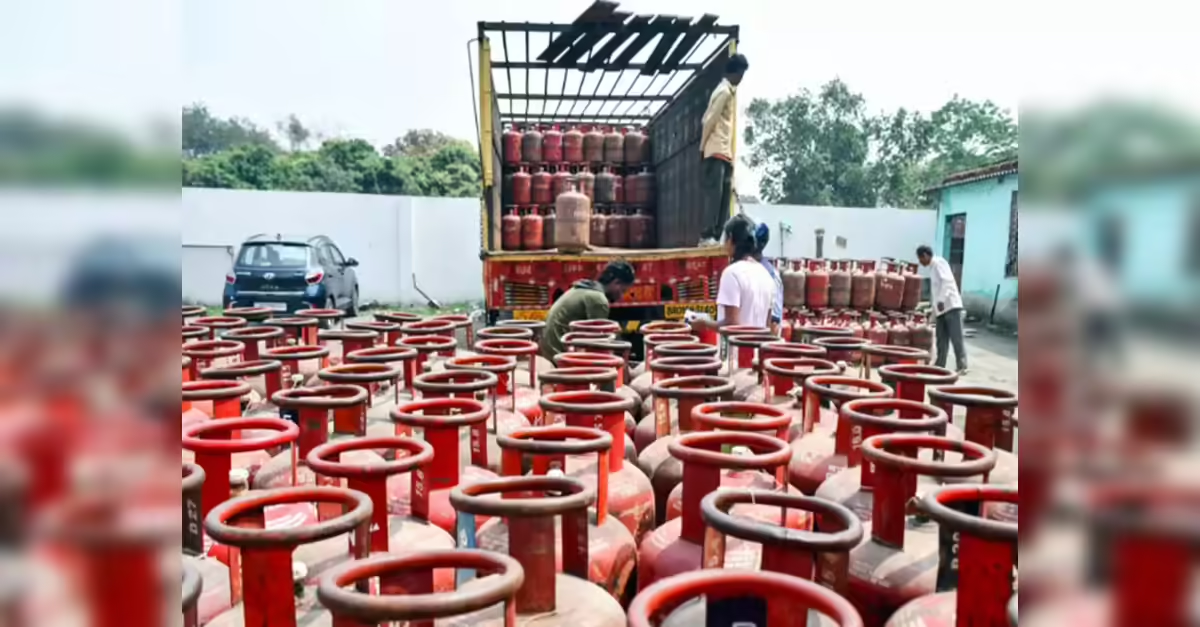
The impact of the Qatari LNG disruption is already being felt acutely in India’s industrial sector. Reports indicate that fertilizer plants are currently receiving only about 70% of their required gas supplies, forcing many facilities to either scale down operations or accelerate scheduled maintenance shutdowns. This has significant implications beyond India’s borders, given the country’s status as the world’s largest importer of urea. A prolonged gas shortage could compel India to increase its reliance on international fertilizer markets, potentially driving up global prices and, in turn, increasing agricultural costs worldwide. Furthermore, the Indian Steel Association has warned of a “huge adverse impact” on steel-sector MSMEs and ancillary units due to potential shortages of propane and liquefied petroleum gas, threatening employment for a significant workforce. This situation exemplifies how localized geopolitical events can swiftly create far-reaching economic consequences across interconnected global supply chains.
Upcoming Events and Forward-Looking Investor Strategies
The unfolding situation in the Middle East demands close monitoring of both geopolitical developments and key energy market indicators. Investors should prepare for potential increased volatility, particularly in natural gas futures, and keep a vigilant eye on crude oil’s geopolitical risk premium. In the coming weeks, several critical data releases will offer further insights into market fundamentals. The EIA Weekly Petroleum Status Reports, scheduled for April 22nd and April 29th, will provide crucial updates on U.S. crude and product inventories, which could either exacerbate or mitigate current price pressures. The Baker Hughes Rig Count on April 24th and May 1st will shed light on North American production trends, while the comprehensive EIA Short-Term Energy Outlook on May 2nd will offer updated global supply and demand forecasts, potentially integrating the latest geopolitical risks into its projections. Moreover, the stark warning from former US President Donald Trump regarding a “severe military response” to any further attacks on Qatar underscores the high-stakes nature of the conflict. This adds a critical, unpredictable dimension to the geopolitical landscape that investors must factor into their forward-looking models, necessitating agile portfolio adjustments to navigate potential escalations and market shifts.


