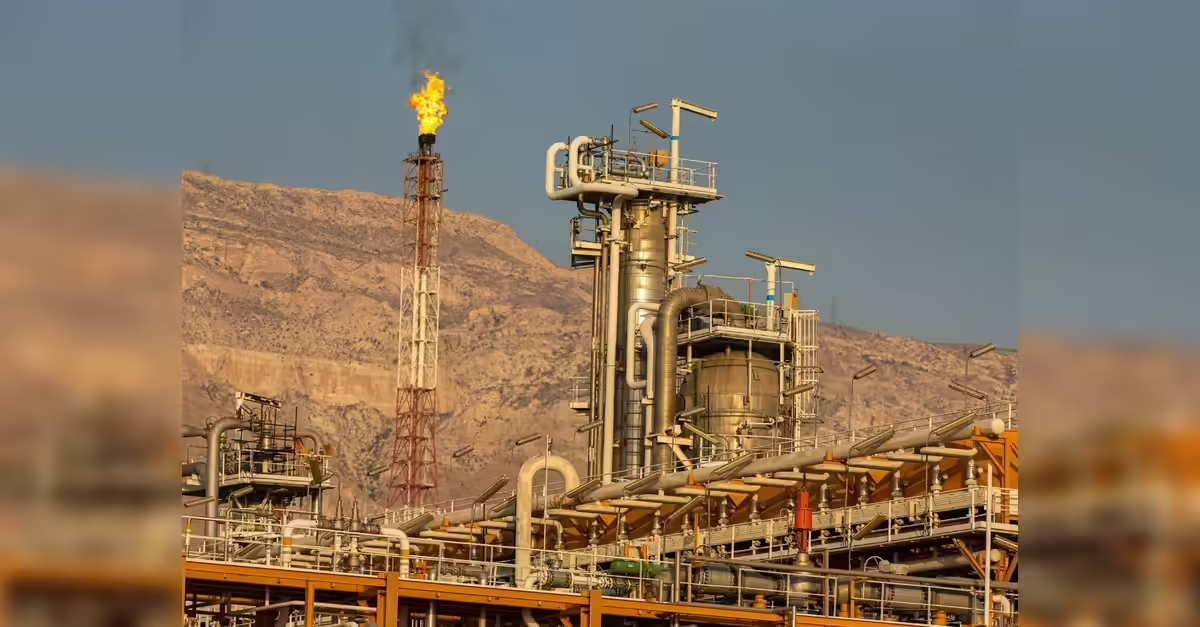
The global energy landscape has been irrevocably altered by recent escalations in the Middle East, pushing the market into what many now fear is a deepening gas crisis. An Iranian drone attack on Qatar’s Ras Laffan liquefied natural gas (LNG) plant has inflicted extensive damage, with repair timelines stretching up to five years. This event, representing the first major supply interruption in three decades for the world’s largest LNG facility, has not merely tightened the market; it has fundamentally reshaped the supply-demand balance for years to come. For investors, understanding the gravity of this situation and its ripple effects across the entire energy complex is paramount, as we move from an anticipated gas glut to a stark deficit, presenting both immense challenges and critical investment opportunities.
The Ras Laffan Outage: A Multi-Year Supply Shock
The closure of Qatar’s Ras Laffan plant earlier this month, followed by subsequent strikes in retaliation for an Israeli action on the vast South Pars fields, has created an unparalleled disruption. The latest attacks have critically damaged two of the plant’s production trains, removing a combined 12.8 million tons of annual output capacity from the global market. This equates to approximately 17 percent of Qatar’s total LNG exports and a significant portion of global supply, with each week of shutdown costing the world the energy equivalent to power Sydney’s homes for an entire year. The projected five-year repair timeline underscores the long-term nature of this crisis, moving beyond short-term market volatility to a structural shift in global energy flows. This long-term supply contraction means higher energy prices for most economies and, more critically, could irreparably damage industrial demand in emerging nations, which are vital growth markets for LNG.
Navigating Current Market Volatility Amidst Geopolitical Tensions
The immediate impact of the Middle East conflict has been a complex interplay of forces on global energy prices. As of today, Brent crude trades at $91.9 per barrel, reflecting a 1.44% decline within a day range of $91.39 to $94.21. WTI crude similarly saw a 1.61% dip, settling at $88.23, after trading between $87.64 and $90.71. While these figures represent a short-term pullback, it’s crucial to contextualize them within the broader trend: Brent crude has seen a 7% decrease over the past 14 days, from $101.16 to $94.09. This recent cooling in crude prices might offer a deceptive sense of stability. However, the closure of the vital Strait of Hormuz and ongoing supply chain disruptions, coupled with the profound shock to LNG markets, suggest that underlying price support remains robust. Gasoline prices, currently at $3.09 per gallon, albeit down 0.96% today, continue to reflect persistent inflationary pressures. Investors must recognize that while crude markets might react to broader economic sentiments or temporary de-escalations, the severe and long-lasting curtailment of LNG supply provides a strong floor for the entire energy complex, particularly for natural gas prices.
Forward Outlook: Monitoring Key Indicators and Upcoming Events
The long-term implications of the Ras Laffan outage are severe, with analysts like Saul Kavonic from MST Marquee warning of a “doomsday gas crisis scenario.” This crisis has almost certainly erased the global gas glut widely anticipated for this year, quickly turning the balance negative. According to Morgan Stanley, an interruption beyond one month “quickly brings a deficit,” and if it stretches to three months, it will constitute the largest LNG outage in the industry’s half-century history. For investors, tracking upcoming market signals and events will be critical. The EIA Weekly Petroleum Status Reports, scheduled for April 22nd, April 29th, and May 6th, will provide crucial insights into inventory levels and demand shifts in the face of this supply shock. Similarly, the Baker Hughes Rig Count on April 24th and May 1st will indicate North American production responses. Perhaps the most pivotal release will be the EIA Short-Term Energy Outlook on May 2nd. This report will offer updated projections that will undoubtedly reflect the new reality of the Middle East’s hobbled LNG production, confirming the shift from surplus to deficit and guiding market expectations for the rest of 2026 and beyond. Investors should pay close attention to how these reports re-evaluate global gas supply forecasts.
Investor Concerns and Strategic Positioning in a Deepening Crisis
Our proprietary reader intent data reveals a clear focus from investors on market direction and long-term price predictions, with common queries like “is WTI going up or down?” and “what do you predict the price of oil per barrel will be by end of 2026?” While short-term volatility remains, the structural shift in LNG supply suggests sustained upward pressure on natural gas prices and, by extension, supportive fundamentals for the broader energy sector. The gas crisis poses a significant challenge for all market participants. With virtually no spare LNG capacity, no strategic reserves, and no easy replacements, the global economy will be forced to use less gas. This is a major setback for a fuel promoted as a reliable bridge to renewable power, with severe consequences for power plants, fertilizer, and textile factories. Investors should consider strategic shifts in their portfolios. Companies with robust, diversified LNG portfolios outside conflict zones, those focused on gas-to-power solutions in regions less dependent on Middle Eastern supply, or those with strong hedging strategies will be better positioned. We anticipate that South and Southeast Asia will be immediate casualties of this crisis, impacting their industrial growth and energy security. The ripple effect from this long-term shock could be even more significant than the 2022 energy crisis, demanding a re-evaluation of energy investment strategies for the foreseeable future.


