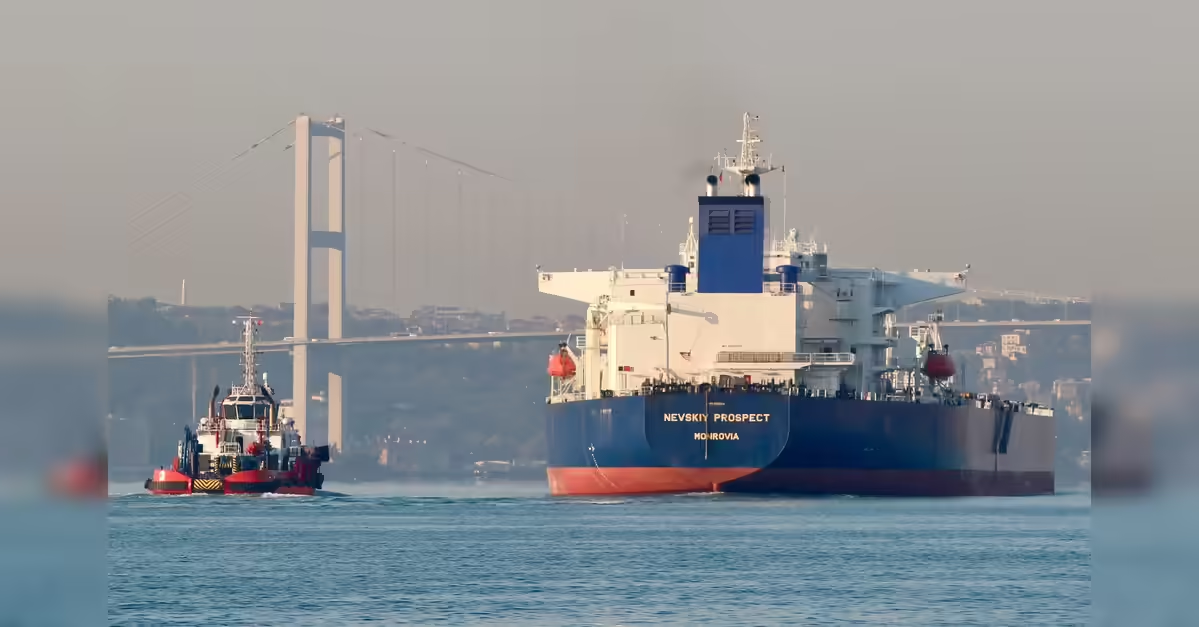
A significant realignment of global crude trade flows is currently underway, with India emerging as a pivotal player in the Russian oil market. This strategic pivot, driven by a confluence of geopolitical concessions and evolving supply needs, is directly impacting established shipping routes, most notably those previously destined for China. Our proprietary data indicates a pronounced shift in tanker movements, signaling profound implications for global oil prices, regional supply dynamics, and the strategic positioning of key market participants. This analysis delves into the mechanisms of this re-routing, its immediate market effects, and the critical data points investors must monitor to navigate this evolving landscape.
The Great Re-Routing: India’s Strategic Pivot
The global oil market is witnessing a dramatic reallocation of crude supplies, spearheaded by India’s aggressive uptake of Russian oil. Ship-tracking data reveals multiple instances of tankers performing mid-voyage U-turns, diverting from original destinations in China to ports across India. A prime example is the Aqua Titan, an Aframax vessel, which loaded Urals crude from a Baltic Sea port in late January and initially signaled China’s Rizhao as its destination. However, in mid-March, days after the United States granted India a temporary green light to increase Russian purchases, the vessel executed an about-face in Southeast Asian waters and is now slated to arrive in New Mangalore on March 21. This single rerouting is emblematic of a broader trend, with Indian refiners reportedly snapping up a staggering 30 million barrels of Russian oil in the week following the concession. This influx helps India compensate for lost Middle Eastern supplies due to the war in Iran, demonstrating a calculated move to secure energy needs amidst regional instability. Notably, this shift has seen at least seven tankers carrying Russian oil switch their destinations from China to India, indicating a systemic change where China is no longer Moscow’s singular importer of last resort, a role it had assumed after India initially reduced its purchases.
Market Dynamics and Price Implications
The re-routing of Russian crude to India, coupled with the return of other buyers such as Japan and South Korea, is exerting discernible pressure on global oil market dynamics. As of today, Brent crude trades at $92.95 per barrel, reflecting a slight dip of 0.31% within a day range of $92.57 to $94.21. Similarly, WTI crude stands at $89.45, down 0.25% today. However, these intraday movements should be viewed in the context of a broader trend: our 14-day Brent trend data shows a notable decline of over 7%, from $101.16 on April 1st to $94.09 yesterday, April 21st. The recent influx of buyers for Russian crude could serve as a counterweight to this downward pressure. Increased demand, especially for Urals crude, is likely to tighten the market for similar sour crude grades globally, potentially pushing up prices for benchmark crudes. While the immediate impact might be localized to differentials, the cumulative effect of increased competition for Russian barrels and broader supply reconfigurations could provide a floor for prices and even catalyze an upward trajectory. This directly addresses the underlying investor question of whether WTI, and crude prices generally, are heading up or down, suggesting that while recent trends have been soft, the geopolitical and trade shifts introduce a significant bullish factor.
Beyond Russian Urals: A Broader Supply Chain Reconfiguration
The scope of this trade flow re-routing extends beyond just Russian Urals crude, signaling a more comprehensive reconfiguration of Eurasian energy supply chains. Evidence of this broader shift can be seen with the Suezmax Zouzou N., which is carrying Kazakh CPC Blend crude. This tanker sailed from Novorossiysk on Russia’s Black Sea, initially signaling the waters off Rizhao, China. However, in early March, it too reversed course and is now signaling India’s Sikka as its next destination, with an estimated arrival date of March 25. This development is critical because CPC Blend is a light, sweet crude, distinct from the heavier, sour Urals. The diversion of Central Asian crude through Russian ports, then re-routed from China to India, underscores a deeper strategic realignment. It suggests that India is not merely seeking a discount on distressed Russian barrels but is actively positioning itself as a major recipient for a variety of crude grades, leveraging geopolitical flexibility to secure diverse energy sources. This fundamental shift has implications for Central Asian producers, their traditional markets, and the intricate web of global crude logistics, indicating a more profound and lasting change than a mere opportunistic trade.
Navigating Future Volatility: Key Data Points for Investors
In this rapidly evolving market, discerning investors must closely monitor upcoming energy events for critical insights into supply and demand balances. These scheduled releases will provide granular data necessary to assess the real-time impact of these trade shifts. The EIA Weekly Petroleum Status Reports, scheduled for April 22nd, April 29th, and May 6th, will offer crucial updates on U.S. crude oil and product inventories, refinery utilization, and demand indicators. Similarly, the API Weekly Crude Inventory reports on April 28th and May 5th will provide an early look at U.S. stock changes. Shifts in these metrics, particularly in light of global re-routings, could signal tightening or loosening supply conditions. Furthermore, the Baker Hughes Rig Counts on April 24th and May 1st will provide vital data on North American drilling activity, a key indicator of future supply. Perhaps most critically, the EIA Short-Term Energy Outlook, due on May 2nd, will present updated forecasts for global supply, demand, and prices. This report will be instrumental in understanding how major agencies are adjusting their models to account for the new geopolitical realities and trade flow reconfigurations, offering a benchmark against which investors can calibrate their own outlooks.
Investor Takeaways: Positioning for a Shifting Landscape
The seismic shift in crude trade flows, with India’s increased appetite for Russian and Central Asian oil, presents both opportunities and risks for energy investors. A common question echoing across our reader base, and indeed the broader market, is regarding the future trajectory of crude prices and how these dynamics will shape the end-of-year outlook for 2026. The return of significant buyers to the Russian crude market, coupled with India’s burgeoning demand, is a powerful force that could underpin prices, potentially counteracting recent market softness. Investors should consider the potential for increased profitability among Indian refiners, who are securing diversified and potentially more competitive crude supplies. Shipping companies involved in the Russia-India route may also see sustained demand. Conversely, refiners in other regions, particularly Europe, might face increased competition for alternative crude sources if Middle Eastern supplies become tighter or more expensive due to diversions away from Europe. The “war in Iran” context, which initially spurred India’s need for alternative supplies, remains a significant geopolitical risk factor that could further disrupt traditional trade routes and exert upward pressure on prices. Astute investors will need to remain agile, leveraging real-time data and forward-looking analysis to identify companies best positioned to benefit from, or mitigate risks associated with, this evolving global energy landscape.


