

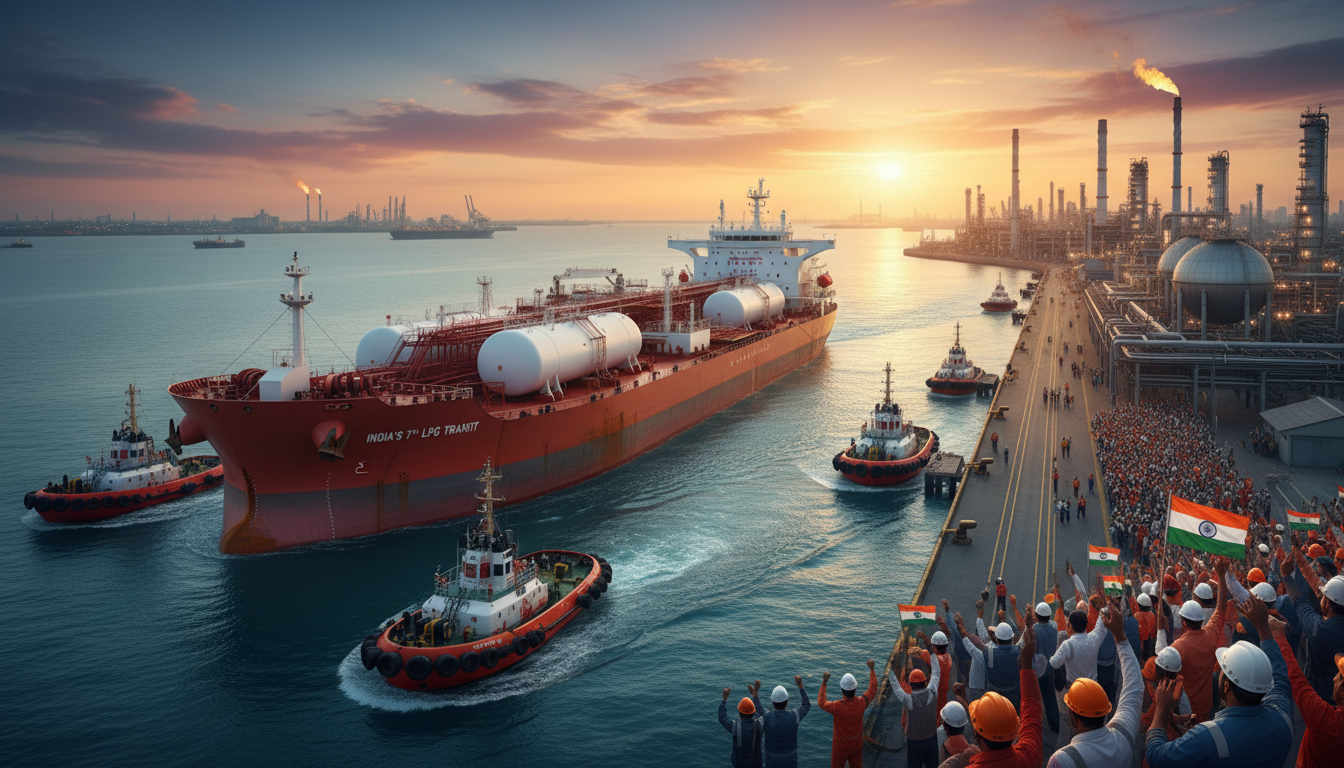
The global energy market continues to navigate a complex web of geopolitical tensions and evolving trade dynamics, presenting both challenges and opportunities for investors. Recent developments impacting India’s energy imports highlight the critical importance of secure maritime pathways and robust financial frameworks in the volatile oil and gas sector. As West Asian conflicts persist, the successful transit of vital liquefied petroleum gas (LPG) shipments offers a measure of stability, while a significant shift in Iranian crude trade underscores a growing focus on payment terms and counterparty risk.
Navigating the Strait of Hormuz: Securing India’s LPG Lifeline
In a period marked by elevated maritime risk, India’s energy security has demonstrated resilience as the seventh India-flagged LPG tanker, the Green Sanvi, successfully navigated the Strait of Hormuz. This critical chokepoint, essential for a substantial portion of global oil and gas trade, has seen six other LPG vessels reach Indian ports since the outbreak of regional hostilities. This steady flow of LPG is paramount for India, a nation with burgeoning energy demand, where LPG serves as a crucial fuel for millions of households and industries.
Despite these successes, investors must remain cognizant of ongoing vulnerabilities. Currently, seventeen Indian-flagged vessels remain positioned west of the Strait of Hormuz, with two, the Green Asha and the Jag Vikram, laden with LPG and awaiting transit orders. These two vessels were reportedly drifting northeast of Abu Musa Island in the Persian Gulf, adhering to instructions from the Indian Navy as they prepared for their passage. The active involvement of naval forces in guiding these commercial vessels through high-risk areas underscores the heightened security measures now embedded in global energy logistics. For investors, this demonstrates the critical role of state-backed security in mitigating geopolitical supply chain risks, a factor that can directly influence insurance premiums and operational costs for tanker operators and commodity traders alike.
Iranian Crude Flows: Financial Terms Reshape Global Trade
While LPG shipments demonstrate fortitude, the dynamics of crude oil trade, particularly concerning sanctioned barrels, reveal a significant recalibration. A recent incident involving the Eswatini-flagged crude tanker Ping Shun offers a stark illustration. Originally signalling a destination for the Vadinar facility of Deendayal Port at Kandla in Gujarat, India, the vessel, purportedly carrying 600,000 barrels of Iranian crude, abruptly altered its course mid-voyage, now indicating Dongying in China as its new destination. This potential diversion represents a pivotal moment, as it would have marked India’s first receipt of Iranian crude in six years, a testament to the complex geopolitical tightrope India walks in balancing its energy needs with international sanctions.
Sumit Ritolia, a lead analyst at global analytics firm Kpler, highlighted that such mid-voyage destination changes are not unprecedented for Iranian crude. He emphasized that this event underscores the increasing sensitivity of trade flows to financial terms and counterparty risk, often eclipsing purely logistical considerations. Ritolia pointed to payment-related issues as the likely catalyst, indicating a notable tightening of commercial terms by sellers. This shift involves a move away from the traditional 30-60 day credit window towards demands for upfront or near-term settlement. For investors monitoring the global crude market, this signals a significant de-risking strategy by sellers of sanctioned oil, placing a greater immediate financial burden on buyers.
The implications are far-reaching. While experts suggest the cargo could still find its way to an Indian refinery if payment issues are ultimately resolved, the incident accentuates how commercial arrangements are becoming as pivotal as logistics in determining the flow of Iranian crude to nations other than China. This development effectively raises the cost and complexity of procuring Iranian oil for countries like India, potentially driving more of these volumes towards buyers willing and able to meet stringent, rapid payment terms, predominantly China. Investors should monitor how these evolving payment structures could influence regional crude pricing, shipping patterns, and the strategic positioning of national oil companies in securing diverse supply sources.
Investment Implications: Geopolitics, Supply Chains, and Commodity Flows
These two distinct narratives – the measured success in securing LPG imports via a volatile Strait and the dramatic shift in Iranian crude trade – collectively paint a compelling picture for energy investors. They underscore the dual pressures of physical security and financial integrity in maintaining robust energy supply chains. Geopolitical risk premiums remain a defining feature of the current oil and gas market, influencing everything from insurance costs for maritime transport to the willingness of financial institutions to underwrite commodity deals.
For portfolios exposed to energy, understanding the resilience of supply routes like the Strait of Hormuz is crucial. Successful transits, even under duress, can bolster confidence in the continuity of supply, mitigating sharp price spikes driven by panic. Conversely, the Iranian crude diversion serves as a potent reminder of the fragility inherent in sourcing sanctioned commodities. The increasing emphasis on upfront payments suggests a higher risk perception among sellers and financers, potentially limiting the pool of buyers and creating a more concentrated, less transparent market for these specific barrels.
Investors should continue to track developments in West Asia, not just for their immediate impact on crude oil prices, but also for their long-term implications on maritime trade routes, energy diversification strategies of major importing nations like India, and the evolving financial mechanisms that underpin global commodity flows. The premium placed on energy security, both physical and commercial, will likely remain a dominant theme, shaping investment decisions across the entire oil and gas value chain from exploration and production to refining and logistics.
