India’s Strategic Diesel Export Levy Reshapes Domestic Fuel Market Dynamics
India, a vital player in the global energy arena, has once again demonstrated its proactive stance in managing its domestic fuel market. A recent significant increase in the export tax on diesel is poised to compel a critical price alignment between the nation’s dominant state-run oil marketing companies (OMCs) and private fuel exporters, a move that could finally resolve a protracted disagreement over crucial domestic supply contracts. For investors tracking the intricate energy landscape of the subcontinent, this policy shift signals a recalibration of market incentives and refining profitability.
The operational framework of India’s fuel distribution sees state-owned behemoths like Indian Oil, Bharat Petroleum Corporation Ltd (BPCL), and Hindustan Petroleum Corporation Ltd (HPCL) collectively commanding approximately 90 percent of the retail fuel market. These OMCs routinely procure a portion of their diesel requirements from key private refiners such as Reliance Industries and Nayara Energy, alongside other state-run refiners with limited direct retail presence, including MRPL, CPCL, and Numaligarh Refinery. Historically, these procurement agreements often linked pricing to international diesel benchmarks, offering a clear market-based mechanism.
The Battle Over Procurement Costs Amid Frozen Retail Prices
However, the current global energy climate, characterized by persistently elevated international diesel prices, has collided with India’s domestic policy of maintaining stable retail pump prices. This divergence has placed considerable financial strain on OMCs, prompting them to seek avenues for capping their procurement costs at levels below prevailing international benchmarks. This situation ignited a significant standoff, as OMCs advocated for a new pricing formula based on the Indian crude basket price plus an additional $15 per barrel. Conversely, private refiners staunchly defended a formula derived from the benchmark diesel price, net of any applicable export tax.
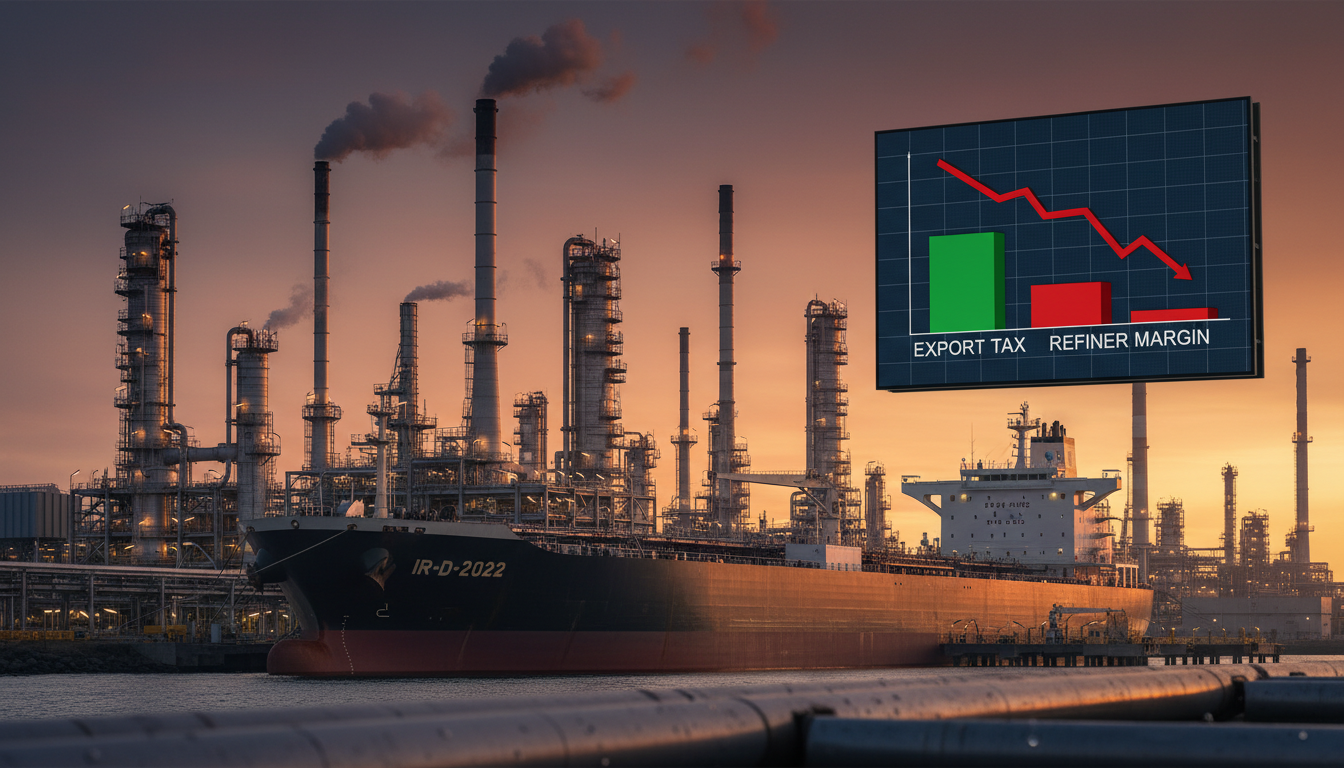
The government’s intervention came decisively. On a recent Saturday, authorities announced a substantial hike in the export duty levied on diesel. The duty surged from an initial ₹21.5 per litre, equivalent to approximately $37 per barrel, to a much steeper ₹55.5 per litre, translating to about $95 per barrel. This pivotal policy adjustment aims to bridge the economic chasm separating the two opposing pricing methodologies.
Quantifying the Convergence: A Detailed Financial Analysis
To fully grasp the impact of this increased export duty, a comparative analysis of the pricing scenarios from March to April is crucial for investors. In March, the disparity between the OMCs’ desired price and the refiners’ position was stark, exceeding $20 per barrel.
Based on an average Indian crude basket price of $113.5 per barrel in March, the OMC’s proposed formula would have yielded a diesel price of approximately $128.5 per barrel ($113.5 + $15). In stark contrast, considering the March average Arab Gulf diesel benchmark of $186.6 per barrel and subtracting the then-export duty of $37 per barrel, the refiners’ preferred formula resulted in a price of roughly $150 per barrel ($186.6 – $37).
Fast forward to April, following the implementation of the higher export tax, the landscape shifted dramatically. With the average April Indian crude basket price rising to $124.64 per barrel, the OMC formula now suggests a diesel price of approximately $140 per barrel ($124.64 + $15). Simultaneously, utilizing the April Arab Gulf diesel benchmark of $238.4 per barrel and factoring in the new, elevated $95 per barrel export duty, the refiners’ preferred calculation arrives at approximately $143 per barrel ($238.4 – $95).
This critical adjustment has effectively narrowed the pricing discrepancy between the two factions to a mere $3 per barrel. The government’s strategic move has thus largely achieved its immediate objective of fostering greater alignment in domestic diesel procurement pricing, making it significantly easier for OMCs and refiners to find common ground.
Refiner Perspectives and Broader Market Implications for Investors
Private refiners, along with standalone state refiners, had previously resisted the OMCs’ pricing proposals, citing that their crude acquisition costs were often significantly higher than benchmark-linked levels. This argument highlighted the challenge of reconciling international input costs with a constrained domestic selling price environment. The increased export tax directly impacts their export margins, effectively making domestic sales more attractive relative to the reduced profitability of overseas shipments. This policy lever pushes more refined product towards the domestic market, aligning with India’s energy security objectives.
For investors, this policy underscores the Indian government’s willingness to intervene in commodity markets to ensure domestic stability and affordability. While the immediate outcome appears to be a stabilization of procurement negotiations, the long-term implications for refining profitability, particularly for export-oriented private players, bear close monitoring. It raises questions about future investment in refining capacity, technological upgrades, and the strategic positioning of companies like Reliance and Nayara within India’s evolving energy matrix. The ongoing balancing act between market liberalization and state intervention will continue to shape the risk-reward profile for participants in India’s dynamic oil and gas sector.