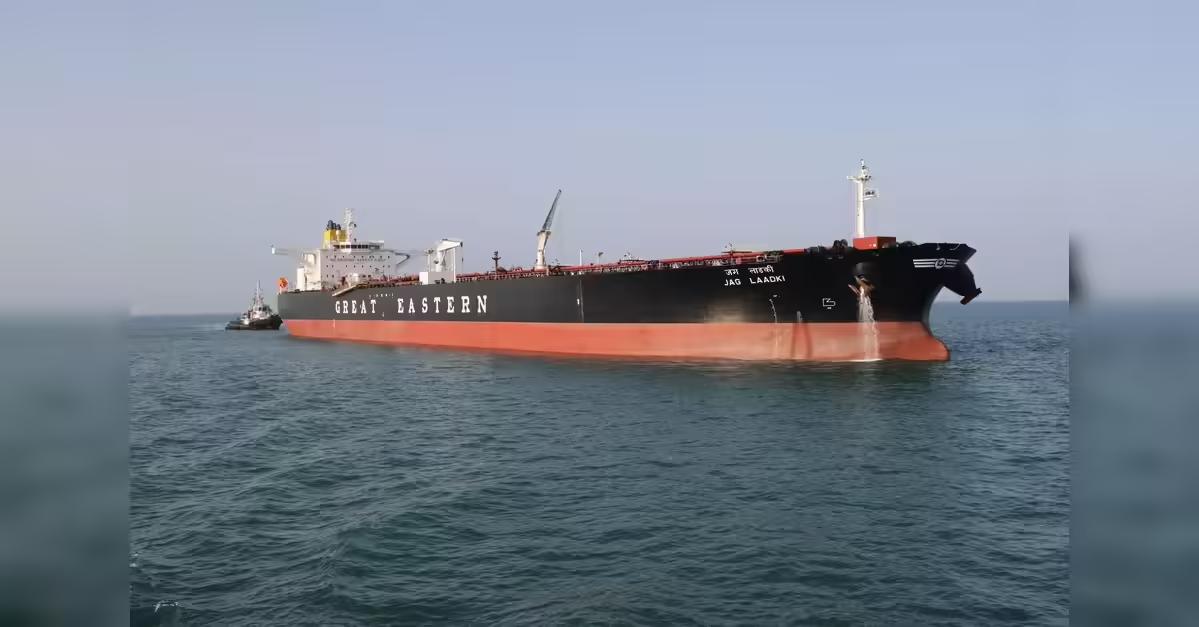
The successful and timely arrival of the Indian-flagged oil tanker, Jag Laadki, at Mundra port with 80,800 metric tonnes of Murban crude from the UAE, following an attack at Fujairah’s oil terminal on March 14, 2026, offers a critical lens through which to view current geopolitical risk and its impact on global energy markets. This incident, while concerning, ultimately demonstrated the resilience of key maritime trade routes and the effectiveness of proactive security measures. For investors, it underscores a nuanced reality: while regional tensions remain a constant, the immediate supply chain response can often mitigate the worst fears of disruption, shifting the focus back to underlying market fundamentals and forward-looking indicators.
Geopolitical Resilience Amidst Market Fluctuations
The safe passage of the Jag Laadki, departing Fujairah shortly after the March 14 attack and arriving without incident, signals a strong message about the robustness of the India-UAE crude flow. This was not an isolated event; two other Indian-flagged LPG carriers, MT Shivalik and MT Nanda Devi, also completed their transits through the Strait of Hormuz earlier in March, carrying 92,712 metric tonnes of LPG. These successful voyages, despite heightened tensions in West Asia, provide a degree of reassurance regarding the security of vital shipping lanes. However, this localized resilience has unfolded against a backdrop of broader market shifts. As of today, Brent Crude trades at $92.95, reflecting a modest daily decline of 0.31%, with its intraday range spanning $92.57 to $94.21. Similarly, WTI Crude stands at $89.45, down 0.25% for the day, trading between $88.76 and $90.71. Looking at the wider trend, our proprietary data indicates that Brent has actually softened significantly over the past two weeks, dropping from $101.16 on April 1, 2026, to $94.09 by April 21, 2026 – a substantial decrease of $7.07, or 7%. This suggests that while specific geopolitical incidents like the Fujairah attack can cause momentary jitters, the market’s overall trajectory is currently being driven by a more complex interplay of demand outlooks, inventory levels, and macroeconomic sentiment rather than an immediate, sustained geopolitical risk premium.
India’s Strategic Imperative and Supply Chain Safeguards
India’s proactive approach to safeguarding its energy imports and maritime trade routes is a key factor in the market’s ability to absorb localized disruptions. The government’s immediate and transparent communication regarding the Jag Laadki’s status, coupled with its ongoing naval presence under “Operation Sankalp,” underscores a strategic commitment to supply chain security. This operation, designed to secure shipping routes and ensure safe passage for commercial vessels, is a critical deterrent and a practical measure that instills confidence. Furthermore, the Directorate General of Shipping’s coordination with ship owners and Indian missions, along with the Union Shipping Minister’s close monitoring, demonstrates a comprehensive oversight. The advisory to ports to provide relief measures, including concessions on anchorage, berth hire, and storage charges, highlights a concerted effort to minimize economic friction during periods of elevated risk. For investors, this level of governmental engagement in a major consuming nation like India, which is heavily reliant on Middle Eastern crude, signals a strong political will to maintain stable energy flows, thereby reducing the probability of widespread or prolonged supply disruptions impacting global prices due to regional flashpoints.
Navigating Investor Concerns: Beyond Immediate Risk
Our proprietary intent data reveals that while investors track geopolitical events closely, their overarching focus remains firmly on price direction and future market stability. We see a consistent stream of queries, with investors keenly asking, “is WTI going up or down?” and “what do you predict the price of oil per barrel will be by end of 2026?” This indicates that while the successful transit of vessels like the Jag Laadki is positive for supply chain confidence, it doesn’t fully resolve the broader uncertainties surrounding oil price trajectories. The market has effectively shrugged off the immediate impact of the Fujairah incident, largely because the disruption was contained and transit continued. This suggests that the “geopolitical risk premium” is currently more muted than historical precedents might suggest, perhaps due to factors like global inventory levels, OPEC+ spare capacity, or perceived demand softness. Investors are clearly looking for signals beyond isolated incidents, seeking clarity on the fundamental drivers that will shape crude prices over the coming months and into the end of the year. Their focus is shifting from immediate operational risks to the larger supply-demand balance and macroeconomic headwinds or tailwinds.
Forward Outlook: Key Data Points and Catalysts
While the successful crude deliveries from the UAE offer short-term reassurance, the true catalysts for market direction in the coming weeks will stem from fundamental data. Investors should closely monitor a series of upcoming energy events that will provide fresh insights into global supply, demand, and inventory dynamics. The EIA Weekly Petroleum Status Reports, scheduled for April 22, April 29, and May 6, will offer crucial updates on U.S. crude oil, gasoline, and distillate inventories, refining activity, and demand indicators. These reports are often significant market movers, influencing sentiment around the global supply-demand balance. Similarly, the Baker Hughes Rig Count on April 24 and May 1 will provide an early look into North American production trends, a critical input for supply forecasts. Furthermore, the API Weekly Crude Inventory reports on April 28 and May 5 will offer an industry-side perspective ahead of the official EIA data. Perhaps one of the most anticipated releases for a longer-term perspective is the EIA Short-Term Energy Outlook (STEO) on May 2. This report will provide updated forecasts for supply, demand, and prices across various energy commodities for the remainder of 2026 and beyond. Collectively, these events will likely exert a far greater influence on crude price direction than localized, contained geopolitical incidents, guiding investors’ expectations for where oil prices are headed by the end of 2026 and shaping strategic portfolio decisions.


