

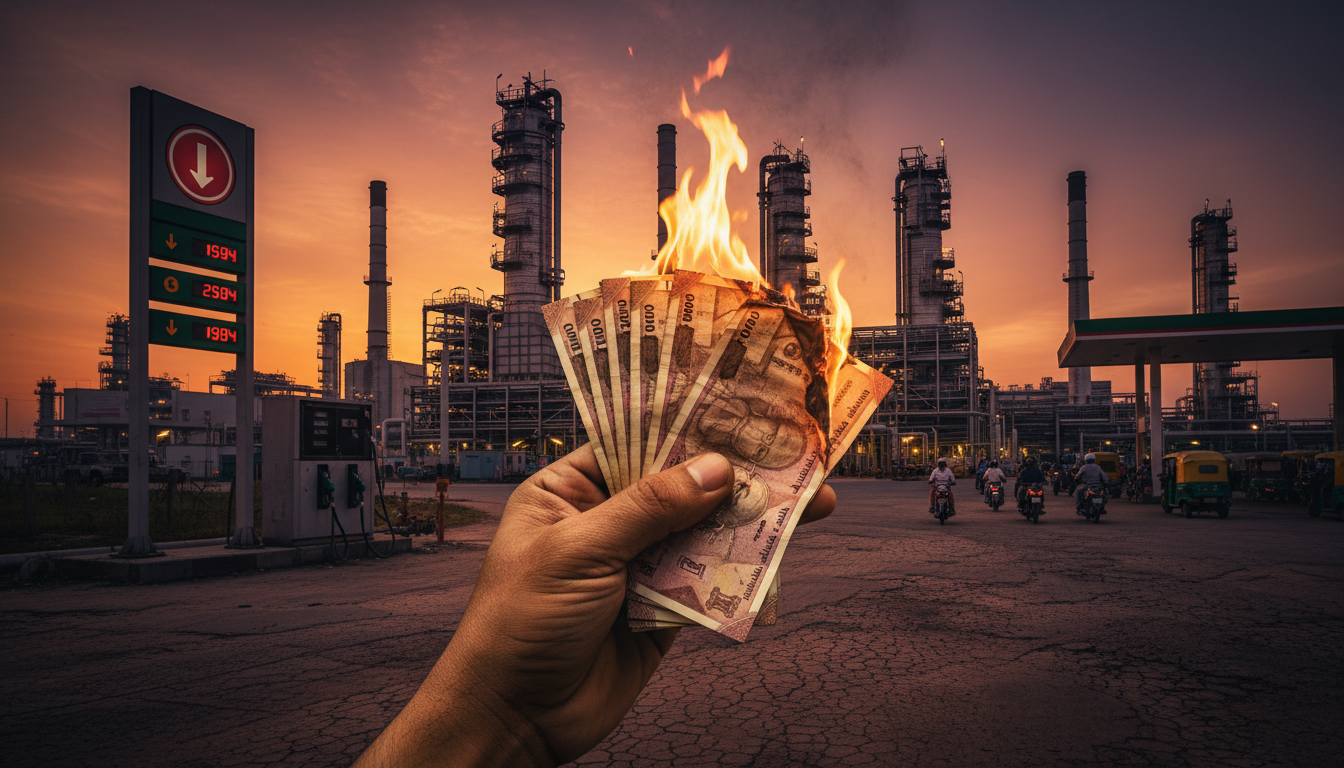
India Implements Significant Fuel Tax Cuts Amidst Surging Global Oil Prices
In a decisive move to stabilize its domestic energy market and shield consumers from escalating global crude oil prices, the Indian government has announced substantial reductions in central excise duties on petrol and diesel. This strategic intervention, confirmed by Petroleum and Natural Gas Minister Hardeep Singh Puri on Friday, comes at a considerable fiscal cost, reflecting New Delhi’s commitment to containing inflationary pressures stemming from geopolitical disruptions. Investors are closely scrutinizing these measures, weighing the immediate relief for consumers and oil marketing companies against the widening fiscal deficit implications.
Late Thursday, the government slashed excise duties on petrol by 10 rupees ($0.11) per liter and on diesel by an identical margin. This adjustment brings the excise duty for petrol down to 3 rupees per liter from its previous 13 rupees, while diesel now commands zero rupees per liter, a significant drop from 10 rupees. Minister Puri acknowledged that this policy shift would result in a “huge hit” to the central government’s tax revenues. However, the move is explicitly designed to absorb the shock of an international crude market that has witnessed prices skyrocket from approximately $70 a barrel to around $122 within the span of a single month, primarily driven by the ongoing Iran war and its consequential disruptions to global energy supplies.
Bolstering Domestic Supply and Mitigating Industry Losses
Beyond consumer protection, the duty cuts also provide critical relief to domestic oil companies. These entities had been absorbing significant losses, estimated at around 24 rupees per liter for petrol and 30 rupees per liter for diesel, due to the widening gap between international crude costs and regulated retail fuel prices. By lowering excise duties, the government effectively steps in to share a portion of this burden, aiming to improve the financial health and operational viability of India’s oil marketing sector.
In a parallel effort to safeguard domestic fuel availability, the government simultaneously increased duties on exported petroleum products. Export duties on diesel have been raised to 21.5 rupees per liter, while aviation turbine fuel (ATF) exports now incur a duty of 29.5 rupees per liter. Finance Minister Nirmala Sitharaman underscored the rationale behind these additional levies, stating they were implemented to “ensure adequate availability of these products for domestic consumption” and to “provide protection to consumers from rise in prices.” This multi-pronged approach signals a clear priority: insulating the Indian market from external volatility, even if it means disincentivizing exports.
India’s Economic Vulnerability to Global Energy Shocks
As the world’s third-largest oil importer and second-largest consumer of liquefied petroleum gas, India remains acutely susceptible to fluctuations in global energy markets. The current geopolitical landscape, marked by persistent energy supply disruptions and fears over the closure of the Strait of Hormuz, presents a formidable challenge to India’s economic stability. Experts warn that if global oil prices remain persistently above the $100 per barrel mark, the structural risks to the Indian economy will significantly escalate, particularly if domestic policy responses are not adeptly managed.
The government’s choice to absorb higher energy costs via tax cuts, rather than allowing retail prices to surge, prevents an immediate inflationary spiral that could severely temper economic growth. However, this strategy inevitably expands the nation’s fiscal deficit. For investors, this creates a complex scenario where short-term consumer stability is bought at the expense of long-term fiscal prudence. The delicate balancing act India faces underscores the profound impact global energy dynamics have on its sovereign financial health and attractiveness as an investment destination.
Macroeconomic Indicators Flash Warning Signs
Evidence of the Middle East conflict’s macroeconomic ripple effects is already becoming apparent in India. The flash Purchasing Managers’ Index (PMI) for March, released recently, indicated a slowdown in India’s private-sector activity to its lowest level since October 2022. This deceleration was primarily attributed to softer domestic demand, compounded by the ongoing geopolitical tensions, unstable market conditions, and intensifying inflationary pressures. Companies surveyed cited these factors as significant impediments to growth, with cost inflation now hovering near a four-year high.
Looking ahead, financial analysts are providing stark projections. Pankaj Murarka, CEO and Chief Investment Officer at Renaissance Investment Managers, offered a grim outlook should oil prices settle in the $85-$95 a barrel range post-conflict. Such a scenario, he predicts, could lead to incremental capital outflows of $40 billion to $50 billion—representing more than 1% of India’s Gross Domestic Product. Crucially, this sustained pressure on energy costs could trim India’s economic growth forecast from an initial 7.2% down to 6.5%, significantly impacting corporate earnings and overall market sentiment.
Investor Outlook: Navigating India’s Energy-Driven Economic Landscape
India’s recent policy decisions underscore the critical interplay between global energy markets and domestic economic stability. While the government’s intervention provides immediate relief to consumers and stabilizes the operating environment for oil marketing companies, it introduces an added layer of scrutiny on the nation’s fiscal health. Investors active in Indian equities, bonds, and infrastructure projects must carefully monitor the trajectory of international crude prices, the effectiveness of these domestic policy levers, and the government’s ability to manage its fiscal targets. The long-term resilience of India’s growth story remains inextricably linked to its capacity to navigate the turbulent waters of global energy markets while balancing its commitment to consumer welfare and fiscal responsibility. The coming quarters will be pivotal in assessing the true cost and ultimate success of this ambitious fiscal gambit.
