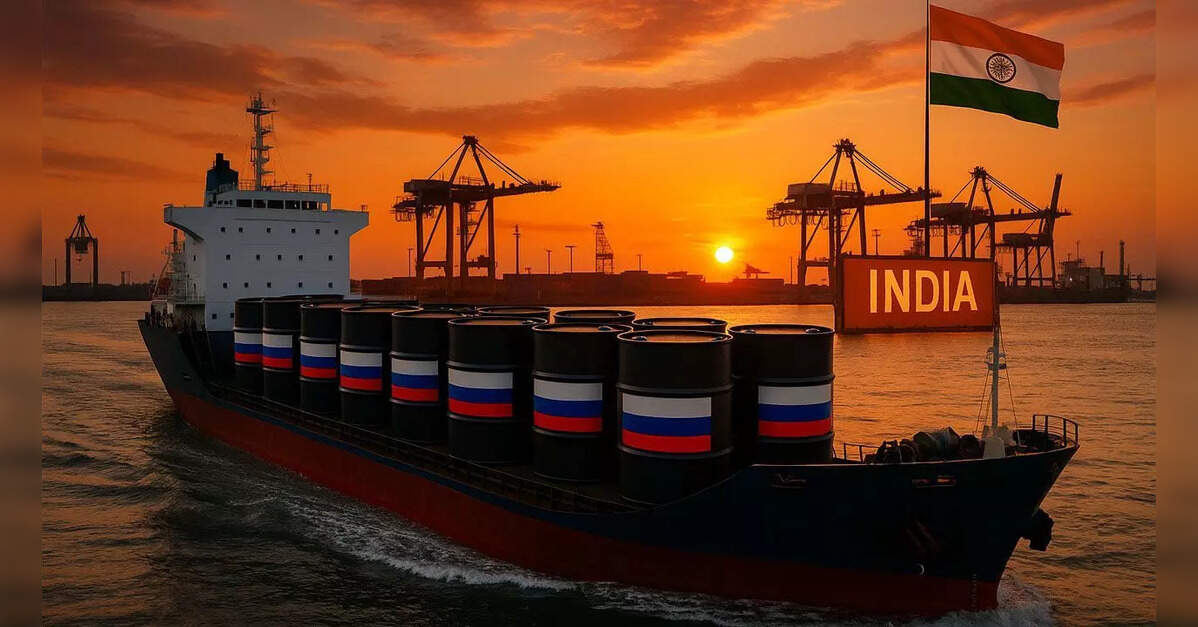
India’s steadfast commitment to sourcing Russian crude, despite escalating tariff pressures from the United States, underscores a critical pivot in global energy geopolitics and supply chain resilience. This isn’t merely a political stance; it’s a calculated economic strategy driven by the imperative of energy security for 1.4 billion people. For oil and gas investors, this dynamic creates both challenges and opportunities, reshaping traditional trade flows and demanding a nuanced understanding of geopolitical leverage and market fundamentals. OilMarketCap’s proprietary data reveals a market currently navigating significant volatility, making India’s “best deal” approach particularly pertinent.
India’s Energy Security: A Pragmatic Stance in a Volatile Market
India’s ambassador to Russia, Vinay Kumar, recently articulated New Delhi’s unwavering resolve to procure oil from wherever it secures the most favorable terms, emphasizing energy security as a core national interest. This position directly challenges the U.S. decision to impose a 25% tariff increase on Indian imports, raising the total levy to 50% as a direct penalty for continued Russian oil purchases. India has unequivocally labeled these tariffs as “unfair, unreasonable, and unjustified,” signaling no intention to compromise.
This steadfastness comes at a time when the global oil market is exhibiting considerable turbulence. As of today, Brent crude trades at $90.38, reflecting a significant 9.07% decline within the day, with a range spanning from $86.08 to $98.97. Similarly, WTI crude has fallen to $82.59, down 9.41%. This daily volatility is set against a broader trend where Brent crude has dropped by $20.91, or 18.5%, from $112.78 on March 30th to $91.87 on April 17th. Such a market environment amplifies the strategic value of discounted Russian oil for a major importer like India. The ability to settle transactions in national currencies, reportedly without hurdles, further insulates India and Russia from traditional financial sanctions, reinforcing the resilience of their bilateral energy trade. For investors, India’s actions highlight the increasing fragmentation of global energy markets and the importance of understanding sovereign strategic interests over purely ideological alignments.
Geopolitical Headwinds and Shifting Trade Dynamics
The U.S. tariff hike on Indian goods represents a direct application of pressure aimed at deterring India’s energy trade with Russia. However, India’s External Affairs Minister, S. Jaishankar, and Ambassador Kumar have both forcefully rejected this pressure, noting that other nations, including the U.S. and European countries, continue various forms of trade with Russia. This argument underscores a perception of double standards and reinforces India’s commitment to prioritizing its own economic and energy needs.
For investors, these geopolitical crosscurrents translate into tangible risks and potential re-pricing in various sectors. The 50% total levy on Indian imports by the U.S. could impact industries exporting to America, potentially leading to supply chain adjustments or a search for alternative markets. Conversely, India’s deepening trade ties with Russia, extending beyond energy to sectors like electronics, automobiles, construction materials, and IT products, suggest a long-term strategic reorientation. While Indian exports to Russia are currently “far below potential,” concerted efforts to improve transportation infrastructure and expand services trade indicate a robust, if nascent, alternative trade corridor. Investors must evaluate how these shifting alliances and trade routes will impact global commodity flows, shipping, and the competitive landscape for international businesses operating in these regions.
Upcoming Market Events to Shape Future Oil Prices
The market’s current volatility and India’s strategic purchasing decisions are deeply intertwined with upcoming supply-side events that will significantly influence future crude prices. Investors are particularly focused on the next 14 days, which include several critical junctures for the global oil market. The OPEC+ Joint Ministerial Monitoring Committee (JMMC) meeting on April 18th, followed by the Full Ministerial meeting on April 19th, are paramount. Our reader intent data shows a strong interest in “OPEC+ current production quotas,” indicating that market participants are keenly awaiting signals on future supply levels.
Any decision by OPEC+ to adjust production quotas, whether increasing, maintaining, or even cutting output, will directly impact the global supply-demand balance and, consequently, crude benchmarks like Brent and WTI. A tightening market could see prices rebound, while an increase in supply could push them lower, further influencing India’s “best deal” calculations. Beyond OPEC+, the weekly API and EIA crude inventory reports on April 21st, 22nd, 28th, and 29th will provide crucial insights into U.S. supply and demand dynamics, while the Baker Hughes Rig Count on April 24th and May 1st will signal future drilling activity. These events will offer fresh data points for investors attempting to answer the frequently asked question: “What do you predict the price of oil per barrel will be by end of 2026?” India’s persistent demand, particularly for discounted barrels, adds a unique and significant factor to this complex forecast.
Beyond Crude: Diversifying Bilateral Trade and Investment Horizons
While India’s pursuit of energy security through Russian oil dominates headlines, it’s crucial for investors to recognize the broader strategic intent to diversify and expand bilateral trade beyond the energy sector. Ambassador Kumar highlighted India’s ambition to increase exports to Russia in areas such as electronics, automobiles, construction materials, textiles, and IT products, alongside improving services trade, including financial and digital services. This represents a long-term play to build a more comprehensive economic partnership, aiming to unlock potential currently “far below” its true capacity.
This diversification strategy offers new investment horizons. Opportunities may emerge in logistics and transportation infrastructure development to support increased trade volumes between the two nations, as well as in manufacturing and technology sectors that can leverage new market access. Investors should look beyond the immediate energy narrative to identify companies well-positioned to capitalize on these evolving trade corridors. As geopolitical alignments shift, understanding these underlying economic initiatives becomes key to identifying growth areas and mitigating risks in an increasingly interconnected, yet fragmented, global economy.


