

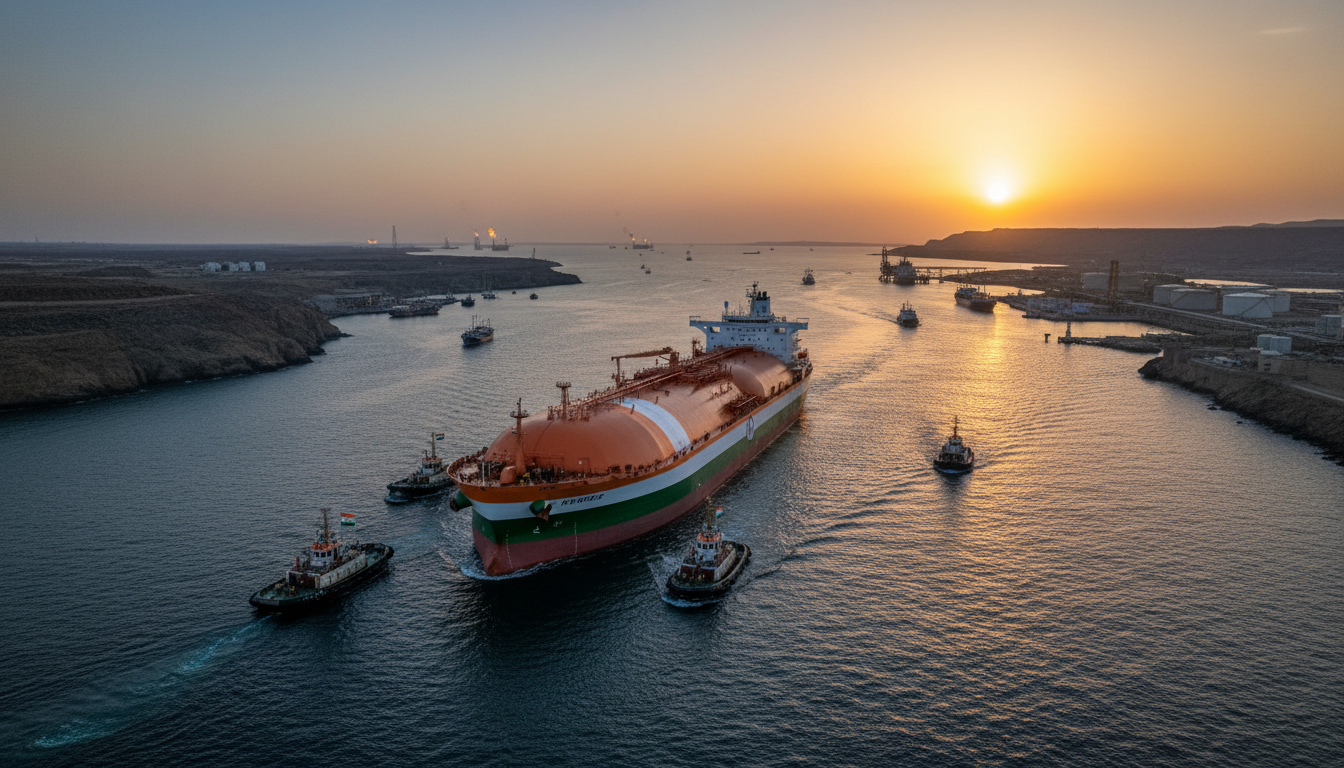
The global liquefied petroleum gas (LPG) market is currently navigating a volatile geopolitical landscape, with significant implications for major importers like India. Recent ship-tracking intelligence from industry sources indicates that two critical India-bound LPG tankers, BW Elm and BW Tyr, have successfully transited the Strait of Hormuz. These vessels are now positioned in the eastern sector of the strait, having cleared the high-risk Gulf region, a development closely monitored by energy market participants and investors.
This critical maritime passage occurs amidst escalating tensions in the Middle East, primarily driven by the ongoing US-Israeli conflict with Iran, which has introduced substantial disruption to vital shipping lanes. Iran recently issued a statement affirming that “non-hostile vessels” could still traverse the strategic waterway, provided they coordinate with Iranian maritime authorities. Such pronouncements add a layer of complexity and uncertainty to global energy logistics, impacting freight rates and supply chain reliability.
India, as the world’s second-largest LPG importer, faces an acute challenge. The Ministry of Ports, Shipping and Waterways, through Special Secretary Rajesh Kumar Sinha, confirmed on a recent Friday that twenty Indian-flagged vessels, including five LPG carriers, were experiencing delays and were effectively stranded within the Gulf region. This represents a significant choke point for a nation heavily dependent on seaborne energy imports. While the situation remains precarious, there has been some positive movement, with four LPG tankers—Shivalik, Nanda Devi, Pine Gas, and Jag Vasant—having successfully exited the strait, signaling a gradual easing for some cargoes.
The nation’s reliance on LPG is profound, serving as a primary cooking fuel for millions of households. In the past year, India’s LPG consumption reached 33.15 million tonnes. A staggering 60 percent of this demand was satisfied through imports, with nearly 90 percent originating from the Middle East. This heavy geographical concentration of supply exposes India to considerable geopolitical risks and makes its energy security particularly vulnerable to regional instability. The current supply crunch has compelled the Indian government to reallocate LPG supplies, prioritizing household consumption over industrial usage, a move that highlights the severity of the crisis and its potential economic ramifications.
Despite some successful transits, several Indian-linked LPG carriers remain in a holding pattern. Industry data continues to show Jag Vikram, Green Asha, and Green Sanvi positioned in the western Strait of Hormuz. India’s shipping strategy includes actively loading LPG onto empty vessels that have been stalled in the Gulf, an operational maneuver aimed at maintaining some fluidity in its import pipeline. This proactive approach underscores the urgent need to mitigate delays and secure critical energy supplies.
Diversifying Supply Chains: A Strategic Imperative
Recognizing the inherent risks of over-reliance on a single region, India has actively pursued strategies to diversify its LPG sourcing. A notable success in this effort was the recent docking of the Pyxis Pioneer at Vadinar. This vessel delivered approximately 18,000 metric tonnes of LPG from the United States, marking a crucial step towards expanding India’s supplier base beyond its traditional Middle Eastern partners. This strategic shift is vital for building resilience against geopolitical shocks and ensuring more stable, predictable energy supplies for its vast population.
For energy investors, these developments underscore the growing importance of supply chain resilience and geographical diversification within the global LPG market. Companies with robust logistics networks, diversified sourcing options, or those investing in new import infrastructure stand to benefit from these evolving market dynamics. Conversely, firms heavily exposed to regional instability or relying on singular trade routes face heightened risk profiles.
Geopolitical Risks and Market Volatility
The enduring tensions in the Strait of Hormuz, a critical chokepoint for a significant portion of the world’s oil and gas trade, continue to infuse uncertainty into commodity markets. Any escalation could lead to increased maritime insurance premiums, higher freight costs, and potentially significant spikes in LPG prices. Investors should closely monitor diplomatic efforts and security developments in the region, as these factors will directly influence the cost and availability of energy commodities globally.
India’s proactive steps, from attempting to clear stranded vessels to securing cargoes from distant suppliers like the United States, reflect a strategic imperative to safeguard its energy interests. The nation’s ability to navigate these complex geopolitical waters while ensuring uninterrupted energy supplies will be a key determinant of its economic stability and growth trajectory. The long-term implications include potential shifts in global LPG trade routes, increased investment in alternative energy infrastructure, and a heightened focus on domestic production capabilities across major importing nations.
Outlook for LPG Markets and Investor Considerations
The current environment highlights the fragility of global energy supply chains and the profound impact of geopolitical events on commodity markets. For investors, understanding the intricate web of energy geopolitics, maritime logistics, and national energy security strategies is paramount. The shift towards diversified sourcing, as exemplified by India’s actions, could present new investment opportunities in shipping infrastructure, long-haul freight, and gas processing facilities outside traditional supply hubs.
Furthermore, the domestic implications for India are significant. The government’s decision to prioritize household LPG supply could impact industrial sectors reliant on the fuel, potentially leading to increased demand for alternative energy sources or a temporary slowdown in certain industries. Investors with exposure to Indian industrial sectors should assess these potential disruptions. Overall, the situation reinforces the premium placed on adaptable supply chains and robust energy security frameworks in an increasingly unpredictable global landscape. The market will continue to closely watch India’s progress in mitigating its LPG supply challenges, as its strategies could set precedents for other energy-dependent nations.
