

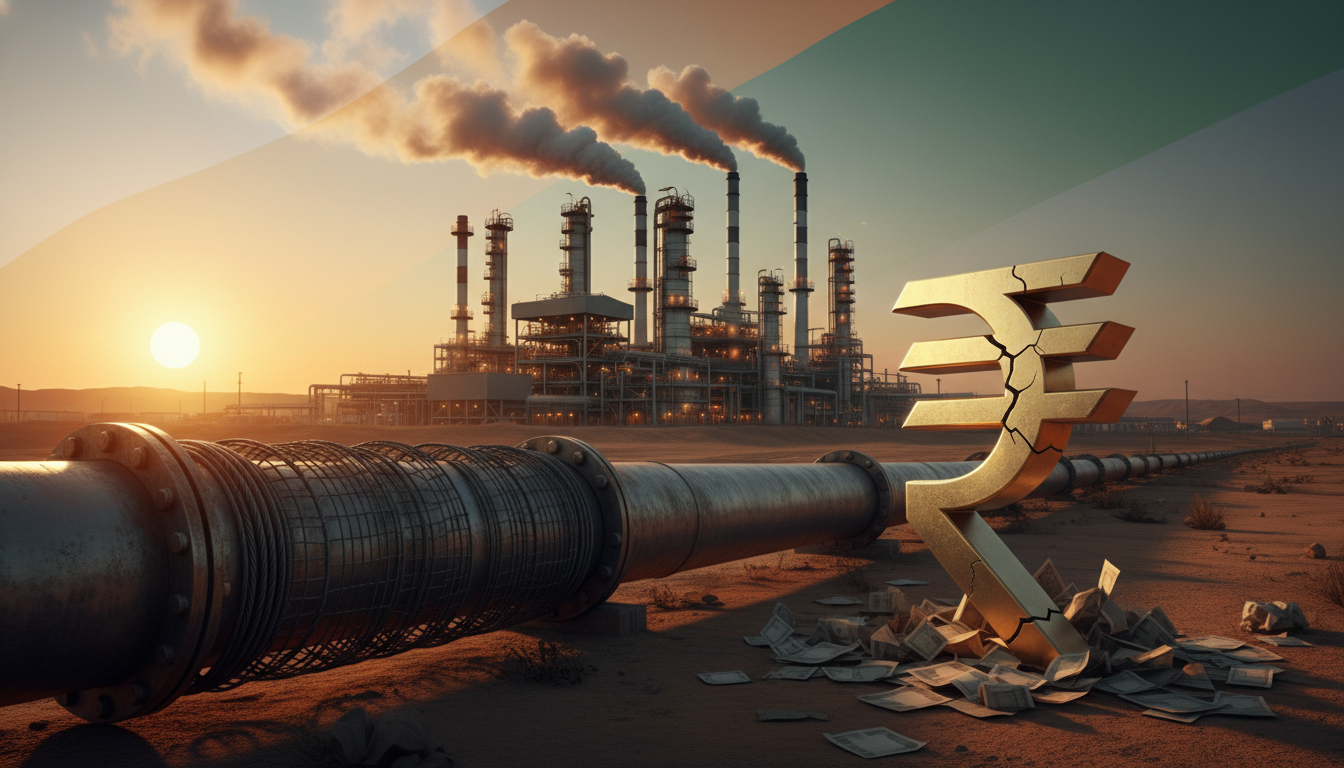
India’s Energy Import Strain Threatens Rupee Stability and Economic Outlook
India, a global economic powerhouse and the world’s third-largest crude oil importer, finds itself at a critical juncture. Escalating geopolitical tensions, particularly the ongoing conflict involving Iran, have sent shockwaves through global energy markets, directly translating into immense pressure on India’s national currency, the rupee, and its broader economic health. Despite aggressive interventions by the central bank, the rupee continues its struggle, signaling deeper structural vulnerabilities tied to the nation’s energy import dependency.
The Reserve Bank of India (RBI) recently deployed significant measures to quell speculative trading within the foreign exchange market, aiming to buttress the rupee against its slide to historic lows. While these actions initially provided a fleeting uplift, with the currency briefly gaining as much as 1.4% at Monday’s open after the RBI capped banks’ open positions, the respite proved temporary. The rupee quickly reversed course, closing at a fresh record low of 94.8325 per dollar. This swift erosion of initial gains underscores the formidable forces at play, predominantly India’s insatiable demand for crude oil.
The Widening Current Account Deficit: A Core Challenge
Economists widely attribute the rupee’s persistent weakness to the severe strain placed on India’s current account deficit (CAD). This deficit, the most comprehensive gauge of a country’s international trade in goods and services, expands significantly when foreign exchange outflows for imports outstrip inflows from exports and other sources. With soaring crude prices directly inflating India’s import bill, more dollars are exiting the economy than entering, creating a fundamental imbalance that pressures the national currency.
Compounding this issue is the anticipated decline in remittances from the estimated 10 million Indian expatriates working in the Gulf region. These critical foreign inflows typically provide a substantial buffer to India’s external accounts. A reduction in these remittances, alongside the surging cost of oil, acts as a dual drag on the nation’s foreign exchange reserves and exacerbates the CAD.
Abbas Keshvani, Asia Macro Strategy Director at RBC Capital Markets, succinctly captured the essence of the problem, stating in a recent interview that “the pressure on the rupee is not just from speculators; it comes from the real demand for dollars in the economy.” He highlighted that even prior to the Middle East’s current unrest, India contended with a substantial trade deficit, a gap now poised to widen even further under current conditions.
Financial Projections Paint a Challenging Picture
The financial implications of these trends are stark. Analysts at Standard Chartered Plc forecast that India’s current account deficit, which was expected to settle at approximately 1% of GDP for the fiscal year concluding in March, could expand dramatically to 2.5% of GDP in the upcoming fiscal year. This significant deterioration underscores the acute vulnerability of India’s external balances to energy price shocks. Nomura Holdings Inc. economists further illustrate this sensitivity, estimating that every 10% increase in the price of crude oil could broaden the current account deficit by around 0.4% of GDP.
Looking ahead, a more pessimistic scenario, outlined by Bloomberg Economics’ Abhishek Gupta, forecasts severe economic ramifications. Should the conflict intensify and lead to a prolonged closure of the critical Strait of Hormuz, global oil prices could average $125 per barrel through the fiscal year ending March 2027. Such a scenario, Gupta warned in a recent note, could balloon India’s balance-of-payments deficit by over $130 billion – an unprecedented economic shock for the nation. The balance of payments, a broader measure encompassing both the current and capital accounts, provides a comprehensive view of all financial transactions between a country and the rest of the world.
Unprecedented Deficits and Capital Flight Concerns
Prior to the current conflict, Gupta had projected India would record a balance-of-payments surplus of $10 billion for the current fiscal year. However, recent data from the RBI reveals a surplus of $63.7 billion in fiscal 2024, followed by an estimated deficit of $5 billion in fiscal 2025. This projected deficit marks a significant turnaround. Anubhuti Sahay, India economist at Standard Chartered, underscored the gravity of the situation, noting that India’s balance of payments is on track for a deficit for the second consecutive year in this financial year – a situation “which has never happened before.” She added that the “risk of a third year of balance of payment deficit has increased” for the next financial year commencing in April, intensifying the downward pressure on the rupee.
Adding another layer of concern, Soumya Kanti Ghosh, group chief economic advisor of State Bank of India and a member of the Economic Advisory Council to the Prime Minister, cautioned about a potential capital account deficit for the current fiscal year. This phenomenon, he stated, “has never happened since 1991” and reflects a flight of foreign investors from emerging markets like India towards safer global assets amidst heightened uncertainty. Such an outflow of capital further depletes foreign exchange reserves and contributes to currency depreciation.
Economic Growth Headwinds Ahead
The compounding pressures from elevated crude prices and external account deficits are also casting a shadow over India’s economic growth prospects. In response to these headwinds, economists led by Santanu Sengupta at Goldman Sachs Group recently revised down India’s 2026 growth forecast to 5.9%. This adjustment follows an earlier cut just two weeks prior, when the projection was lowered from 7% to 6.5%, demonstrating the rapidly evolving and challenging macroeconomic environment driven primarily by energy cost escalations.
Investors in the oil and gas sector, particularly those with exposure to emerging markets, must remain acutely aware of India’s evolving economic landscape. The interplay of high crude prices, a struggling currency, and widening deficits presents significant risks and opportunities. The ongoing geopolitical instability, particularly in the Middle East, will continue to dictate global oil price trajectories, making vigilance and strategic positioning paramount for navigating these turbulent waters.
