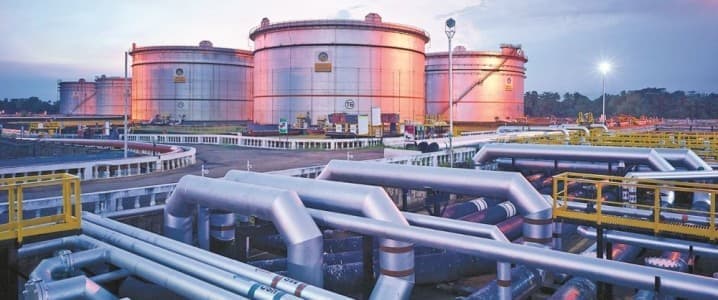
India’s energy landscape presents a fascinating paradox for global oil markets: a slight month-on-month dip in crude processing amidst robust long-term demand projections and a strategically evolving import matrix. In January 2026, Indian refiners processed 5.63 million barrels per day (bpd) of crude, a marginal 0.2% decrease from December’s 5.64 million bpd. While this minor contraction might initially suggest a cooling in demand, a closer look reveals a market grappling with short-term fluctuations while solidifying its position as the undisputed future engine of global oil consumption. For investors, understanding these nuances – from immediate market signals to India’s geopolitical maneuvering and upcoming supply-side catalysts – is paramount to positioning effectively in a volatile crude environment.
India’s Refining Performance and Immediate Market Signals
The 0.2% month-on-month fall in India’s crude throughput to 5.63 million bpd in January 2026, translating to 23.81 million metric tons, warrants careful interpretation. While a sequential decline from December’s 5.64 million bpd, it stands in contrast to the broader strength in India’s domestic fuel consumption, which, despite a dip from 21.71 million metric tons in December, was still nearly 3% higher than in January 2025. This annual growth underscores the underlying resilience of India’s energy appetite, suggesting the monthly processing dip may be more of a temporary operational adjustment or inventory management rather than a fundamental shift in demand trajectory.
This immediate operational data for India arrives as global crude markets navigate significant volatility. As of today, Brent crude trades at $93.86 per barrel, marking a substantial daily gain of 3.79% from its opening. This rebound follows a challenging period where the benchmark saw its value diminish by nearly 20%, shedding approximately $23.49 from $118.35 on March 31st to $94.86 just yesterday. Similarly, WTI crude is now priced at $90.22, up 3.2% today. These price movements highlight the sensitivity of crude markets to both perceived demand signals and supply-side uncertainties. The Indian processing figures, though small in deviation, contribute to the complex mosaic of data points that traders and investors analyze daily, influencing the intraday swings we observe in the $89.11-$95.53 range for Brent and $85.5-$92.23 for WTI.
Strategic Diversification: India’s Geopolitical Energy Play
India’s energy security strategy is arguably one of the most dynamic in the global oil market, driven by its reliance on imports for over 80% of its crude supply. The country is meticulously balancing its access to discounted Russian oil with robust engagements with traditional suppliers from the Middle East and the United States. However, the most significant strategic shift observed recently is India’s aggressive diversification away from an over-reliance on any single region. Amidst intensified U.S. political pressure and tariff threats, India has notably increased its crude imports from West African nations like Nigeria and Angola, broadening its supply base.
A pivotal development in January 2026 further reshaped India’s import calculus: the U.S. Treasury’s Office of Foreign Assets Control (OFAC) issued a general license to Reliance Industries Ltd, India’s largest private refiner, authorizing direct purchases and refining of Venezuelan-origin oil. This move, following the U.S. military’s capture of former Venezuelan President Nicolás Maduro and subsequent control over Venezuela’s oil sales, is explicitly aimed at reducing India’s dependence on Russian crude. For Indian refiners, Venezuelan heavy crude presents a compelling value proposition, sold at a discount and being particularly compatible with sophisticated refining facilities such as Reliance’s sprawling Jamnagar complex. This strategic maneuver not only enhances India’s energy security but also introduces a new variable into global crude trade flows, offering Indian refiners greater optionality and potentially influencing future pricing dynamics for various crude grades.
India: The Indisputable Engine of Future Oil Demand
While short-term processing figures offer a snapshot, the long-term trajectory of India’s oil demand is an overwhelming bullish factor for the global energy market. India is not merely a significant consumer; it is projected to be the single largest driver of global oil demand growth for decades to come. Current forecasts indicate a substantial rise from approximately 5.6 million barrels per day (mb/d) in 2024 to over 6.6 mb/d by 2030. Looking further out, this growth accelerates dramatically, potentially reaching an astonishing 13.7 mb/d by 2050. To put this into perspective, India is expected to capture nearly half of all additional global barrels produced over this period.
This robust long-term outlook is paramount for investors evaluating the future of the oil and gas sector. A frequently posed question by our readers is, “What do you predict the price of oil per barrel will be by end of 2026?” While precise predictions are challenging amidst geopolitical fluidity, India’s burgeoning demand provides a powerful structural tailwind. Even a marginal monthly dip in processing, as seen in January, pales in comparison to the sheer scale of anticipated growth. Companies with strategic investments in refining capacity, upstream assets capable of supplying diverse crude grades, and logistics infrastructure catering to the Indian subcontinent are uniquely positioned to benefit. The underlying demand strength from India serves as a critical counterweight to short-term bearish sentiments, suggesting that while WTI crude may fluctuate daily, the long-term directional pressure on prices remains firmly upward due to this insatiable demand growth.
Navigating Volatility: Upcoming Events and Strategic Positioning
For astute investors, the next two weeks present a barrage of critical data releases and strategic meetings that will shape immediate market perceptions and potentially influence short-term price movements. The timing of today’s OPEC+ Joint Ministerial Monitoring Committee (JMMC) Meeting on April 21st, 2026, is particularly crucial. With Brent crude showing a significant rebound after a sharp two-week decline, any signals regarding production policy from this influential group will be closely scrutinized. A decision to maintain or adjust current output levels will have immediate implications for global supply balances, especially considering recent demand signals from key growth markets like India.
Beyond OPEC+, the market will keenly await the EIA Weekly Petroleum Status Reports on April 22nd and April 29th, which provide granular data on U.S. crude oil and product inventories, refinery utilization, and demand indicators. These are complemented by the API Weekly Crude Inventory reports on April 28th and May 5th. Together, these reports offer vital insights into the North American supply-demand picture, a significant factor in global pricing. Furthermore, the Baker Hughes Rig Count on April 24th and May 1st will indicate future production trends. Perhaps most significant for longer-term guidance is the EIA Short-Term Energy Outlook (STEO) scheduled for May 2nd, 2026. This report will provide updated projections for global oil supply, demand, and prices, incorporating recent developments and potentially refining forecasts for India’s demand growth, which, as discussed, remains a linchpin for global market stability. Investors should monitor these events closely, using them to refine their tactical positions and adjust their long-term strategies in response to evolving market fundamentals and geopolitical currents.


