

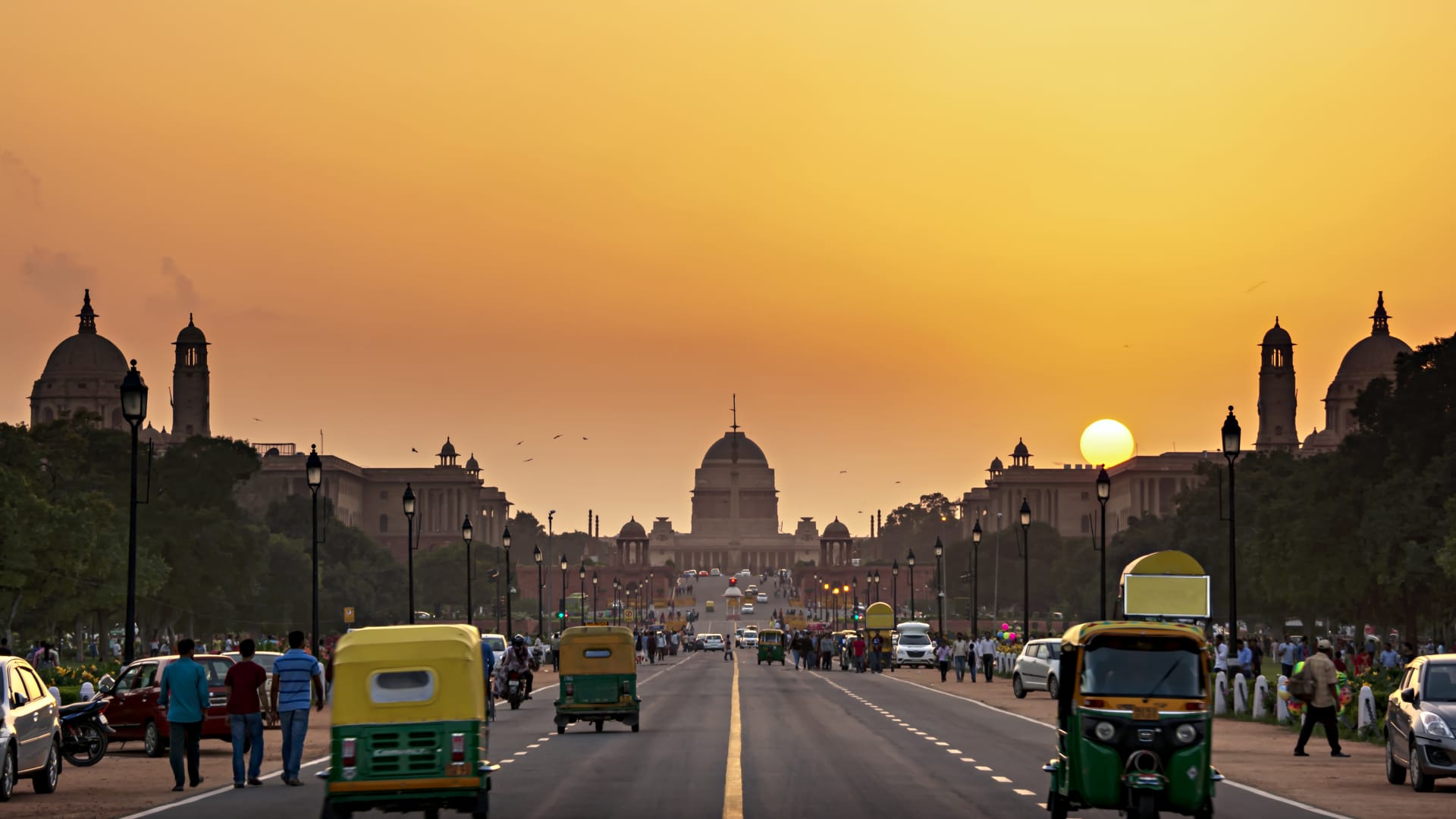
India’s GDP growth is expected to reach 6.4% in 2024, and will hit 7% in 2026, according to S&P Global.
Kriangkrai Thitimakorn | Moment | Getty Images
New Delhi is feeling the heat as tensions in the Middle East show no signs of cooling, with high oil prices likely to increase the country’s already substantial energy import bill, while disruptions to flight routes hamper airline operations.
India imports nearly 85% of its crude, equivalent to roughly 4.2 million barrels per day, said Pankaj Srivastava, senior vice president at energy research firm Rystad Energy, who said even “a few dollars’ increase in prices can materially affect [the country’s] energy economics.”
“Rising [oil] prices will weigh on the balance of payments and could put further pressure on the rupee,” he added.
Oil prices have soared since U.S. and Israeli strikes on Iran — the fourth-largest oil producer in OPEC — began over the weekend, putting a supply shock in focus. The Islamic Republic’s Supreme Leader Ayatollah Ali Khamenei was killed, prompting waves of attacks by Tehran across the region, targeting countries in the Middle East with U.S. military bases.
Brent crude prices hit a new 52-week high on Monday, surging 9.3% to reach $79.40 a barrel.
“Every US$10/bbl sustained rise in oil prices will hit Asia’s GDP growth directly by 20-30 [basis points],” Morgan Stanley said in a note on Sunday, adding that India could be especially vulnerable.
India’s current account deficit, which is 1.2% of its GDP, would be widened by 50 basis points for every $10/bbl rise in oil price, the analysts said.
“Thailand, Korea, Taiwan, and India would be more exposed to downside to growth on account of their wider oil and gas balances,” the report said.
Oil traffic through the Strait of Hormuz has halted due to extremely high insurance rates on account of Iran’s attacks on the U.S. bases in Gulf countries, experts said, which is also pusing up oil prices.

The Strait of Hormuz is a critical waterway that links major energy producers — including Saudi Arabia, Iran, Iraq and the United Arab Emirates — to global markets, and is responsible for the passage of about 20% of the world’s oil supplies.
Latest vessel tracking data suggests around half of India’s crude oil imports currently transit through the Strait of Hormuz, global brokerage Nomura said in a report on Sunday.
Buying Russian oil?
“It is bad timing for India,” Ellen Wald, president of Transversal Consulting, told CNBC’s “Inside India” on Monday. “India’s oil purchases will be under the microscope” if it buys additional Russian oil cargo, she added.
India imported 1.16 million barrels per day of Russian oil until a week ago, lower than its average intake of 1.71 million barrels per day in 2025, according to energy data provider Kpler. It was replacing this oil with supply from the Middle East, which has now been disrupted.

Since August last year, Indian exports to the U.S. were subject to a tariff rate of 50%, of which 25% was a punitive tariff designed to dissuade India from buying Russian oil.
Following an interim trade deal last month, the U.S. removed the punitive tariff on India, stating that New Delhi had “committed to stop directly or indirectly importing Russian Federation oil” and will purchase “energy products from the United States.”
But Washington warned New Delhi that it will monitor India’s Russian oil imports and any attempt to resume purchases could lead to a renewal of punitive tariffs. That makes any supply disruptions due to the Iran conflict even more problematic for India.
Despite the scrutiny, Wald said, “I have a feeling no one’s going to really fault them [India] for doing what they need to do to get through the next month.”
India resuming Russian oil purchases remains a likely scenario, as “a significant volume of Russian crude of the appropriate grade is already available on water,” said Shrivastava from Rystad Energy.
Flight disruptions
While the impact of rising oil prices is a big concern for New Delhi, flight disruptions due to airspace closures over the Middle East are an immediate stress affecting travelers to and from India.
Westbound flights from India fly over Iran and the Arabian Peninsula, said Sajay Lazar, CEO of Indian aviation consultancy Avialaz Consultants. “The Middle East corridor is India’s largest westbound corridor, and this [disruption] will impact Indigo and Air India heavily,” he added.
With the Middle East in effect a “warzone,” and the existing shutdown of Pakistani airspace for Indian carriers, some flights bound to Europe and the U.K. from India have been cancelled, while others are being rerouted.
Shares of India passenger airline IndiGo, which trades as Interglobe Aviation, opened nearly 5% lower on Monday.
The company, which did not respond to CNBC’s request for comment, said in post on Monday that “the temporary suspension of select international flights operating through parts of the Middle Eastern airspace has been extended.”
Tata Group and Singapore Airlines-owned Air India has cancelled all flights to and from the UAE, Saudi Arabia, Israel, and Qatar for Monday, it said in a post on X. It has also cancelled some flights from New Delhi to Europe, but said many of its other flights to Europe and North America will fly as per schedule “using alternative routings over available airspaces.”
Impact on airlines
Aviation experts say alternative routes will not only add to flight times but will also significantly increase costs for these airlines. At present, the westbound flights out of India are seeing up to 4 hours of longer flight times, they said.
“The weekly impact to Indian and international airlines flying to and from India stands at an extremely conservative estimate of Rs 875 crores [about $96 million],” said aviation expert Mark D. Martin of Martin Consulting. He added that the “airspace situation” is unlikely to improve for at least one week.
On Sunday, Trump told the Daily Mail newspaper that the conflict with Iran could go on for the next four weeks. Iran’s security chief Ali Larijani, meanwhile, said in a post on X that Tehran has no plans to engage in negotiations with the United States.
If the situation escalates further, India could seek access from China to use its airspace from the north, allowing aircraft to overfly the Commonwealth of Independent States into Europe, Martin said.
A total of 350 flights operated by Indian domestic carriers were cancelled on Sunday, according to India’s aviation regulator.
