

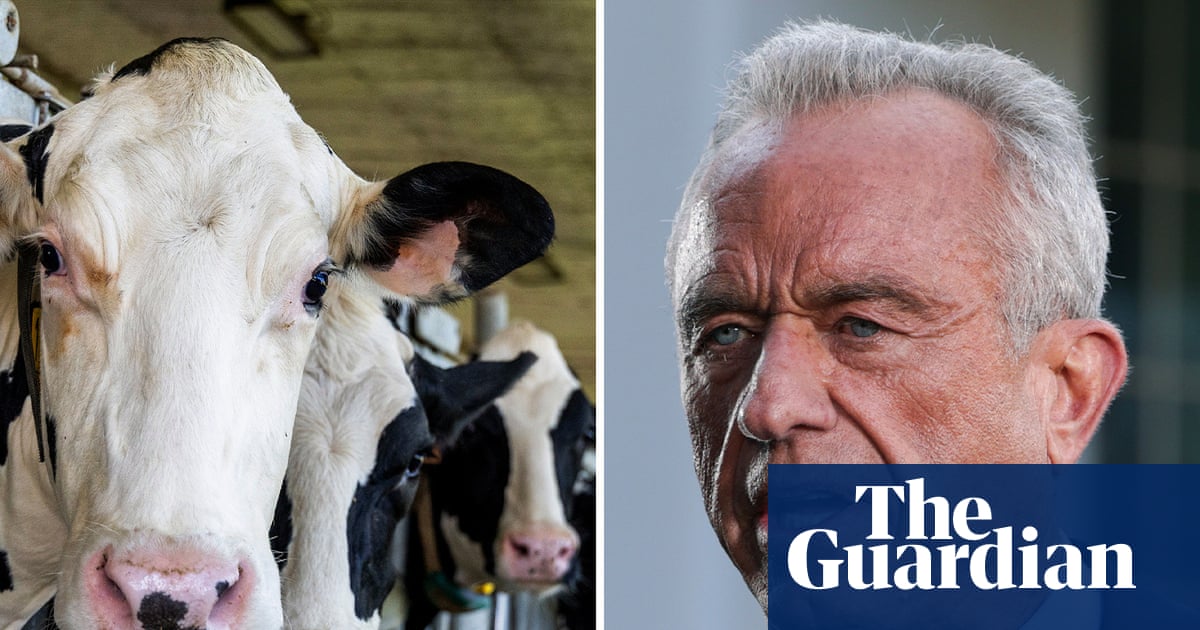
The Trump administration’s new dietary guidelines urging Americans to eat far more meat and dairy products will, if followed, come at a major cost to the planet via huge swathes of habitat razed for farmland and millions of tons of extra planet-heating emissions.
A new inverted food pyramid recently released by Donald Trump’s health department emphasizes pictures of steak, poultry, ground beef and whole milk, alongside fruits and vegetables, as the most important foods to eat.
The new guidelines are designed to nearly double the amount of protein currently consumed by Americans. “Protein and healthy fats are essential and were wrongly discouraged in prior dietary guidelines,” said Robert F Kennedy Jr, the US health secretary. “We are ending the war on saturated fats.”
But a surge in meat-eating by Americans would involve flattening vast tracts of ecosystems such as forests to make way for the hefty environmental hoofprint of raised livestock, emitting large quantities of greenhouse gases in the process, experts have warned.
Even a 25% increase in the amount of protein consumed in this way in the US would require about 100m acres of additional agricultural land each year, an area around the size of California, and add hundreds of millions of tons of extra pollution to an already overheating planet, according to an estimate by the World Resources Institute (WRI), a non-profit research body.
“We are seeing millions of acres of forest cut down and agricultural expansion is the lead driver of that – adding 100m acres to that to feed the US means additional pressure on the world’s remaining ecosystems,” said Richard Waite, the director of agriculture initiatives at WRI.
“It’s already hard to feed the global population while reducing emissions and stopping deforestation, and a shift in this direction would make the challenge even harder. We need to reduce the impact of our food systems urgently and the US is an important piece of the puzzle in doing that.”
While many Americans will simply ignore the guidelines, the new framework will probably influence institutions such as schools and federal workplaces. The average American already eats about 144kg (317lbs) of meat and seafood a year, second globally only to Portugal, and ingests more protein than previous federal government guidelines recommended.
Any further increase will be felt in places such as the Amazon rainforest, which is already being felled at a rapid rate for cattle ranches and to grow livestock feed.
Red meat, in particular, has an outsized impact upon the planet – beef requires 20 times more land and emits 20 times more greenhouse gas emissions per gram of protein than common plant proteins, such as beans. The raising of cows, pigs, lamb and other animals for slaughter is also associated with significant localized air and water pollution.
“To the extent that people follow these guidelines and eat more animal protein foods, particularly beef and dairy, they will negatively impact our environment, since the production of these foods emits way more greenhouse gases than vegetable protein foods, or even other animal foods,” said Diego Rose, a director of nutrition at Tulane University.
Choosing beef over beans and lentils is “a big choice we make that has real consequences”, said Waite. “If people want more protein there are ways to do that via eating plant-based foods without the environmental impacts. We can have our protein and our forests, too.”
Animal agriculture is responsible for about a fifth of global emissions, with little progress made in recent years to reduce its impact as more of the world starts to demand meat products. Worldwide consumption of pork, beef, poultry and meat is projected to reach over 500m tonnes by 2050 – double what it was in 2000.
In the US, much of this meat-eating is concentrated in a relatively small group of avid carnivores – just 12% of Americans consume nearly half of the country’s beef, a 2024 study found. But plant-based options, including “fake meat” burgers, have suffered a slump in sales in recent years amid a resurgent trend in meat-eating, fueled by online “meatfluencers” and a broader desire to consume more protein.
The environmental problems associated with the meat industry were previously highlighted by Kennedy himself, when he was a campaigner on green issues. At one point, Kennedy even said the pork industry is an even bigger threat to the US than Osama bin Laden, the terrorist mastermind.
“The factory meat industry has polluted thousands of miles of America’s rivers, killed billions of fish, pushed tens of thousands of family farmers off their land, sickened and killed thousands of US citizens, and treated millions of farm animals with unspeakable and unnecessary cruelty,” Kennedy wrote in 2004.
However, since becoming Trump’s health secretary, Kennedy has sought to elevate meat-eating, dismissing an independent scientific committee’s advice to emphasize plant-based proteins to instead favor meat.
“The Trump administration will no longer weaponize federal food policy to destroy the livelihoods of hard-working American ranchers and protein producers under the radical dogma of the Green New Scam,” a spokesperson for the Department of Health and Human Services said in response to questions about the knock-on environmental impacts of the new guidelines.
“Americans already eat a lot of meat, so this promotion of more meat and things like beef tallow is puzzling to me,” said Benjamin Goldstein, a researcher at the University of Michigan who has studied the huge emissions associated with meat-eating by city-dwellers in the US.
“We needed to be addressing climate change two decades ago and we are still not doing enough now. If we are adding more greenhouse gases to impose unnecessary ideas of protein intake, that’s going to destabilize the climate further. It’s going to have a big impact.”
