

This story originally appeared in the November 2025 issue of Modern Materials Handling.
“Don’t send someone out to dig a ditch with a spoon.”
For many life situations, that’s mighty good advice from Ron May, principal engineer at Lucas Systems. But from a supplier of voice-based wearables in today’s warehousing and manufacturing environments, those are words to live by. And after 40 years in the technology industry, May knows.
These words immediately bring us to a key point you need to know about wearables today: If your thinking on wearables is limited to the hardware of these back-of-hand, arm- or head-mounted data devices, that’s only half the story. Because without the latest developments in the software side of these systems, they would not be much more than spoons trying to move way too much information.
As Lior Elazary, CEO of inVia Robotics, points out, “the average warehouse manager makes 200 decisions per day, but the warehouse needs more than 1 million decisions to be made.”
That thinking raises an interesting question: How can you possibly bridge that gap?
They go by many different names. Zebra Technologies calls it Zebra DNA. Over at EPG, it’s known as the EPG One App. Then, there’s the Lucas Management Console, inVia Logic WES and ProGlove’s INSIGHT Warehouse 360. And still more similar systems are out there.
Call them what any supplier wants to, but they all are trying to accomplish the same objective. That is to provide a software and management network that does more than just direct workers’ individual activities. In addition, and perhaps more importantly, each provides a framework that assesses all the variables in order fulfillment and optimizes how they are used throughout the day in real time.
Don’t misunderstand. The wearable hardware itself remains essential to delivering data in real time to each worker. In fact, data at each person’s fingertips (almost literally and certainly figuratively) is still the essence of wearables.
“But, we are shifting from a focus on hardware to a focus on workflow,” says Chris Demeo at EPG. “And this is having a ripple effect on warehouse efficiency all the way out to trucks delivering inventory and those taking it away,” he adds.
“Wearables are about fixing problems in real time in any facility,” explains Elazary.
He goes on to say that much of any warehouse’s activities have been consistent and repeatable day after day. “But facilities are strongly moving in the opposite direction with more changes and unknowns creeping into each day’s activities,” Elazary adds.
“Facilities are now operating much more like a spaceship. Often there’s lots of automation. Customer requirements are highly fluid. And even the inventory itself is so dynamic,” says Elazary.
That means wearables have to do more than deliver real-time information to workers. “That data is all about adapting workflows on the fly and ensuring that workers adapt to these shifts. It’s all about workflow orchestration and the transformation of order fulfillment,” adds Elazary.
Sounds like a tall order for a tiny screen on the back of someone’s hand. But it’s what wearables are all about right now. No spoons allowed.
Making connections
The people over at ProGlove are prone to say: “As warehouses are becoming increasingly data centric, decision-makers have also come to recognize that a well-informed and connected workforce is a more productive one.”
Later in the story we detail some of the gains that have been made recently in complex operations using wearables. But let’s start with what wearables have become. What started as a navigation tool for order fulfillment is now a key player in overall warehouse operations.
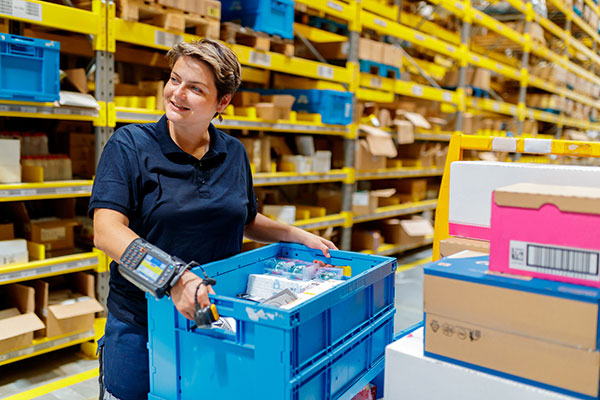
A range of devices is available. Beyond voice headsets, hipsters and even vests, the list includes scanners on rings and back-of-hand as well as wearable computers, tablets, cell phones and more, explains Wes Coleman, industry principal at Zebra.
If this sounds familiar, it should. Coleman says “people have the latest technology in their pocket, car and home so they expect it at work.”
(This is a good point to say this story does not cover what is or is not going on with glasses and other visual headsets in the warehouse. That’s a story for another day and time. After all, we’re much too early to have any idea how important Meta’s late September introduction of Ray-Ban Display glasses may fit in warehouse wearables.)
Acceptance of wearables
User acceptance of wearables is a must. “That’s key to any wearable’s success today,” says Coleman. From what he’s seen, Coleman says user acceptance has become increasingly important since 2020.
He cites a couple of reasons.
One, people retention. Ask them to use a device they don’t want to use does not contribute to their interest in the job.
This starts with a device’s intrinsic ease of use. There are two aspects here.
Training time is key to initial user acceptance. Literally, how much training is needed before anyone is sufficiently proficient in use of the wearable? Some systems say no training is needed for the speech engine itself. Just strap it on and start picking.
For others it’s less than an hour for the user to become acquainted with the voice system guiding them. In any case, users are ready to be productive in fairly short order.
Another is ease of moving from pick to pick as well as other activities required in the DC.
One prominent advance here is with voice systems. An ability to understand many languages is table stakes at this point. But increasingly important is the ability to switch between two languages during a single pick or other activity. Seamlessly.
Interestingly enough, even Apple thinks that’s a good idea. A prominent feature of its September introduction of AirPods Pro 3 is the ability to do real-time translations using Siri.
Form factor and ease of use matter a lot for warehouse wearables. So do the objectives that the system must achieve.
Coleman says accuracy of each pick is the top priority in pharmaceutical in particular. Mispicks are just too expensive. So, the wearables screen size has to be large enough, he says, to provide all key information to avoid mispicks.
In retail, the typical size of a facility is large as are the number of SKUs. So, wearables present an opportunity to simplify order fulfillment. Coleman says that generally calls for the use of a single type of wearable across the facility.
Then, there’s the matter of information systems connected to wearables. We are way past the stage of only linking to a warehouse management system (WMS), however common that still is.
Other systems tied to wearables, says Demeo, include warehouse execution systems (WES), warehouse control systems (WCS), supply chain towers, workforce management, contract and billing management as well as dock management and multi-carrier parcel software. Clearly, no person with a wearable these days is an island.
And well, they shouldn’t be. Wearables are, in fact, the edge of edge computing. Right where pickers and inventory meet. While so much compute occurs in the cloud off site, wearables are increasingly developing capabilities to run software on the edge in the DC.
“These devices are extremely powerful and intelligent. Wearables make decision making more seamless,” says May of Lucas.
By now, you might be wondering how wearables are rising to all these challenges. AI, of course.
May says that large language model (LLM) versions of AI have been used with voice for most of its commercial life. AI helps voice systems increase the accuracy of the system’s response to workers’ words. It also helps the system to respond more quickly to speech. Machine learning, a subset of AI, is also largely responsible for wearables’ capabilities advances.
But as Elazary of inVia points out, AI does not always sit on the wearable device. Instead, it is often in the cloud or on a local server. And beyond the abilities just mentioned, AI also helps non-voice wearables to better direct people in the warehouse and enhance process optimization from a distance.
The power of wearables
All of this is great technology, but does it work? You bet. In fact, there’s a long list of successes. We are long past the point of a simple proof of concept.
Here are three with a range of notable achievements.
We’ll start with a voice solution at distributor Pet Food Experts. Who doesn’t love their pet(s) and want the best for it (them)? Fortunately, EPG’s voice system helped on several fronts.
The company had several issues in the DC: lack of inventory visibility, short picks and co-mingled pick locations, to name three. In addition to fixing those issues, EPG’s voice system improved productivity by 38% and achieved 99.9% order accuracy. In addition, voice improved employee retention by 20%.
As Elazary points out, inVia is focused on connecting with the WES as well as the WMS using arm-mounted tablets. He says that while the WMS knows what needs to be done, the WES decides how to get it done.
At CarParts.com, inVia improved workflow by 400% over what was previously possible connecting the wearable only to the WMS. Those gains were due to the use of AI-orchestrated workflows across picking, replenishment and packing. That balanced pick density with service level agreement deadlines.
As to ease of use, Elazary says new hires hit 75% productivity in less than an hour. “That accelerates onboarding and increases worker confidence,” he adds.
In another example, Republic National Distributing Company (RNDC) ships 45 million bottles of alcoholic beverages in 9 million orders to more than 250,000 customers. May, principal engineer at Lucas, says a voice system with the Lucas Management Console doubled picking productivity with 99.6% accuracy.
While the voice system, which took about 30 minutes of training, guides workers through picking, the Lucas Management Console sits in the background. May says it provides the essential real-time visibility into operations, exception, individual productivity and workflow.
“The system even views real-time progress against the day’s orders and decides where to best allocate workers to keep pace,” May adds.
Stories like these three are not difficult to come by with wearables. And future stories are likely to become even more compelling as wearables increasingly provide the edge to managing work flows in real time.
That said, Demeo of EPG has an even greater ambition for the future role of wearables. He wonders how they might, in time, create a predictive loop in warehouse operations and order fulfillment. Wouldn’t that be powerful?
