

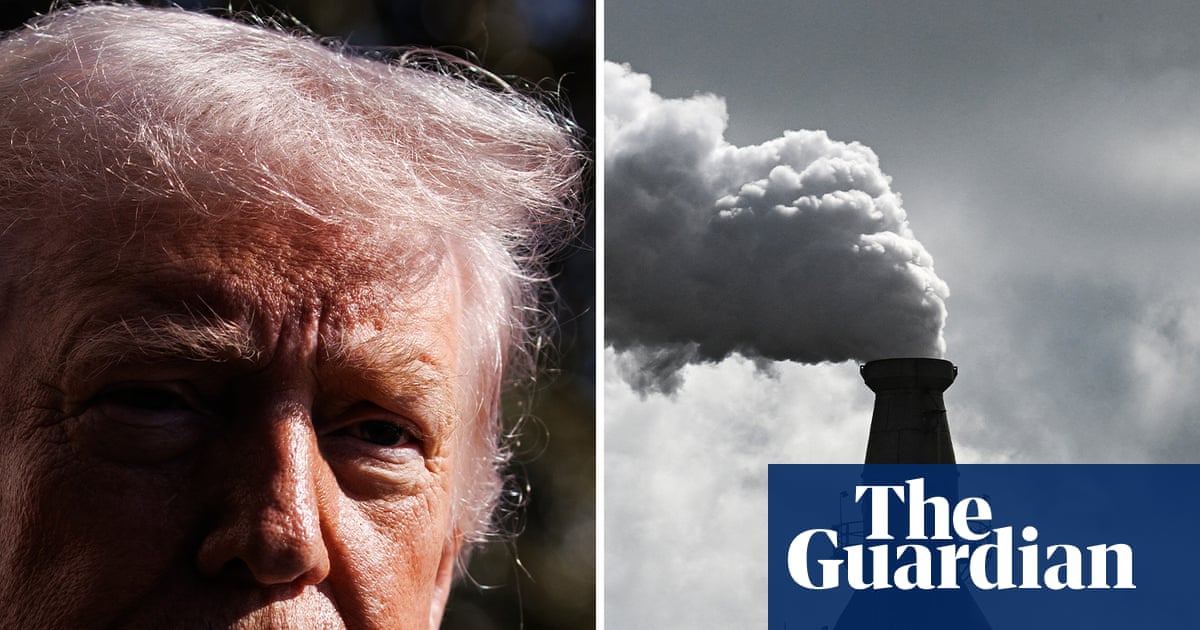
The Trump administration’s repeal of a foundational climate determination could clear a path for new litigation and policies targeting big oil, legal experts say.
Earlier this month, Donald Trump’s Environmental Protection Agency (EPA) finalized a rule revoking the “endangerment finding”, a 2009 determination that established that greenhouse gases threaten public health and welfare. The move eliminated federal limits on climate-warming emissions from motor vehicles, and is expected to extend to all other pollution sources.
Critics say the change was designed to reward oil companies, which poured record sums into Trump’s campaign. Ironically, it could also weaken a shield the fossil fuel industry has used against attempts to make it pay climate damages around the US.
The future of that legal shield will soon face a major test as the supreme court considers a fossil fuel industry petition to quash a climate lawsuit filed by a Colorado city.
In recent years, dozens of US states and local governments have brought climate-focused lawsuits against big oil. Since 2024, Vermont and New York have also passed “climate superfund” policies that compel oil majors to help cover the costs of climate disasters.
Fossil fuel companies and their allies have claimed that these laws and lawsuits should be thrown out because they are pre-empted by the federal Clean Air Act. The endangerment finding rollback could topple that reasoning, said Pat Parenteau, environmental law expert at Vermont Law School.
“I don’t see how oil companies can, with a straight face, any longer make that argument,” he said.
In 2011, the supreme court dismissed a climate lawsuit by Connecticut against a power company, saying emissions should be regulated by the EPA under the Clean Air Act, not the courts. Since then, nearly a dozen climate lawsuits against big oil have been dismissed on similar grounds. Many of those dismissals have been appealed.
Now, if the federal government no longer regulates greenhouse gases, no federal law should be read to preclude other efforts to control them, said Parenteau.
Public nuisance claims – alleging companies harmed communities’ health and safety and should fund abatement – may be especially benefited by the endangerment finding’s rescission, said Michael Gerrard, the founder of Sabin Center for Climate Change Law.
But oil companies have argued that suits framed around deceptive messaging or marketing – rather than emissions – are still fundamentally about pollution and should be pre-empted by the Clean Air Act, said Parenteau.
“All climate accountability cases could be affected,” he said.
Trump’s justice department also sued New York and Vermont over their climate superfund policies, partially on the grounds that the Clean Air Act already controls greenhouse gas emissions. The EPA rollback could undercut those claims, said Sarah Light, a law professor at the University of Pennsylvania.
“The argument would be that there is a comprehensive, federal statutory scheme that applies to the same subject matter as the climate superfund laws, and therefore the Clean Air Act pre-empts the laws,” she said. “But now the administration is taking the position that the Clean Air Act no longer applies to greenhouse gas emissions, so arguably, there is no comprehensive federal statutory scheme at all for greenhouse gas emissions.”
The supreme court on Monday moved to weigh in on the pre-emption question, when it agreed to consider a petition from two oil companies to end a climate lawsuit filed by Boulder, Colorado. Federal law prevents the seeking of climate damages in state court, the companies claim.
If the justices side with the oil companies, they could void the Boulder case – and potentially other climate accountability lawsuits and the superfund laws. But doing so could put them in a complicated position if they later weigh in on the endangerment finding.
Trepidation from corporate interests
The threats to this legal shield may be one reason that “a lot of companies and industry … are really concerned” about the endangerment finding repeal, Andres Restrepo, a senior attorney at the Sierra Club, said on a press call on Wednesday.
“[There is] really a good evidence of the fact that industry is nervous about about EPA moving forward with us,” he said.
The utility trade group Edison Electric Institute warned last fall that a repeal could trigger “increased litigation”, while the American Petroleum Institute (API) last month supported a repeal for vehicles but notably not for stationary sources such as power plants.
This contradicts earlier API messaging. In the 1990s, the trade group coordinated a multi-industry campaign opposing federal greenhouse gas regulation, and later tried to block the endangerment finding before it was finalized, notes the fossil fuel watchdog Fieldnotes.
In its revocation of the endangerment finding, the EPA focused only on repealing pollution controls on vehicles, not stationary sources of pollution including power plants. Experts say the rule undercuts the legal foundation for all greenhouse gas standards and that the agency will probably spell out the implications for other sectors soon.
For now, the “ambiguity” is “by design”, said Delta Merner, lead scientist at the science hub for climate litigation at the science advocacy group Union of Concerned Scientists.
“It gives the fossil fuel industry more time to prepare legal arguments because it creates an uncertainty on where regulation is now,” she said.
The EPA argues that the Clean Air Act “continues to pre-empt” state greenhouse gas laws and regulations.
“The Clean Air Act pre-empts states and political subdivisions from adopting or attempting to enforce emission standards for new motor vehicles and engines, full stop, whether EPA has issued standards for particular emissions or not,” an agency spokesperson said in a statement. “EPA’s repeal does not impact federal pre-emption for motor vehicle and engine emission standards under federal law.”
It was a sign of the agency trying to “have their cake and eat it too”, said Restrepo.
Ultimately, the legal system will decide whether the Clean Air Act still pre-empts climate superfund laws and accountability litigation.
“There is no deference owed to the EPA determination about pre-emption,” said Light. “That’s up to the courts.”
The supreme court could potentially affirm the endangerment finding repeal while maintaining that federal greenhouse gas regulations bar states from emissions control.
“It could say, we agree with [Lee] Zeldin that at this point in time, there isn’t sufficient evidence to justify regulation of greenhouse gases but we’re not saying that at some point in the future the Clean Air Act might apply,” said Parenteau. “It is an intellectually dishonest argument, but they could twist themselves into a pretzel to make it.”
Other efforts in the works
In the past year, fossil fuel companies and their allies have pushed for broad protection from climate accountability efforts.
This month, a US representative from Wyoming said she was working to “craft legislation” aimed at “tackling” big oil lawsuits and climate superfund bills. In January, two red states also introduced bills to shield fossil fuel companies from climate litigation. And last year, Republican state attorneys general urged the justice department to provide a “liability shield” for oil companies, while ConocoPhillips and API pressed Congress on draft legislation to limit climate liability.
Looming threats to the “pre-emption shield” could be driving the push for broader immunity, said Merner, who said oil companies may be seeking a liability waiver akin to the 2005 protections for the firearms industry that have largely protected it from accountability for gun violence.
“Now that there is increased potential for liability, both through litigation and legislation for the industry, we should expect to see a ramp up in [industry attempts] to win that broader shield,” she said.
But communities will “no question” continue pursuing climate accountability in “new and creative ways”, said Merner.
“When national protections fail, state governments and courts become really essential venues for addressing harm and ensuring accountability in these spaces,” she said. “The federal government stepping back from regulating climate pollution doesn’t make the problem disappear.”
