

Tech companies have been funnelling billions of dollars into AI infrastructure projects in the Middle East over the past few years, drawn in by cheap and readily available energy and land, alongside local government support.
But the Iran war spilling over into neighbouring countries in the Middle East throws questions over the future of the data center and digital infrastructure buildout in the region, particularly if it becomes a prolonged conflict, experts told CNBC.
Data centers have already been targeted. Iran’s wave of retaliatory attacks hit AWS facilities in the UAE and Bahrain, causing banking, payments, enterprise and consumer services to experience outages.
While the Iran war will likely not see hyperscalers walking away from existing AI infrastructure builds in the region, it could impact future investment in the case of drawn-out hostilities.
There could be a “shift in where the next wave of capacity gets built,” Patrick J. Murphy, executive director of the geopolitical unit at Hilco Global, told CNBC.
“If geopolitical risk continues to rise in the Gulf, companies may accelerate projects in places like Northern Europe, India or Southeast Asia, where power supply, regulatory frameworks and security conditions are more predictable.”

‘Targets for attack’
The Middle East has fast become a key hub for tech companies looking to build out infrastructure to support the AI boom.
A concerted push by governments in the region to attract international investment — and divest away from China to appease the U.S. administration — has borne fruit.
Oracle, Nvidia and Cisco are all involved in OpenAI’s AI campus in the UAE — dubbed Stargate — which, in collaboration with Emirati firm G42, will span 10 square miles and include a 5-gigawatt capacity. Saudi company Humain is pouring billions of dollars into AI infrastructure buildouts and Microsoft said it would invest $15 billion into the UAE by 2029.
But security considerations around the facilities that power digital infrastructure in the region have come under scrutiny in the past week following attacks by Iran.
Those strikes signal that data centers may now be “considered legitimate targets for attack in modern armed conflicts,” Aalok Mehta, director at think tank the Center for Strategic and International Studies. “This will significantly change how companies think about data center security going forward.”
AI infrastructure firms will likely be making contingency plans because of the situation, he added. “Either by considering shifting to less vulnerable regions or by hardening current and future data centers with missile defense and counter-drone technology.”
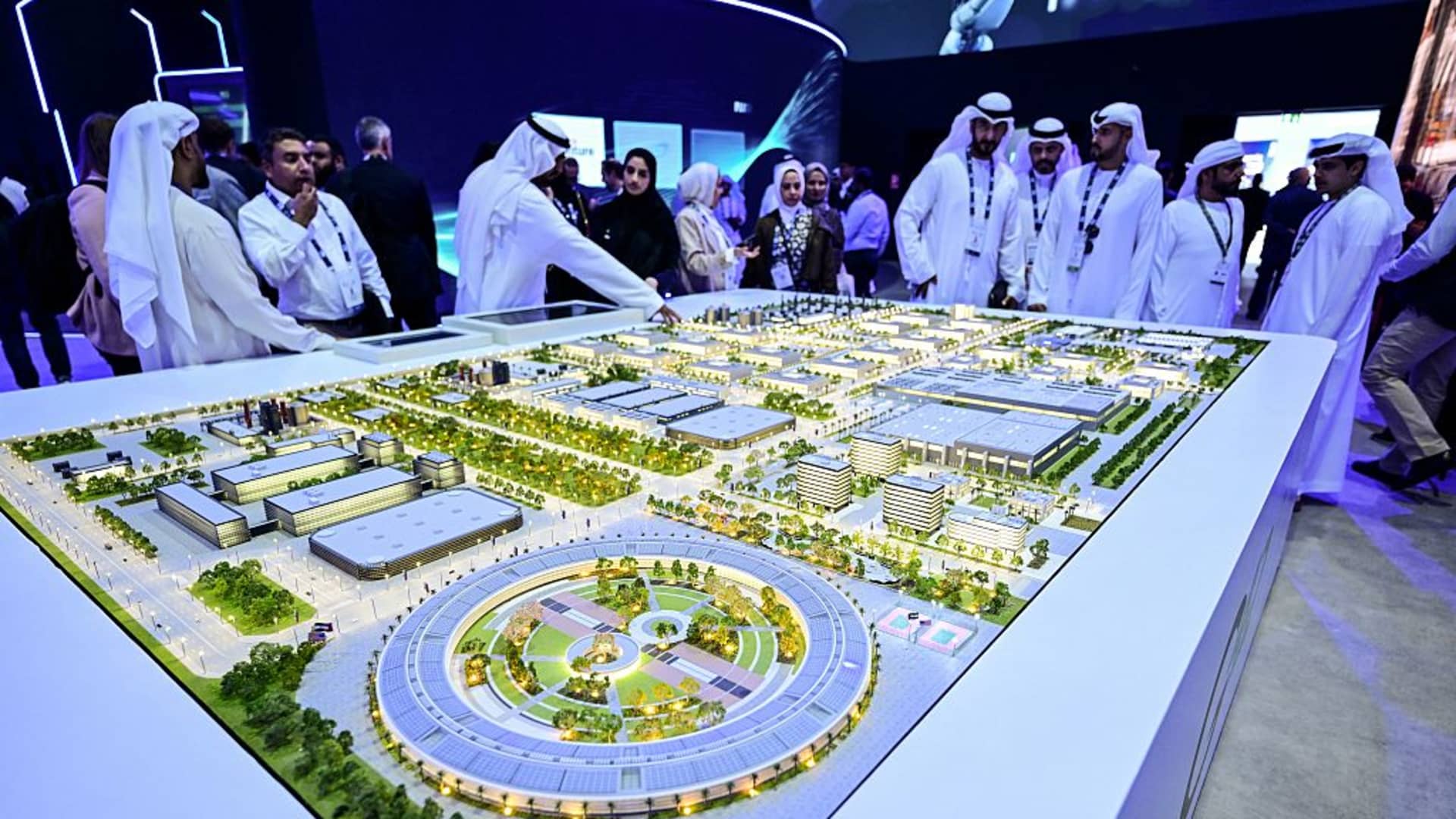
Guests look at a model of the largest data center in the UAE under construction in Abu Dhabi as the Stargate initiative, a joint venture between G42, Microsoft, and OpenAI, during the Abu Dhabi International Petroleum Exhibition & Conference (ADIPEC) in Abu Dhabi on November 3, 2025. (Photo by Giuseppe CACACE / AFP) (Photo by GIUSEPPE CACACE/AFP via Getty Images)
Giuseppe Cacace | Afp | Getty Images
Prolonged conflict
There are still big draws for companies looking to build AI infrastructure in the Middle East.
“The region remains attractive to companies in terms of capital from sovereign wealth funds, government buy-in, available energy and its role as a gateway to markets in the global south,” Tess deBlanc-Knowles, senior director at think tank Atlantic Council, told CNBC.
Governments in the Middle East will also likely be racing to reassure U.S. companies and encourage them to maintain commitments in the region.
“The UAE sees AI buildout as critical to their future and is betting heavily on the technology,” said Mehta. “It is investing many billions of dollars to support the AI transition and has also played a central role in facilitating many of the big AI infrastructure partnerships.”
Given the huge costs invested in already operational facilities, alongside the power contracts, land agreements and fiber connectivity, it’s unlikely AI hyperscalers will look to relocate built capacity.
“Data centers typically need to be located close to their customers to ensure low latency and reliable service,” Tancrede Fulop, senior equity analyst at Morningstar, told CNBC. “Relocating or closing facilities could therefore lead to service-level agreement breaches and reputational risk.”
But scenario planning around the Iran war and its impact on the wider Middle East region will be weighing on investment committees and boards.
Rather than exiting the region, companies could take steps to “hedge their investments,” by slowing new capital deployments or pausing planned partnerships, deBlanc-Knowles said.
Should the conflict persist or escalate, those hedges may transition into an “evaluation of alternative regional hubs to reduce exposure to sustained disruptions from a wider regional conflict,” she added.
The Iran war could cause digital infrastructure developer Pure Data Centre Group — which has operational data centers in Riyadh and Abu Dhabi, and is planning further expansion in the Middle East — to “slow down” in the region, Gary Wojtaszek, chairman and interim chief executive officer at the company, told CNBC.
Pointing to the energy and capital available in the Middle East, Wojtaszek said: “Up until the prior week, I would have been like, ‘Hey this is awesome, right?’ And now it’s like, okay, well, maybe we’ll slow down here.”
“But I do think that eventually the hostilities are going to settle down,” he said, adding that “there’s going to be a lot more focus on doing development there” in the future.
Companies could start cost-benefit calculations to guide their future investment plans, said Mehta.
“They’ll be asking questions like: How long might this war last? How much will new hardening measures cost? Are there any viable alternative sites for data center buildouts? How much delay would shifting to an alternative location cause?”
Google and Microsoft declined to comment on how the Iran war was impacting its data center and AI infrastructure projects in the region. AWS, G42, Humain and OpenAI did not respond to a request for comment by the time of publication.
