

Warehouse automation often feels like a forced choice: go all in on a fully automated distribution center or stick with manual processes and hope growth doesn’t outpace capacity.
What’s Related
LT Apparel Group found a middle ground.
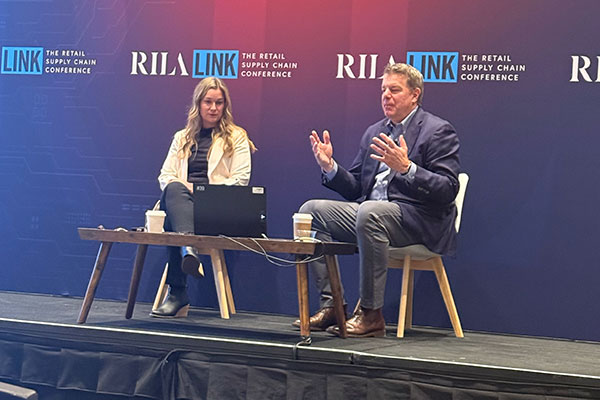
At last week’s Retail Supply Chain Conference hosted by Retail Industry Leaders Association, executives from LT Apparel Group shared how the family-owned apparel company used flexible, phased automation to scale operations, add SKUs, and handle peak volumes without expanding its distribution center footprint.
The breaking point
For nearly 30 years, LT Apparel operated out of a small, largely manual distribution center in Dayton, New Jersey. As order volumes grew, especially during peak back-to-school season, the facility struggled to keep up.
“We were facing capacity issues,” said Steve Wuebker, Senior Vice President, Operations at LT Apparel. “Operations constraining the company’s ability to grow is the worst thing in the world.”
The biggest challenge wasn’t case picking. About 75% of LT Apparel’s volume moves case-in, case-out and was already flowing efficiently. The real pain point was unit-level picking, opening cartons, picking individual items, and assembling customer orders across thousands of SKUs.
Choosing flexibility over full automation
Rather than designing a fully automated facility, LT Apparel focused narrowly on solving its unit-picking problem. As a family-owned company without in-house engineering teams, flexibility was critical.
“We don’t have a staff of mechanical or industrial engineers,” Wuebker said. “When it’s time for us to make a change, we build partnerships to help us grow.”
Working with KPI Integrated Solutions, LT Apparel designed a system that could scale over time instead of locking the company into a fixed automation footprint.
Starting small and growing
LT Apparel opened a new distribution center in late 2022 and launched the first phase of automation, combining an AutoStore system for unit storage with a Tompkins Robotics T-Sort solution for order consolidation.
The initial system included roughly 20,000 AutoStore bins and was designed specifically to support unit-level picking. The footprint for picking, sorting, and packing shrank from about 125,000 square feet to roughly 25,000 square feet.
Instead of stopping there, LT Apparel continued to adjust and expand the system as needed:
In 2023, the company expanded T-Sort capacity to handle additional order profiles
From 2023 to 2024, it doubled AutoStore capacity to approximately 40,000 bins
The expanded system allowed LT Apparel to close all third-party logistics operations and bring that volume in-house
“We really only built what we needed to service the business we had,” Wuebker said. “And we left white space in the building.”
Why the investment paid off quickly
The impact was immediate. LT Apparel increased average unit-picking throughput from roughly 30,000 units per day to as many as 150,000 units during peak season. Units per labor hour more than tripled, and pick-and-pack chargebacks dropped from about 2% of sales to roughly 0.25%.
By consolidating 3PL volume under one roof, the company saved about $4 million in a single year. Peak staffing levels dropped from more than 600 workers to fewer than 200, largely by reducing seasonal temporary labor rather than eliminating full-time roles.
Lessons learned
Wuebker emphasized that flexibility was the real advantage. Certain high-velocity products, like Carhartt beanies, bypass the automated system entirely because they are faster to pick manually. That decision, he said, reflects the importance of not over-automating every SKU.
“Don’t box yourself in,” Wuebker said. “If you over-automate and your business changes, you’ll be throwing money away.”
His advice for other supply chain leaders: start earlier than you think, document business processes thoroughly, and overinvest in data and systems integration.
“If you’re already seeing capacity constraints,” he said, “it’s already time to be implementing automation.”
