

Cuba is adrift. Six decades of US economic blockade, the passing of the founding leaders – Fidel and Raúl Castro in quick succession – a few years back, and distancing away of several sympathetic regimes from this last bastion of the left in Latin America has made the nation and its people political and economic orphans.
True, Cuba has withstood some twelve U.S. presidents. They all vowed to end the socialist regime on the island. None of them succeeds. But this time around, things may be different. President Donald Trump is proving to be the country’s arch nemesis. He appears to be on a sustained, indefatigable mission – to orchestrate an internal implosion and force the regime in Cuba to give up its power.
President Trump and his team are following a multipronged offensive. It involves suffocating Cuba on the energy front, pushing it away from its minuscule circle of friendly nations, and shore up a domestic opposition against the regime on the island. This is probably the most effective blockade of the island by the United States since the Cuban Missile Crisis of 1962.
Due to the unprecedented energy blockade, Cuba’s government has already shut universities, secondary schools and non-essential state offices and pulled back on public transport in order to preserve resources. Many of the international flights to Havana are now cancelled due to the lack of aviation fuel. The situation is so dire that the diplomats of foreign countries are now planning to leave the island before it is too late.
Witnessing his policies making already suffering Cubans groan in pain, President Trump has not hidden his glee. He has boasted, “It looks like it [the regime] is ready to fall.”
Trump’s trump card against Cuba – cutting off the irreplaceable energy lifeline. Until Trump’s brazen kidnapping and arrest of Nicolas Maduro, Cuba was receiving some 27,000 barrels of oil per day from Venezuela. It was an arrangement made by Hugo Chavez, the founder of Venezuela’s Bolivarian Revolution.
For nearly three decades, the arrangement worked smoothly. Cuba, which has no oil or alternative energy supplies of its own, compensated Venezuela for its help by providing military, medical and other critical services. This arrangement ended abruptly in early January, following the ousting of Maduro.
Trump seems to have slain two traditional opponents in the Western hemisphere following his Venezuelan military adventure. As he continues to boast, “Without Venezuelan oil, Cuba won’t be able to survive.” Simply put, US sanctions and a deep economic crisis have for years made it impossible for the government to buy enough fuel.
Once upon a time, for over half a century, Cuba was the poster child of the global left. Nations and leaders fell over themselves to come to the aid of Havana whenever Washington sought to squeeze it diplomatically, economically and militarily. This time around, it is different. There are not many takers for Cuba’s cry for help!
Friendless in a fearful world
International response to Cuba’s ongoing energy crisis, following Trump’s actions, remains muted at best. In the vicinity, traditional sympathizers such as Mexico and Brazil, who carry a lot of moral weight and have the wherewithal to address Cuba’s needs, have remained lukewarm in their response. Trump’s threats of immediate economic sanctions on anyone selling oil to the island, forced Mexico to halt its planned shipments.
Brazil, led by a fellow-wing government under Luiz Inácio Lula da Silva, has condemned Trump’s actions against Cuba but has not provided any concrete help. Farther away, Spain, Cuba’s ex-colonial master and a humanitarian intervener led by a socialist regime, has done next to nothing to alleviate the suffering of the islanders.
Other traditional allies of Cuba, such as Russia and China have been watching the plight of Cuba from the sidelines. But have offered precious little. According to the Russian news agency Izvestia, Moscow is preparing to send the much-needed crude to Havana in the near future. Cuba needs urgent energy intervention. When Moscow does decide to send the shipment, it might be too late for the regime and its citizens.
To drum up support and receive critical aid, Cuban Foreign Minister Bruno Rodríguez Parrilla went to China in early February. The trip resulted in sympathetic words of support from Beijing but nothing concrete. Bogged down in its disastrous military campaign in the Ukraine and politically isolated, Russia simply has no strength to come to the aid of Cuba halfway around the world.
In a show of strength, the former leaders of some six Caribbean nations have branded the US blockade as a form of “economic warfare”. They have said: “The global community cannot remain mute and indolent while a fatal, pernicious fuel tourniquet stifles the Cuban economy and suffocates human lives there.” Similarly, in view of the UN Human Rights Commission, “the U.S. executive order imposing a fuel blockade on Cuba is a serious violation of international law and a grave threat to a democratic and equitable international order.”
These are empty words and gestures, at best. In real terms, no institution or state would appear to have the real power and resolve to stand up against the US in the Western Hemisphere.
Advantage trump?
Trump’s policies to isolate Cuba completely are succeeding. There is a certain policy paralysis when it comes to providing any form of support to Cuba from its traditional allies. The situation is so dire that some die-hard left-wing supporters of the regime are finding it difficult to stand up against Trump’s Cuba-related policies.
Cuba’s all-weather friend, the left-wing dictatorship of Daniel Ortega of Nicaragua, has recently introduced a policy of denying entry to Cubans. In neighbouring Guatemala, all Cuban doctors serving in the country have been asked to leave the country.
Cuba’s medical system was already perpetually crisis-stricken along with the island’s economy, with lack of supplies, staff and medicine long being the norm. Now the sector is about to collapse. In the words of Cuban Health Minister José Ángel Portal Miranda, the US blockade of Cuba threatens “basic human safety.” Some five million people in Cuba living with chronic illness are slowly being suffocated as their medications and treatments are gravely undermined. Overseas flights bringing in vital medical supplies have now stopped, as Havana is no longer capable of refuelling airplanes for their outbound flights from Cuban airports.
Little wonder, the UN has warned that if Cuba’s energy needs are not met, this could cause a humanitarian crisis. The island, already suffering from severe shortages of food, fuel and medicine, has implemented rationing measures to protect essential services.
Internal disunity
While President Trump’s hardline policy undertakings under the so-called Donroe Doctrine have facilitated Cuba’s current isolation, that is only part of the story.
Bereft of the leadership of the Castro brothers, the current regime does not enjoy the same legitimacy within Cuba. Critically, the regime lacks the aura of the previous leadership both at home and abroad. According to a pro-Cuban front, operating from outside Cuba, “the Main Problem is the Dictatorship and the Failure of its Economic Model. Free and Fair Elections. Equal Opportunities.”
With the passing of the Castros, the socialist revolution feels a little too distant to the current generation of Cubans. Even in those countries where Cuba always received a warm welcome, there is a growing rigidity towards the present regime. Many of Cuba’s traditional allies feel the country lacks democracy and transparency in governance. Although they themselves may be authoritarian, they are also not oblivious to the fact that there is systematic repression by the Cuban regime of political opponents. These factors have undoubtedly contributed to the erosion of solidarity towards Cuba.
Under the circumstances, provoking a humanitarian crisis would be in the best interest of Washington to initiate regime change in Cuba.
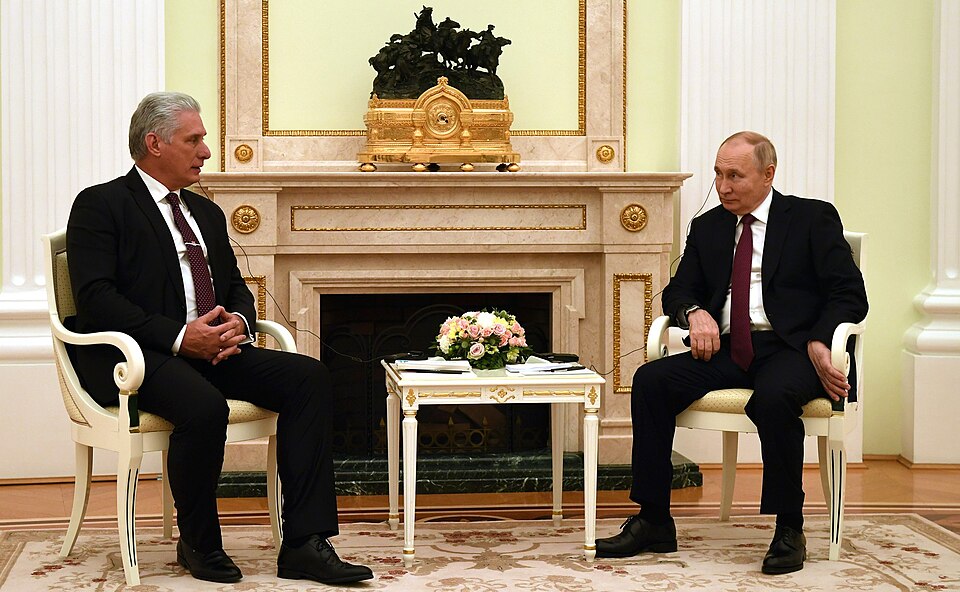
[Photo by kremlin.ru, CC BY 4.0, via Wikimedia Commons]
Amalendu Misra is a professor of international politics in the School of Global Affairs, Lancaster University, United Kingdom. He’s on X (formerly Twitter) @MisraAmalendu. The views and opinions expressed in this article are those of the author.
