

Stay informed with free updates
Simply sign up to the Oil & Gas industry myFT Digest — delivered directly to your inbox.
The writer is a UK-based accountant and co-author of ‘Formation: The making of Nigeria from Jihad to Amalgamation’
Nigeria has had a troubled relationship with crude oil since the first commercial well flowed at Oloibiri in 1956. Time and again, the promise of easy money has resolved into a pattern of windfalls that enrich the state without strengthening it.
The “cement armada” — the mid-1970s oil-boom-generated fiasco when Nigeria ordered far more cement for public works than it could handle, leaving hundreds of ships stranded offshore — is only one, vivid example. From the mismanaged windfall of higher prices pushed up by the 1990-1991 Gulf war to perennial controversies over what the national oil company collects, spends and remits to the treasury, straightforward national progress has not transpired.
Yet the most corrosive and lasting aspect gets less attention: the humiliating inability to add value to the barrel before it leaves Nigeria. The embodiment of this is the state-owned refineries that stand idle for long stretches, despite repeated turnaround plans.
A 2023 parliamentary report found that Nigeria had spent N11.35tn ($25bn) over the past decade trying to fix those refineries, only to remain heavily dependent on imports. The paradox of “crude out, refined fuel in” has cost both dollars and dignity.
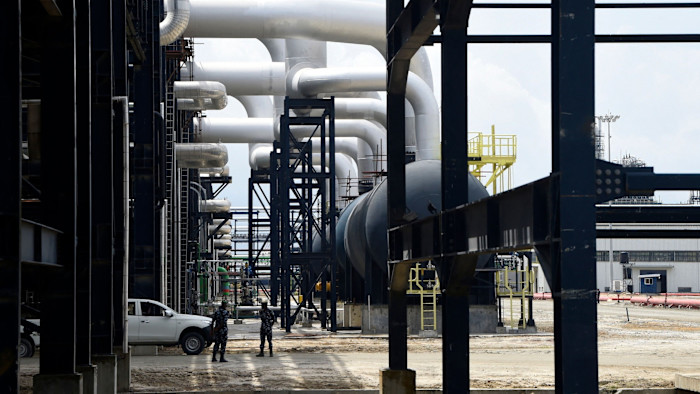
That humiliation helps explain why a vast new refinery in the Lekki Free Zone outside Lagos has become a source of optimism, after it came online in early 2024. If it can run consistently and at scale, Nigeria’s oil economy might begin adding value. The 2,635-hectare Dangote plant’s financing architecture involved both the state and markets. Billed as the world’s largest single-train refinery, it cost $20bn to build and has a capacity of 650,000 barrels a day.

The refinery’s construction was backed by domestic banks at a scale rarely seen for a single project. When it was announced in 2013, the sponsors closed a $3.3bn syndicated facility led by Standard Chartered and GTBank and involving eight other Nigerian banks. The central bank was later reported as offering guarantees of roughly N575bn over 10 years. Aliko Dangote, a leading Nigerian industrialist and the force behind the project, revealed that the company received $2.7bn in foreign exchange allocations from the central bank towards construction. In 2021, Nigeria approved state-owned oil company NNPC’s $2.7bn investment for a 20 per cent stake, although its failure to remit the full amount later saw its holding cut to 7.2 per cent.
That financial commitment helps explain why downstream policy has begun to pivot around the plant. In October 2025 the presidency approved a 15 per cent import duty on petrol and diesel to protect local refiners — but by November regulators had dropped this, following warnings that it risked dependency on a single source. A bitter public confrontation ensued between Dangote, Africa’s richest man, and the regulator notionally overseeing his plant. Ultimately, the heads of the downstream and upstream regulators quit, and President Bola Tinubu nominated replacements.

At the same time, Nigerians have had to absorb the sudden withdrawal in 2023 of a fuel subsidy regarded by many citizens as a straightforward benefit of living in an oil-rich state. In its latest full year, NNPC said the petrol subsidy bill reached N4.39tn (about $10bn) in 2022.
After President Tinubu scrapped the subsidy in his inauguration speech in May 2023, the pump price more than doubled within days, which pushed up transport and food costs.
The change has not been formally reversed, which could affect the new refinery’s future role in the country’s oil industry if subsidies rather than innovation in delivery and supply again shape the downstream system.
Investing in Nigeria

From Nigeria’s economic shock plan, age-gap politics and security to investment, a Q&A with the central bank governor and unblocking the oil pipeline
In theory, every litre refined and sold domestically cuts the demand for foreign exchange and any subsidy the state is tempted to carry. In April 2025, Nigeria’s central bank said fuel imports fell 23 per cent to $14.06bn in 2024, as domestic supply rose, although demand and pricing reforms played a part.
But the refinery is affected by several constraints still facing Nigeria. For instance, it has had to import crude when domestic supply fell short — news reports said it received only five crude cargoes from NNPC early in its operations instead of the 15 expected, which led to purchases of Brazilian and US barrels. Net savings depend on the plant’s output and whether Nigeria can reliably supply it with crude on workable terms — and whether the state can resist the reflex to cap prices when they rise sharply, as they are doing now because of the Middle East war.
The refinery last year announced plans to more than double its capacity to 1.4mn barrels a day by 2028. But doubling throughput requires reliable crude supply on workable terms, stable pricing rules and a downstream market whose protections do not harden into a monopoly.
In addition, refineries carry great emotional weight. In 19th-century America, for instance, petroleum-derived kerosene made domestic lighting a household standard because it became much cheaper than whale oil. When supply becomes boringly reliable, both the economy and the national mood shift.
In Nigeria, “availability” means fewer queues or periods of fuel as national obsession. That quiet revolution of availability is the promise Nigerians are projecting on to a refinery outside Lagos.
