

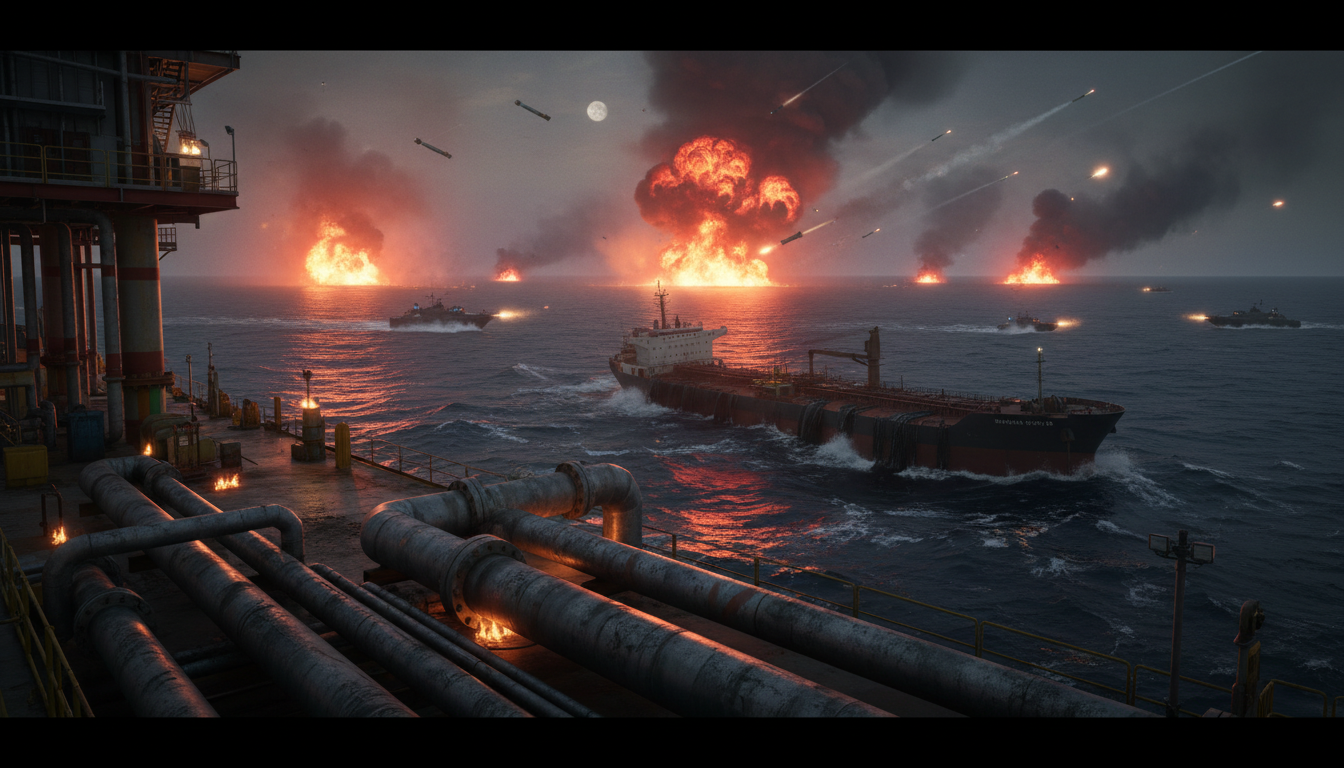
Global crude benchmarks soared Monday, as fresh geopolitical developments in the Middle East introduced a new dimension of risk to already strained energy markets. Investors are keenly observing an escalating conflict that threatens to further disrupt global oil supply chains, reinforcing an outlook for elevated commodity prices and sustained market volatility.
The price rally was immediate and significant. May futures for the international benchmark, Brent crude, surged by an impressive 2.92%, climbing to settle at $115.86 per barrel. Concurrently, U.S. West Texas Intermediate (WTI) futures also saw robust gains, advancing by 3.20% to reach $102.80 per barrel. This sharp upward movement underscores the market’s sensitivity to geopolitical flashpoints, particularly those with implications for the world’s most critical oil-producing region.
Escalation in the Middle East Fuels Price Surge
The catalyst for this latest price surge originated from Yemen, where the Houthi movement declared it had launched missile attacks targeting Israel. This action marks a notable intensification of the regional conflict, representing the Houthis’ first direct engagement in the broader hostilities involving the U.S., Israel, and Iran.
A spokesperson for the Houthi group, Yahya Saree, conveyed via social media that a barrage of ballistic missiles had been directed at what were described as sensitive Israeli military installations. The stated intent behind these strikes was to provide support for Iran and Hezbollah forces operating in Lebanon. This strategic move by the Houthis significantly broadens the geographic scope and complexity of the ongoing conflict, which initially ignited following U.S. and Israeli military actions against Iran on February 28.
For investors in the oil and gas sector, this new front introduces considerable uncertainty regarding supply stability. Any expansion of the conflict carries the inherent risk of disrupting crude production, processing, or transportation infrastructure within the Middle East, a region pivotal to global energy supply. The immediate market reaction reflects this heightened risk premium, signaling a collective investor concern about potential supply bottlenecks.
Analyst Perspective: The ‘Higher-for-Longer’ Paradigm
Financial experts are actively recalibrating their projections amidst these developments. Ed Yardeni, president of Yardeni Research, articulated a growing consensus that global equity markets are beginning to price in a “higher-for-longer” scenario for both oil prices and interest rates. This outlook is intrinsically linked to the increasing probability of a protracted regional conflict, which would continue to exert upward pressure on energy costs and, consequently, inflation.
Yardeni specifically highlighted the critical role of the Strait of Hormuz, a narrow maritime choke point through which a substantial portion of the world’s seaborne oil passes. He cautioned that a sustained blockade or significant disruption to shipping in this vital waterway could trigger a severe market pullback, simultaneously elevating the risks of a global recession. The specter of increased U.S. involvement in the conflict further compounds this uncertainty, likely ensuring that market volatility remains exceptionally high until crude flows demonstrate a clear return to normalcy.
The analyst’s commentary underscores the rapid reassessment of geopolitical risk by energy markets. He observed that “the speed and magnitude of the move underscore how quickly energy markets are repricing geopolitical risk, challenging earlier efforts to keep both oil and bond markets anchored, and reinforcing the risk of sustained disruption in the Strait.” This statement succinctly captures the current sentiment: prior attempts to stabilize these markets are now being overwhelmed by the weight of escalating tensions and the very real threat of long-term supply interruptions.
Implications for Oil & Gas Investors
The current environment presents a complex challenge and opportunity for oil and gas investors. On one hand, elevated crude prices could translate into robust earnings for exploration and production companies, particularly those with diversified assets outside direct conflict zones. Upstream operators might see enhanced cash flows, potentially supporting increased dividends, share buybacks, or debt reduction.
However, the accompanying volatility and the risk of demand destruction due to a global recession temper this optimism. Downstream operators, such as refiners and petrochemical companies, may face margin pressure if crude input costs rise significantly faster than refined product prices or if consumer demand wanes. Service companies might benefit from increased drilling activity spurred by higher prices, but project timelines could be affected by broader economic uncertainty.
Prudent investment strategies in this climate demand a keen focus on company fundamentals, including balance sheet strength, operational efficiency, and geographical exposure. Companies with strong hedging strategies, diversified revenue streams, and a proven ability to navigate challenging market conditions are likely to be more resilient.
Navigating Future Volatility
As the conflict unfolds, several key indicators will be crucial for investors to monitor. Any further escalation in the Middle East, particularly actions that directly impact major oil infrastructure or shipping routes, will undoubtedly trigger additional market responses. Statements and actions from major global powers, including the U.S. and its allies, regarding their involvement or mediation efforts, will also play a significant role in shaping market sentiment.
Furthermore, attention will remain fixed on global crude inventories and demand metrics. While geopolitical risks currently dominate the narrative, underlying supply-demand fundamentals will eventually reassert their influence. However, until there is a clear de-escalation of tensions and a reduction in the perceived threat to the Strait of Hormuz, investors should anticipate a continued environment of heightened risk premiums and unpredictable price swings in the oil market. The “higher-for-longer” thesis for crude prices appears firmly entrenched, requiring a cautious yet agile approach from those invested in the dynamic energy sector.
