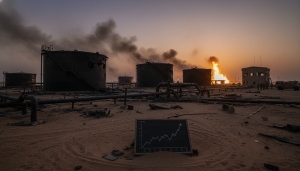
Middle East Crude Producers Signal Tentative Hormuz Reopening Amid Geopolitical Flux
Major oil producers across the Middle East are sending cautious signals to global markets, initiating preliminary steps that suggest a potential softening of restrictions on crude exports through the strategically vital Strait of Hormuz. This development, closely watched by energy investors and commodity traders alike, indicates that key Gulf petrostates are beginning to prepare for a resumption of more regular oil flows through the critical chokepoint, following recent geopolitical shifts in the region.
Specifically, Saudi Arabia, Kuwait, and Iraq have approached their primary Asian clientele, soliciting cargo loading nominations for both April and May. These nominations are critically linked to export terminals whose shipments necessitate passage through the Strait of Hormuz. This move represents a tangible, albeit tentative, step toward normalizing crude logistics in a region where export routes have been severely disrupted by recent conflicts and heightened tensions.
Strait of Hormuz Remains Under Tight Control Despite Ceasefire
Despite the optimism generated by a recently announced ceasefire, commercial traffic through the Strait of Hormuz has not yet witnessed a material increase. For Iraq and Kuwait, this maritime passage represents their sole export conduit for crude oil, while a significant portion of Saudi Arabia’s vast crude output also depends on its navigability. Industry experts highlight that transit remains highly controlled and selectively enforced, preventing a return to open commercial navigation that characterizes stable periods. This persistent restriction underscores the fragility of the situation and the enduring geopolitical risks impacting global energy supply chains.
Intelligence firms specializing in maritime activity have noted that passage through the Strait continues to be tightly managed. Their assessments confirm that while there is an expectation of eventual reopening, the reality on the ground shows no immediate return to pre-conflict shipping volumes. This means that, for the foreseeable future, crude carriers and their cargo face an environment of restricted movement, requiring coordinated approvals that complicate efficient logistical planning for refiners and traders worldwide. The geopolitical premium embedded in oil prices reflects this ongoing uncertainty.
Saudi Arabia’s Strategic Export Maneuvers and Limitations
Saudi Aramco, the world’s leading crude exporter, has reportedly requested customers to submit loading nominations for May from both its Yanbu terminal on the Red Sea and the Ras Tanura port. This dual approach is significant: Yanbu provides an alternative route, bypassing the Strait of Hormuz entirely, whereas cargoes originating from Ras Tanura are inherently dependent on its passage. This underscores the strategic flexibility, yet also the inherent vulnerability, of Saudi Arabia’s export infrastructure.
Last month, Riyadh had proactively shifted to bolster its Red Sea exports from Yanbu, as the traditional Ras Tanura shipments faced confinement within the Persian Gulf due to transit difficulties. For April deliveries, Aramco informed Asian term buyers that they would exclusively receive the flagship Arab Light crude grade loaded at Yanbu. While Yanbu offers a crucial bypass, analysts caution that Saudi Arabia’s Red Sea capacity cannot fully compensate for the vast volumes historically shipped through the Strait of Hormuz, leaving a significant supply gap if the chokepoint remains severely restricted.
Iraq’s Proactive Approach to Resuming Exports
Iraq, a key OPEC producer, appears to have navigated the complex geopolitical landscape with somewhat greater agility. Reports suggest that Iraqi vessels have received clearance to transit the Strait of Hormuz, offering a glimmer of hope for its crude export operations. Notably, Baghdad had begun soliciting loading schedules from its clients even prior to the widely announced ceasefire, signaling an earlier anticipation of improved transit conditions compared to its regional counterparts. This proactive stance highlights Iraq’s urgent need to restore full export capacity and monetize its significant oil reserves, offering a potential boost to global crude supply if sustained.
Market Response and Persistent Shipping Uncertainty
In the wake of the ceasefire announcement, segments of the trading and refining community have moved to book tankers destined for the Middle East, hoping to capitalize on an eventual easing of restrictions and secure crude supplies. However, the shipping industry remains on high alert. A substantial lack of concrete details regarding the mechanisms, timing, and assuredness of passage continues to fuel caution. As of the end of the trading week, Iran retains effective control over the Strait of Hormuz, maintaining its authority over maritime traffic in one of the world’s most critical energy arteries. This ongoing control, coupled with ambiguous directives, keeps the shipping sector on edge and contributes to elevated insurance premiums and freight rates, directly impacting the delivered cost of crude for consumers.
Investment Implications: Navigating Volatility and Supply Risks
For energy investors, these developments present a complex landscape of cautious optimism intertwined with significant supply chain vulnerabilities. The potential, however tentative, for increased flows through the Strait of Hormuz could exert downward pressure on immediate oil prices by alleviating some supply fears. Conversely, any reversal in sentiment or a tightening of transit controls could swiftly reignite geopolitical risk premiums, pushing crude benchmarks higher.
Investors should closely monitor official statements regarding maritime passage, tanker traffic data, and regional diplomatic efforts. Companies with exposure to Middle Eastern crude production, international shipping, and refining operations that depend on these supplies will experience direct impacts. Diversification strategies and a keen understanding of geopolitical risk remain paramount in this volatile market environment. The stability of the Strait of Hormuz remains a cornerstone of global energy security, and its full, unrestricted reopening would represent a significant de-risking event for the entire oil market ecosystem.