

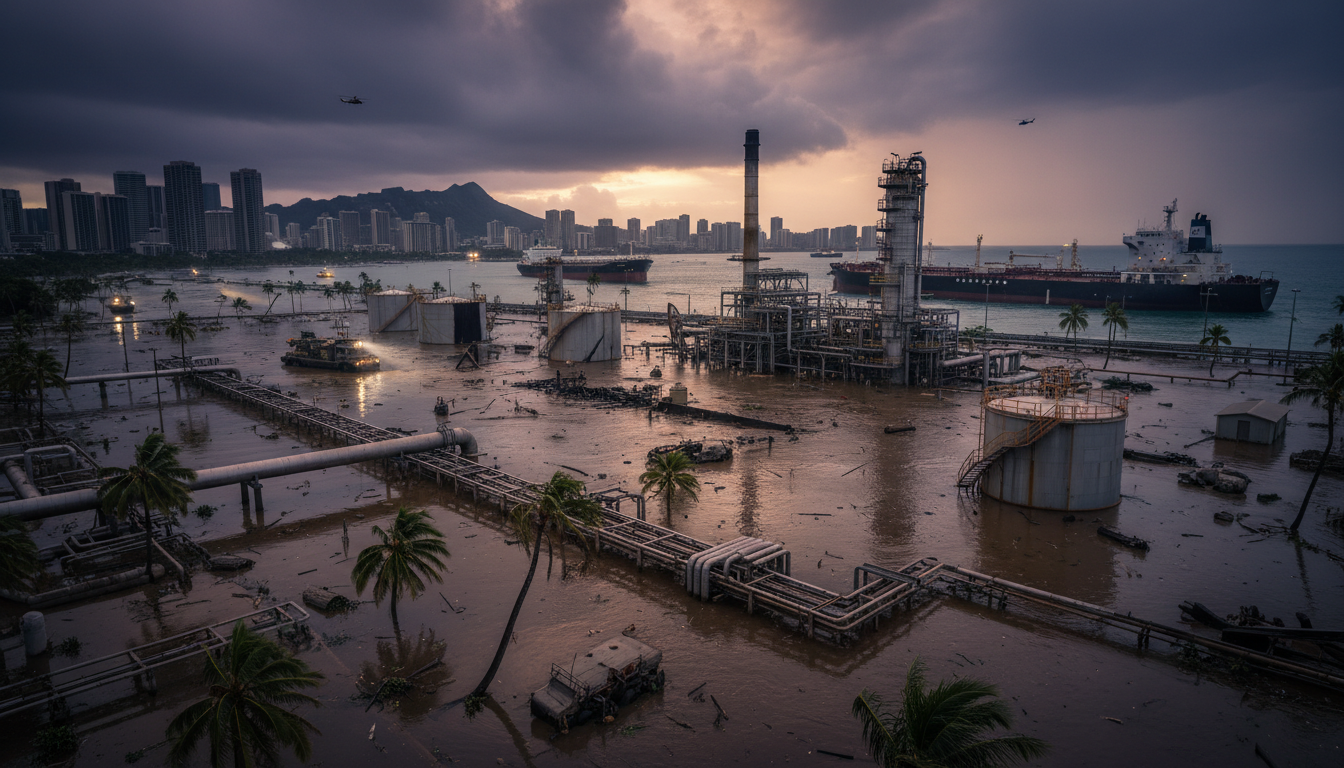
Oʻahu Flood: A Case Study in Operational Risk and Infrastructure Vulnerability for Investors
The recent catastrophic flooding on Oʻahu’s North Shore serves as a stark reminder for investors regarding the critical importance of robust infrastructure, timely risk assessment, and effective communication in the face of escalating climate-related events. While local officials initially cited unexpected conditions and difficult decisions, a deeper examination reveals a concerning confluence of overlooked warnings, equipment malfunctions, and communication failures that left thousands of residents at severe risk, leading to widespread property destruction and community outcry. For savvy oil and gas investors, understanding these vulnerabilities is paramount, as similar breakdowns can impact regional economic stability, supply chain integrity, and the long-term viability of energy assets.
Honolulu’s emergency operations center was fully staffed and active from 10 p.m. on the night of the deluge, yet decision-makers reported operating with limited actionable intelligence and obscured visibility due to the dark and relentless downpour. Randal Collins, who directed the emergency response that night, publicly accepted accountability for the city’s handling of the crisis. This situation underscores a fundamental investment principle: even with personnel in place, inadequate information flow and flawed situational awareness can severely compromise an organization’s ability to protect assets and stakeholders.
Failing Forecasts and Blind Spots in Monitoring
Emergency management agencies across the United States typically rely heavily on National Weather Service (NWS) forecasts to guide resource deployment and public advisories. However, the forecasts preceding the Oʻahu flood proved critically inaccurate, initiating a cascade of poor decisions. Early estimates on March 19 predicted only minor rainfall, with one NWS report suggesting a mere quarter-inch for the afternoon. Honolulu Mayor Rick Blangiardi later indicated receiving an evening forecast of 2 to 3 inches over eight to ten hours. Yet, NWS itself acknowledged “atypically high uncertainty for such a short lead time,” particularly concerning the exact location and intensity of rainfall.
A significant contributing factor to this forecasting uncertainty was the inoperability of a crucial Doppler radar on Molokaʻi, which had been down since March 12 due to motor issues and remained unrepaired for several more days. This radar was vital for estimating real-time rainfall intensity and location on Oʻahu hours in advance. Collins confirmed that the radar outage contributed directly to the “vagueness of information” that hampered officials’ decision-making capabilities. In a historically wet winter that had already necessitated multiple evacuations, the extended outages of this critical piece of monitoring infrastructure, evident in service logs since late November, represent a significant operational oversight that directly translates into heightened risk for regional assets and the local economy.
Ignoring the Alarms: Stream Gauges and Missed Opportunities
Despite the meteorological blind spots, tangible ground-level indicators were screaming warnings. Throughout the evening, water levels in streams and reservoirs surged across the island. A key gauge in the Kaukonahua Stream near Otake Camp, a primary indicator for potential flooding in Waialua, showed alarming acceleration. By 8:25 p.m., its water level had climbed 2 feet in just two hours. The NWS consequently updated its prediction, warning of heavy showers moving toward Oʻahu. Mayor Blangiardi would later describe the event as a “rain bomb,” with 10 inches falling in two hours.
The first flash flood advisory, disseminated via the city’s HNL Alerts system, went out at 8:52 p.m. However, this system’s efficacy is limited: it requires opt-in subscriptions, and only about 11% of Oʻahu’s population (approximately 110,000 people) are registered. This low penetration rate highlights a fundamental weakness in crisis communication infrastructure, directly impacting public safety and increasing the risk of widespread disruption and damage. Investors must consider such communication bottlenecks when assessing the resilience of local markets and critical infrastructure assets.
Rapid Escalation and the Community’s Early Warning
While official alerts lagged, residents in flood-prone Waialua and Haleʻiwa began sensing the unprecedented severity of this storm. Wendell Toki of Otake Camp observed his rain-measuring bucket overflowing and his usually vocal poultry falling silent – a traditional local indicator of impending danger. Yet, as North Shore residents went to sleep, the only official alert was a general island-wide advisory, failing to convey the impending “unfathomable amount of rain.”
The first targeted flash flood warning for the northern half of Oʻahu was finally issued at 10:57 p.m., broadcasting to cellphones about expected or ongoing flash flooding, with rainfall rates of 1 to 3 inches per hour. By 11 p.m., the Otake Camp stream gauge registered 24 feet deep, surging another 3 feet within half an hour, rapidly approaching the 28-foot flood stage. Notably, just a week prior, a 29-foot level at this same stream had triggered an evacuation. Yet, on March 19, despite exceeding 28 feet by 11:40 p.m. and cresting over 30 feet by midnight, no evacuation order was issued. Collins later admitted this did not “raise as many alarm bells as maybe we wish it had,” a critical lapse in judgment from an investment risk perspective.
Life-Threatening Conditions and Delayed Response
By 11:30 p.m., Levi Rita at Dillingham Ranch witnessed “ungaugeable” depths, with water burying a Dodge truck and flowing through his house. The NWS issued a “dangerous and life-threatening situation” alert at 11:39 p.m., warning of rapidly worsening conditions. Yet, the city’s Emergency Operations Center continued to downplay the severity, with officials focusing on reservoirs like Wahiawā and Nuʻuanu, fearing dam failures that could impact thousands. Collins stated that at midnight, they lacked sufficient awareness to trigger an evacuation order.
Between 12:30 a.m. and 1 a.m., water levels continued to skyrocket. John Sivigny on Waialua Beach Road saw water enter his house within 15 minutes, despite having received no specific North Shore alarms. The Otake Camp stream gauge peaked at 34.93 feet by 1:15 a.m. before ceasing data transmission. Residents reported waist-deep water in bedrooms by 1:30 a.m., with emergency services unable to reach them due to impassable roads. For almost three hours after the initial 11 p.m. flash flood warning, city officials issued no further alerts, leaving residents to navigate rapidly rising waters on their own. By the time the next city flash flood warning arrived at 1:52 a.m., many were already swimming for their lives.
The Aftermath: Accountability, Damages, and Future Resilience
The first official advice for residents to evacuate if possible, including guidance to seek rooftops, came at 3:42 a.m. The initial civil defense sirens, typically used for tsunamis, finally sounded at 4:23 a.m., but one siren was inoperable, and another barely audible. It was later revealed that 15 of Oʻahu’s 176 sirens were awaiting repair or replacement. An official evacuation order was issued around 5:30 a.m., followed by a critical miscommunication at 8:30 a.m. when an erroneous alert warned of the 120-year-old Wahiawā Dam’s failure, prompting the National Guard to evacuate shelters. Although clarified 30 minutes later, this incident highlighted the fragility of aging infrastructure and the cascading effects of misinformation in crisis.
The profound community frustration boiled over at a subsequent meeting with Mayor Blangiardi. Residents, many in mud-stained clothes, vehemently challenged the official narrative, pointing out that local volunteers with backhoes were conducting rescues long before first responders arrived. Calls for an apology from officials for failing the community were met with resistance, with the mayor stating his team had been working diligently for days. This public confrontation underscores the significant social and economic fallout that arises from perceived leadership failures during crises, potentially leading to increased demands for public investment in resilience, higher insurance premiums, and more stringent regulatory oversight.
Investment Insights from O’ahu’s Experience
For investors monitoring the broader energy and infrastructure landscape, the Oʻahu flood offers crucial lessons:
- Infrastructure Vulnerability: The Molokaʻi radar outage and the inoperable sirens highlight the risks associated with aging or inadequately maintained monitoring and warning systems. Robust, redundant infrastructure is a non-negotiable for operational continuity and safety.
- Predictive Analytics & Data Integrity: Over-reliance on vague forecasts and the failure to act on clear, real-time data from stream gauges underscore the need for advanced, reliable predictive models and a culture of decisive action based on empirical evidence.
- Effective Communication Channels: The low adoption of HNL Alerts and delayed, generic warnings reveal significant weaknesses in public communication strategies. Reliable, pervasive, and actionable alert systems are critical for protecting populations and assets.
- Climate Change Adaptation: As extreme weather events become more frequent and intense, investments in climate-resilient infrastructure and adaptive strategies will become increasingly important for asset valuation and risk mitigation.
- Operational Resilience and Accountability: The breakdown in timely decision-making and the subsequent community backlash emphasize the need for strong leadership, clear protocols, and genuine accountability in emergency management. These factors directly influence investor confidence and long-term economic stability in affected regions.
The Oʻahu flood is more than just a local tragedy; it is a critical case study in the escalating challenges faced by communities and critical infrastructure in an era of rapid climate change and evolving risk profiles. Investors must integrate these lessons into their due diligence, seeking out enterprises and regions that prioritize proactive resilience, robust data infrastructure, and transparent communication.
