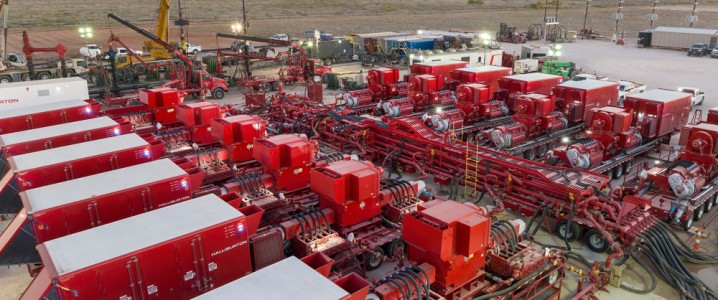
The oilfield services (OFS) sector is signaling caution. Despite Halliburton Company (NYSE: HAL) reporting second-quarter 2025 earnings precisely in line with analyst expectations, the company’s outlook casts a shadow over the industry’s near-to-medium term prospects. This warning from one of the sector’s bellwethers, particularly one with significant exposure to the U.S. fracking market, resonates deeply with prevailing market sentiment and recent crude price trajectories. Investors are now keenly assessing the implications for capital expenditure (capex) cycles and the broader energy investment landscape.
Halliburton’s Q2 2025: A Deeper Look at the Numbers and the Warning
Halliburton delivered a net income of $472 million, translating to $0.55 per share, for the second quarter of 2025. This performance marks a significant sequential improvement from Q1 2025, which saw net income of $204 million or $0.24 per share, and met the consensus analyst estimate. However, the headline figures belie a more cautious underlying narrative. North American revenues, a crucial barometer for the U.S. onshore market, remained relatively flat sequentially at $2.26 billion but declined approximately 9% year-over-year. International revenue offered a brighter spot, increasing 2% sequentially to $3.3 billion, yet even here, specific regions like Saudi Arabia and Kuwait experienced lower activity across several product service lines.
Chairman, President, and CEO Jeff Miller’s direct statement underscores the shifting sentiment: “What I see tells me the oilfield services market will be softer than I previously expected over the short to medium term.” This declaration, coming from a company that has already braced for lower revenues and profits in 2025, suggests a more profound or prolonged slowdown than initially anticipated. While Miller affirmed a commitment to their shareholder returns framework, the immediate focus is on “taking action to address this near term softness.”
North American Headwinds and Global Nuances
The softening outlook is largely driven by persistent weakness in North America. Halliburton’s considerable footprint in U.S. fracking makes it particularly sensitive to domestic drilling activity. Supporting this trend, Baker Hughes’ latest weekly rig count data reveals a decline of 55 active drilling oil rigs in the U.S. compared to this time last year. This reduction in drilling is a direct consequence of E&P companies tightening their belts amid lower oil prices and heightened uncertainty.
SLB, another industry giant, echoed this sentiment. CEO Olivier Le Peuch noted in their recent Q2 earnings call that the total market is experiencing a slight decline in 2025 compared to 2024, specifically highlighting North America’s “short cycle” as declining “more deeply than everyone will anticipate.” He identified it as the “highest drag on to the total capex for the year.” Internationally, while overall revenue saw sequential growth for Halliburton, the specific challenges in the Middle East, particularly in Saudi Arabia and Kuwait, suggest that even regions typically considered growth engines are not immune to reduced activity or project deferrals.
Crude Price Dynamics and Investor Scrutiny
The cautious tone from OFS leaders is inextricably linked to the trajectory of crude oil prices. As of today, Brent crude trades at $94.64 per barrel, reflecting a modest daily decline, but more significantly, it has depreciated over 12% in the last three weeks alone, falling from $108.01 on March 26 to its current level. WTI crude has followed a similar path, trading at $90.90. This downward pressure on prices directly impacts the willingness of exploration and production (E&P) companies to commit capital to new drilling and development projects, which in turn dictates demand for oilfield services.
Our proprietary data indicates that investors are intensely focused on forecasting Brent prices for the next quarter and the full year 2026. This is a critical metric because sustained lower prices erode E&P profitability and lead to cuts in capital expenditure budgets. The current price environment, which has seen Brent dip from recent highs, provides a clear backdrop for the ‘softer’ market outlook articulated by Halliburton and other service providers. Lower crude prices inevitably translate into fewer rigs, less fracking activity, and reduced demand for specialized equipment and personnel.
Upcoming Catalysts: Navigating Future Volatility
The coming weeks hold several key events that could either reinforce or challenge the current cautious OFS outlook. Investors should closely monitor the Baker Hughes Rig Count reports scheduled for April 17 and April 24. A continued decline in U.S. rig activity would further validate the sector’s concerns about North American short-cycle spending and deepen the investor queries regarding the consensus 2026 Brent forecast.
Perhaps even more impactful will be the OPEC+ meetings, with the Joint Ministerial Monitoring Committee (JMMC) convening on April 18, followed by the full Ministerial Meeting on April 20. Any decisions from this influential group regarding production quotas will directly influence global crude supply and, consequently, price stability. A surprise increase in production could put further downward pressure on prices, exacerbating the OFS sector’s challenges, while deeper cuts could provide a much-needed tailwind. These events are pivotal, as they will shape the medium-term oil price environment that E&P companies use to plan their drilling budgets, directly influencing the fortunes of service providers like Halliburton, SLB, and Baker Hughes.
Investment Implications in a Softening Market
The collective warnings from leading oilfield service providers signal a period of increased scrutiny for investors in the OFS sector. While Halliburton’s Q2 earnings met expectations, the forward-looking commentary emphasizes that the operating environment is becoming more challenging. The sequential flatness in North America and specific international headwinds, combined with a decline in crude prices, suggests E&P companies are prioritizing capital discipline over aggressive production growth.
For investors, this means a continued focus on companies with diversified international portfolios, strong balance sheets, and a demonstrated ability to manage costs effectively. While Halliburton’s commitment to shareholder returns offers some reassurance, the immediate future for OFS appears to be one of adaptation and strategic maneuvering in a market facing headwinds on multiple fronts. Vigilance over upcoming rig count data and OPEC+ decisions will be paramount in assessing the sector’s trajectory through the remainder of 2025 and into 2026.


