

Two U.S. appointments have transformed Greenland from a partner into a strategic question. They now test whether Arctic politics will be decided by consent or by power.
Greenland and Denmark found themselves confronting an unexpected challenge when U.S. President Donald Trump revived his controversial claims about the Arctic island and questioned Denmark’s ability to manage it. The policy shift soon took concrete form through two appointments in Washington. Louisiana Governor Jeff Landry was named special envoy to Greenland, and Thomas Emanuel Dans of Texas was placed in charge of the United States Arctic Research Commission. For Copenhagen and Nuuk, these decisions indicated more than administrative change. They showed a new American posture in the Arctic, one that troubles established diplomatic practice and tests the principle of self-determination.
For Copenhagen, the message was clear enough. For Nuuk, it raised old fears in a new form. For Europe, it sounded like a warning bell. Danish Foreign Minister Lars Løkke Rasmussen said the appointment of a special envoy was “totally unexpected” and described public remarks linked to it as “completely unacceptable.” At the same time, the elevation of Thomas Emanuel Dans—an investor with strong political ties and a record of different engagements in Greenland—placed a political figure at the heart of U.S. Arctic research and policy.
Appointments are rarely neutral. In international relations, they often speak louder than formal statements. In this case, they suggested that Greenland is no longer seen by Washington merely as a partner territory within a friendly kingdom. It is now being treated as a strategic object. That shift explains why Denmark reacted so strongly, why the European Union intervened so clearly, and why Greenland’s leaders have returned again and again to one phrase – the right of self-determination.
How U.S. Arctic Policy Changed
The U.S. approach to the Arctic did not change overnight. It evolved over years, and it accelerated after Donald Trump returned to office. During Trump’s first presidency, his interest in Greenland was dismissed by many as rhetorical excess. However, his second term has removed that comfort. What once sounded speculative has moved closer to policy.
Trump has repeatedly framed Greenland as essential to U.S. national security. He has pointed to its location, its resources, and its role in countering Russian and Chinese influence in the Arctic. He has also questioned Denmark’s ability to manage the island and has refused to rule out coercive means. Reuters reported that Trump revived his earlier idea of gaining control over Greenland and has “not ruled out the use of force.”
This language has obvious consequences. Denmark has long been one of Washington’s closest allies. It supported U.S. wars in Iraq and Afghanistan. It moved closely with American security priorities. That history makes the present moment more striking. Danish defence intelligence has now publicly recast the United States as a potential security challenge. A senior Danish analyst called this change “almost a seismic shift.”
The intelligence report further states that “the United States now uses its economic and technological power as a political instrument, including toward allies and partners.” This captures the heart of Denmark’s concern. Pressure does not always arrive with troops. It can arrive through sanctions, influence campaigns, or strategic appointments that bypass established norms.
Within this setting, the appointment of a special envoy to Greenland appeared less like routine diplomacy and more like a unilateral assertion. Denmark’s concerns are therefore natural. Greenland is certainly not a colony waiting for transfer. It is a self-governing territory within the Kingdom of Denmark, with clearly defined legal rights.
Self-Determination, and the Law That Protects Small Peoples
International law offers clear guidance on Greenland’s status. The United Nations Charter prohibits threats to territorial integrity. The core human rights treaties affirm that “all peoples have the right of self-determination.” Greenland’s own 2009 Self-Government Act recognises the people of Greenland as a people under international law with the right to decide their future.
This legal framework exists for a reason. It protects small and middle-level powers in a world of unequal strength. It ensures that geography and resources do not obliterate political agency. Greenland manages its domestic affairs. Denmark manages defence and foreign policy in consultation with Greenland. Any change to this arrangement must come through consent, not pressure.
Greenland’s leaders have been careful and consistent in their response. Prime Minister Jens-Frederik Nielsen said the appointment of a U.S. envoy was “not a cause for concern,” but he also reaffirmed that Greenland controls its own destiny. “We are open to cooperation with other countries, including the United States,” he wrote, “but with respect and based on our values and aspirations.” This is the language of law. It accepts partnership and rejects coercion. Denmark has expressed this stance and has drawn support from the European Union. An EU spokesperson said that “the territorial integrity and sovereignty of the Kingdom of Denmark, including Greenland, must be preserved” and called this principle “essential for the European Union.” These responses show that Greenland is not isolated. Its legal position is fixed in a wider European and international order. The challenge comes from attempts to blur that order by treating strategic value as superior to legal rights.
Politics Behind the Appointments
The appointment of Thomas Emanuel Dans to lead the U.S. Arctic Research Commission adds another dimension to this story. On paper, USARC advises the President and Congress on Arctic research. In practice, it determines policy priorities. Dans described the Arctic as “the most important region in the world” and linked research directly to national security, energy, and resource development.
Dans is a venture capitalist and the founder of American Daybreak, a group that has worked in Greenland outside formal diplomatic channels. ArcticToday has reported that American Daybreak sought to build links with Greenlandic actors who favour closer ties with the United States and helped organise controversial visits by U.S. political figures. This blending of research, politics, and private influence raises serious concerns. Research institutions gain legitimacy because they are expected to serve public knowledge. When they are led by figures closely tied to partisan agendas and business interests, trust disappears. The Arctic then appears less as a shared space of cooperation and more as a field of competition.
The removal of Elizabeth Qaulluq Cravalho from USARC underlines this change. Reuters linked her departure to a broader downgrading of climate research and an upgrading of military and energy priorities. Climate science matters in the Arctic because communities there face immediate environmental change. When climate research is sidelined, local voices are also sidelined. At the same time, Greenland’s mineral wealth attracts powerful actors. Rare earth elements, oil, gas, fisheries, and shipping routes all promise future profits. Business interests see big opportunities. Strategic planners see leverage. The danger is that these interests converge in ways that reduce Greenland to a resource platform rather than a living society.
Greenland as a Test Case for the Arctic Order
Greenland has become the focal point of Trump’s Arctic strategy because it converges all these forces. It hosts the U.S. Pituffik Space Base. It sits astride future shipping routes. It holds valuable resources. It also has a small population with a distinct identity and a clear legal right to choose its future.
The reaction from Denmark, the EU, and Greenland shows that this right is not negotiable. Denmark has summoned ambassadors. The EU has spoken of inviolable borders. Greenland’s leaders have insisted on respect. Even scaled-back visits, such as the decision to limit a U.S. delegation to a military base rather than a cultural event, reflect attempts to lower tension.
The Arctic is entering a difficult sitation of strain. Melting ice is opening new routes and resources. Powerful states are moving closer. Commercial interests are following quickly. Trump’s approach to Greenland forces an uncomfortable question. Can international law restrain power when strategic interests grow stronger? It also tests whether alliances can withstand when pressure replaces consent. For Greenland, the question is about its political future. For Denmark and Europe, it is about whether law carries legitimate power. For the Arctic as a whole, it is about whether the region will be allowed to exist by agreement or by force.
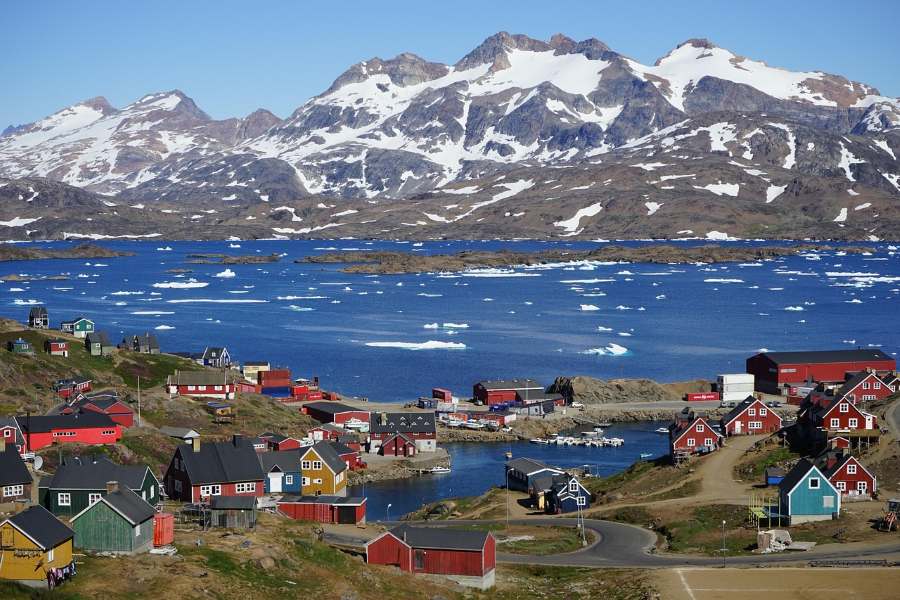
[Image by Bernd Hildebrandt from Pixabay]
The views and opinions expressed in this article are those of the author.

K.M. Seethi, Director, Inter University Centre for Social Science Research and Extension, is the Academic Advisor of the International Centre for Polar Studies at Mahatma Gandhi University, Kerala. He also served as ICSSR Senior Fellow, Senior Professor and Dean of International Relations at MGU.
