

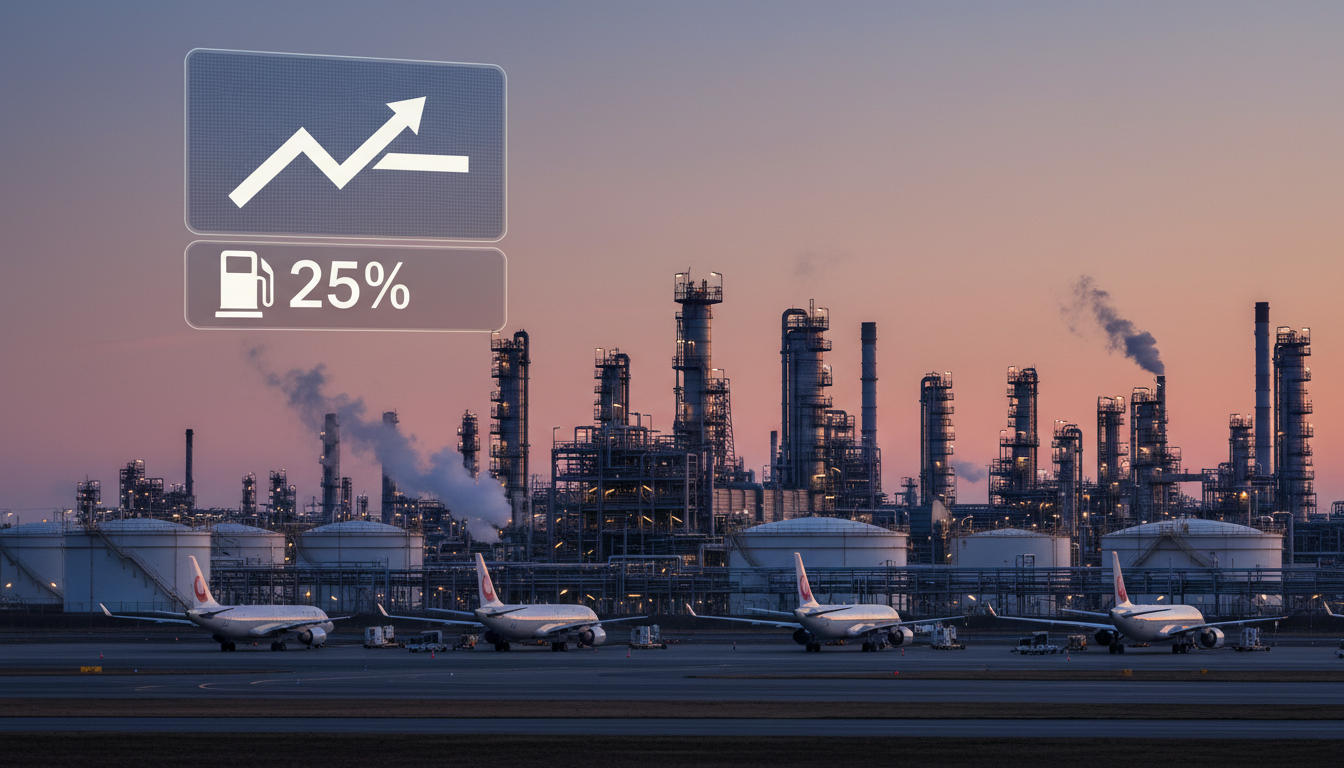
In a move signaling significant market volatility and government intervention, India’s state-owned oil marketing companies (OMCs) recently executed a substantial revision in Aviation Turbine Fuel (ATF) prices. This adjustment, effective early Wednesday, saw an initial staggering 115% increase in Delhi’s jet fuel rates, propelling prices to ₹2.07 lakh per kilolitre (kl) from the previous month’s ₹96,638/kl. Similar sharp hikes materialized across other major metropolitan centers, underscoring the profound impact of a turbulent global energy landscape on domestic operational costs.
However, the Indian government swiftly stepped in, capping the immediate burden on domestic airlines. The Ministry of Petroleum, in close consultation with the Ministry of Civil Aviation, decided on a partial, staggered increase for local carriers, limiting the hike to approximately ₹15 per litre. This strategic intervention aims to shield domestic airfares from an abrupt and severe escalation, a direct fallout of an international energy shock exacerbated by geopolitical tensions in the critical Strait of Hormuz region. Investors in the aviation sector, therefore, witness a complex interplay of market forces and regulatory oversight shaping the industry’s immediate cost structure.
Understanding the Price Dynamics and Regulatory Intervention
The monumental surge in ATF prices was, in many respects, anticipated by market watchers, aligning closely with upward trends in international benchmarks. India’s ATF pricing mechanism, deregulated since 2001, typically involves monthly revisions that mirror global market conditions. The government, acknowledging this established framework, explicitly stated that the current “extraordinary situation” in global energy markets necessitated temporary intervention. This move highlights a delicate balance between free-market principles and the imperative to stabilize essential domestic services amidst unprecedented global pressures.
Under the newly enacted framework, international flight operations will absorb the full brunt of the increased ATF prices, reflecting prevailing global rates without governmental subsidy. Conversely, domestic operations will continue to benefit from this partial insulation, a policy designed to mitigate the pass-through effect on local air travel costs. This bifurcated approach underscores the government’s commitment to supporting domestic economic activity while allowing international markets to dictate pricing for cross-border services.
The Union Civil Aviation Minister, Ram Mohan Naidu, had earlier voiced concerns about potential airfare spikes commencing April 1st. His proactive engagements included appeals to state governments, notably Delhi, to consider reductions in Value Added Tax (VAT) on jet fuel. Discussions also extended to the Petroleum Ministry and various chief ministers, all aimed at formulating a comprehensive relief strategy for the embattled aviation industry. Such governmental dialogues offer crucial insights for investors monitoring the regulatory environment surrounding the energy and transportation sectors.
Geopolitical Tensions Fueling Energy Market Volatility
At the heart of this dramatic shift in jet fuel costs lies the escalating Iran-US-Israel conflict in West Asia. This regional instability has injected immense uncertainty into global crude oil markets, driving prices sharply upward. Military actions and heightened tensions in the Persian Gulf directly threaten oil supplies transiting through the Strait of Hormuz, a narrow yet supremely vital maritime chokepoint. For India, this strait represents the critical artery for nearly 90% of its imported crude oil, making the nation particularly vulnerable to disruptions in this region.
The precarious situation in the Strait of Hormuz has sent shockwaves through the energy complex, pushing jet fuel costs from a relatively stable range of $85-90 per barrel to an alarming $150-200 per barrel. This meteoric rise reflects not just immediate supply fears but also the significant costs associated with potential rerouting of flights to avoid conflict zones or secure alternative fuel sources. For investors in oil exploration and production, this scenario underscores the persistent geopolitical risk premium embedded in crude prices, while for refiners and marketers, it highlights the challenges of managing procurement and hedging strategies in a volatile environment.
Economic Ramifications and Investor Outlook
Beyond the direct impact on OMCs and airlines, the current global energy shock carries broader economic ramifications. Compounding the issue for Indian companies and consumers is a weakening rupee, which further inflates the cost of dollar-denominated crude oil imports. Oil marketing entities like Indian Oil are thus compelled to adjust ATF rates monthly, passing on increased costs, albeit partially for domestic routes. This scenario presents a complex operating environment for airlines, who must navigate higher fuel expenses, potential fare caps, and currency fluctuations, all while maintaining profitability.
For investors eyeing the energy sector, these developments highlight both opportunities and risks. The elevated crude oil prices certainly bolster the revenue prospects for upstream exploration and production companies. However, downstream players, particularly refiners and marketers, face margin pressures due to increased input costs and potential government-mandated price controls on end products like ATF. Aviation sector investors must weigh the benefits of government support for domestic routes against the full exposure of international operations to soaring fuel prices and the potential impact on travel demand.
The interplay of geopolitical events, government policy, and market dynamics will continue to shape the profitability and operational landscape for companies across the energy and aviation value chains. Astute investors will closely monitor global crude price movements, the evolution of conflicts in West Asia, and any further regulatory interventions designed to mitigate the impact of this “extraordinary situation” on the Indian economy and its critical sectors.
