

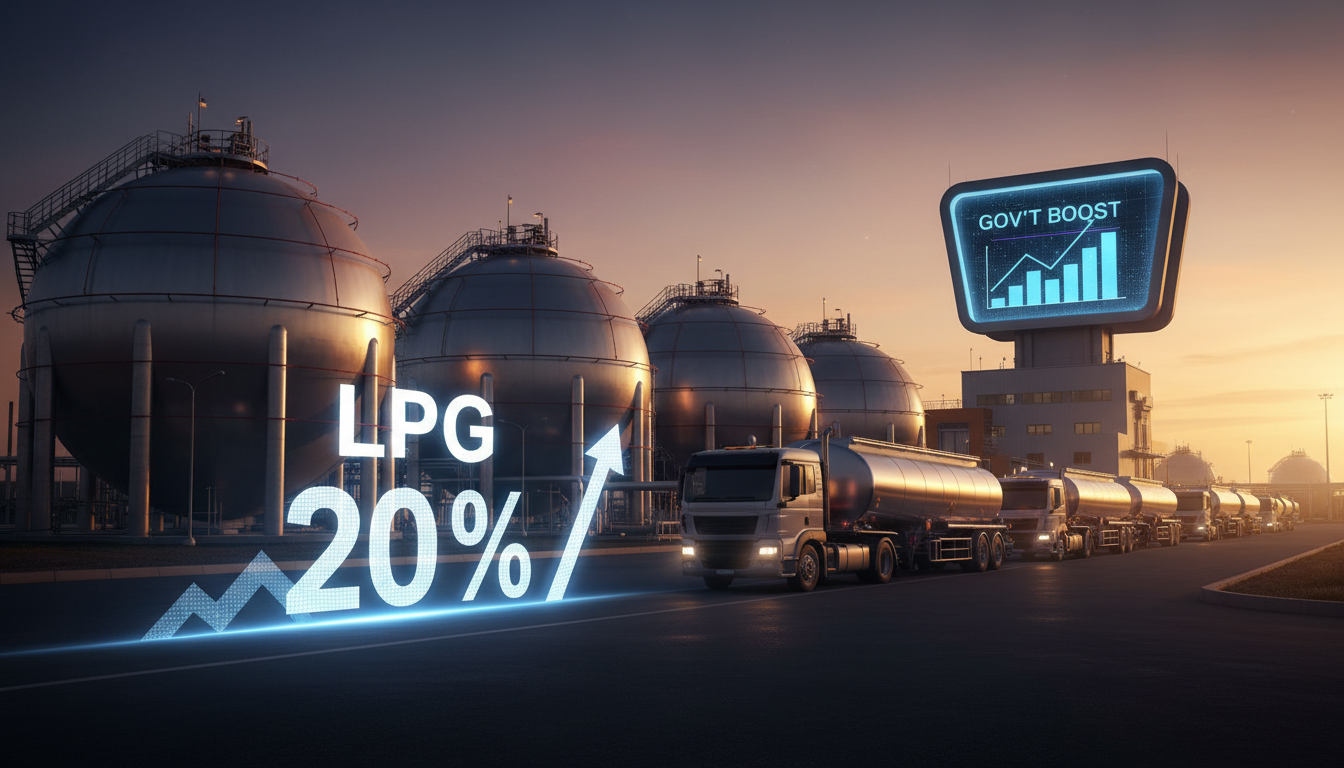
India’s Energy Policy Pivots to Industry: 20% Boost in LPG Allocation Fuels Critical Sectors
In a significant move poised to bolster India’s manufacturing backbone, the nation’s oil ministry has greenlit a substantial 20% increase in commercial liquefied petroleum gas (LPG) allocation, specifically targeting vital industrial segments. This strategic policy adjustment, effective immediately, prioritizes sectors such as steel, automobile, textile, dye, chemicals, and plastics, offering a crucial supply lifeline and signaling a renewed governmental focus on industrial output and economic stability. For investors tracking India’s energy landscape and its industrial growth trajectory, this decision, enacted on March 28, 2026, carries profound implications for operational efficiencies, production capacities, and ultimately, the profitability of key players within these energy-intensive domains.
Navigating Supply Volatility: The Path to Industrial Restoration
The latest directive emerges against a backdrop of recent energy market volatility and domestic supply pressures. Earlier this month, the Centre had made the difficult decision to curtail commercial and industrial LPG supplies, diverting resources to household consumers amidst acute supply concerns. These supply chain disruptions were largely attributed to broader geopolitical tensions, notably those stemming from the Iran conflict. While socially prudent, this prioritization of residential demand introduced significant operational challenges for businesses heavily reliant on LPG, impacting production schedules and increasing input costs across various sectors.
The intervening period saw a pragmatic, phased approach to restoring commercial access. The initial step involved reinstating 20% of pre-conflict consumption levels for essential services such as hospitals and the hospitality sector. This critical first phase aimed to ensure uninterrupted operation for services vital to public welfare. This was quickly followed by an additional 20% allocation for other crucial service providers including restaurants, factory canteens, and community kitchens, further underscoring a strategic, step-by-step return to normalcy for commercial users. This methodical restoration process has been closely watched by market analysts, looking for signs of stability and support for India’s commercial ecosystem.
Targeted Boost: Unpacking the New Allocation Strategy
Petroleum Secretary Neeraj Mittal’s recent communication to state governments confirms the latest expansion, clarifying the precise beneficiaries and the underlying rationale. “Additional allocation shall be given to industries, with priority to steel, automobile, textile, dye, chemicals and plastics, which are labour-intensive and support other essential sectors,” Mittal stated. This declaration highlights the government’s dual objectives: stimulating employment through labor-intensive industries and fortifying sectors that act as linchpins for the broader economy.
Mittal further emphasized a critical distinction: “Among these, priority shall be given to process industries or those requiring LPG for specialised heating purposes that cannot be substituted by natural gas.” This granular approach underscores a sophisticated understanding of industrial needs, acknowledging that for certain manufacturing processes, LPG is not merely an alternative fuel but an indispensable, non-substitutable input. This targeted relief aims to alleviate bottlenecks in critical supply chains, ensuring the smooth functioning and competitiveness of industries that contribute significantly to employment generation and India’s overall economic multipliers.
Sectoral Impact: Fueling India’s Industrial Giants
The implications for the designated priority sectors are considerable, offering potential stability and growth opportunities for investors. The steel industry, a foundational pillar of infrastructure development, often utilizes LPG for specific heating applications in furnaces and rolling mills where precise temperature control and clean combustion are paramount. A secure, increased supply directly translates to enhanced production continuity, reduced operational risks, and potentially lower reliance on costlier or less efficient alternative fuels, boosting profitability for steel manufacturers.
Similarly, the automobile sector, a major consumer of processed materials and a key economic driver, benefits immensely from stable energy inputs for manufacturing components, paint shops, and vehicle assembly. This allocation could stabilize energy input costs, a significant component of vehicle production, thereby improving margins and competitive positioning for automotive companies. The textile and dye industries, known for their energy-intensive processes, especially in dyeing, drying, and finishing, will find this allocation crucial for maintaining competitive production levels and meeting demanding export quotas, directly impacting the performance of listed textile firms.
For the chemicals and plastics sectors, LPG is not only a fuel source but also a critical feedstock and process agent. Ensuring its availability directly impacts manufacturing yields, product quality, and the overall cost structure, offering a competitive edge in both domestic and international markets. These sectors, collectively representing a substantial portion of India’s manufacturing GDP and export revenue, are now better positioned to capitalize on growing demand without the persistent threat of energy supply disruptions, presenting an attractive prospect for long-term investors.
Broader Energy Market Implications and Investment Outlook
From a broader energy market perspective, this escalation in industrial LPG demand signals a sustained uplift in India’s overall gas consumption profile. While domestic production of LPG exists, a significant portion of India’s requirement is met through imports. This renewed industrial appetite could lead to an uptick in global LPG purchases, potentially influencing international prices, shipping dynamics, and the profitability of energy trading firms. Furthermore, the explicit preference for LPG in ‘specialised heating purposes that cannot be substituted by natural gas’ underscores the distinct roles these energy sources play. It indicates that despite the overarching push for natural gas adoption in many sectors, LPG retains its unique and indispensable niche in specific industrial applications, preventing a full substitution and ensuring its continued market relevance. Investors in companies involved in LPG import, storage, distribution, and even specialized equipment for LPG usage could see positive ripple effects from this policy.
The Indian government’s sequential policy adjustments reflect a delicate balancing act between ensuring household energy security and fostering industrial growth. By gradually restoring and now significantly expanding commercial allocations, New Delhi demonstrates a clear commitment to supporting its manufacturing base while prudently managing potential public discontent over energy availability. This pragmatic approach offers a degree of predictability for businesses and investors, suggesting a responsive policy framework that adapts to evolving supply dynamics. For investors, this move derisks operations for many publicly traded companies in the steel, auto, textile, chemical, and plastics industries, improving their input stability and potentially enhancing their valuation. Energy sector investors should also monitor the domestic supply chain, infrastructure development for LPG storage and distribution, and the performance of public sector undertakings (PSUs) involved in the petroleum sector, which will be instrumental in executing this policy.
Future Monitoring and Strategic Considerations
Looking ahead, market participants should closely observe several key indicators to gauge the sustained impact and potential future direction of India’s energy policy. The stability of global LPG supplies and pricing will remain paramount, as will any further developments concerning the geopolitical factors that initially triggered the supply concerns. Domestically, the efficiency of the distribution network and the capacity of existing infrastructure to handle the increased industrial demand will be critical to realizing the full benefits of this allocation. Any further policy pronouncements regarding energy subsidies, environmental regulations impacting fuel choices, or incentives for industrial energy efficiency will also shape the long-term outlook for energy consumers and suppliers alike. This policy pivot, effective as of March 28, 2026, marks a significant juncture in India’s energy journey, reinforcing the nation’s resolve to power its industrial engine even amidst complex global and domestic energy dynamics.
