

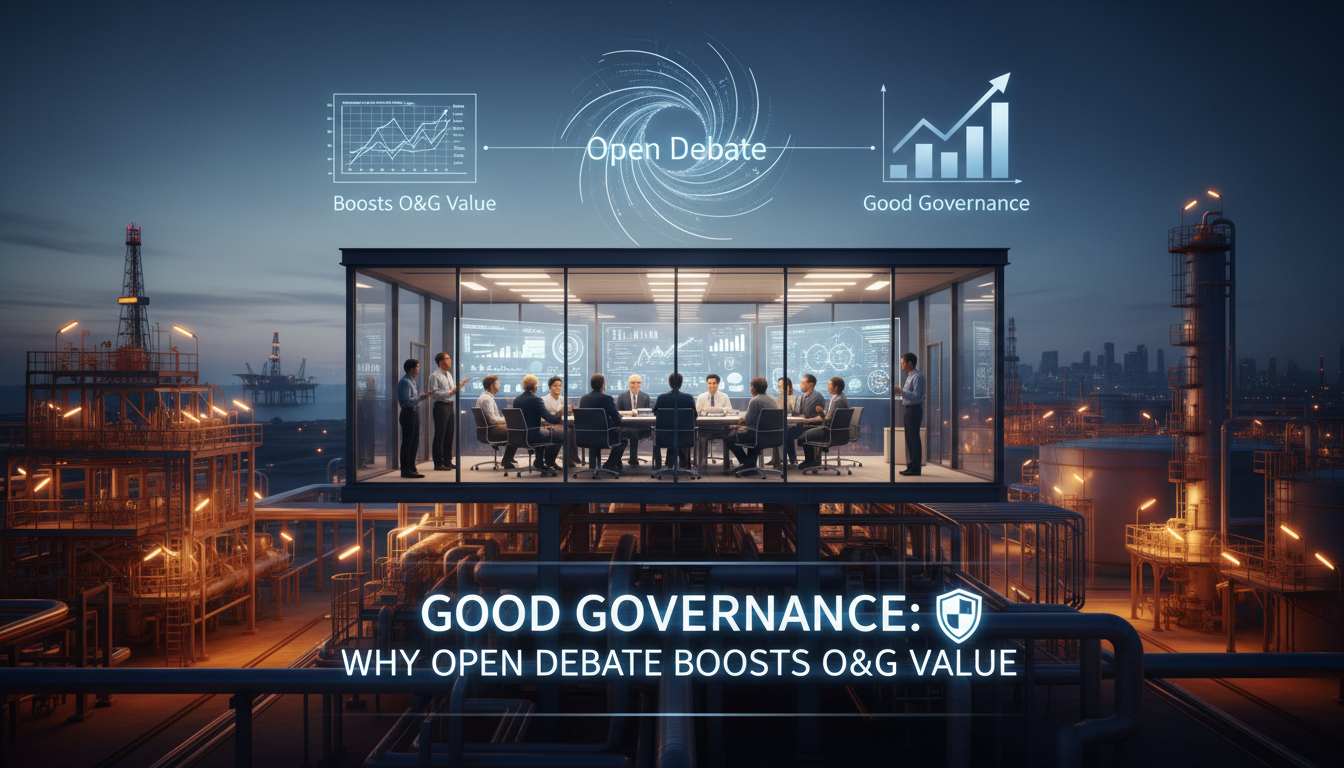
Unlocking Value: Why Agile Corporate Cultures, Borrowed from Tech, Are Imperative for Oil & Gas Investors
In today’s rapidly evolving global economy, the traditional metrics for evaluating investment potential are expanding. While reserves, production volumes, and capital expenditure remain foundational for the oil and gas sector, increasingly, forward-thinking investors are scrutinizing less tangible, yet equally critical, aspects: corporate culture and organizational agility. The ability of a company to foster innovation, openly address challenges, and adapt swiftly can be the decisive factor in navigating market volatility and driving sustainable shareholder returns. Lessons gleaned from high-growth tech companies, often perceived as distant from the energy sector, offer profound insights into building resilient and high-performing organizations.
Consider the paradigm of a leading artificial intelligence developer, Anthropic, a company that has rapidly ascended to prominence, commanding significant investor confidence. Its recent Series G funding round attracted an impressive $30 billion, valuing the company at a staggering $380 billion. This meteoric rise isn’t solely attributable to its technological prowess; a core component of its success lies in a radical, open corporate culture designed to maximize innovation and trust. At Anthropic, the hierarchy is intentionally flattened, and dissenting opinions are not just tolerated but actively encouraged, even when directed at the very top.
Sources within the company, such as Amol Avasare, Anthropic’s head of growth who joined in 2024, describe an environment where employees maintain personal “Slack notebooks” – open digital forums akin to individual Twitter feeds. Here, staff, including CEO Dario Amodei, share their thoughts, project updates, and even direct critiques. Avasare recounted an instance where an employee publicly challenged Amodei in his notebook channel following an all-hands meeting, leading to a robust company-wide debate. This isn’t an isolated event; it’s a foundational tenet of their culture: “It’s encouraged to go to leadership and disagree with them, challenge them publicly, and I think that just leads to a level of trust,” Avasare noted. This philosophy, where transparency and constructive confrontation are celebrated, empowers employees and fosters a dynamic environment where ideas can be rigorously tested and refined.
The Imperative for Oil & Gas: Embracing Agility in a Volatile Market
For investors focused on the oil and gas sector, understanding these cultural dynamics is no longer a peripheral concern. The energy landscape is in constant flux, marked by commodity price swings, geopolitical uncertainties, and the accelerating energy transition. Companies that maintain rigid, top-down command structures risk being slow to adapt, stifling innovation, and making costly strategic missteps. The very principles that drive success in the tech world—open communication, challenging assumptions, and rapid iteration—are becoming increasingly vital for energy producers, refiners, and midstream operators.
Firstly, in an industry undergoing profound technological transformation, from advanced seismic imaging and AI-driven reservoir management to carbon capture and hydrogen infrastructure, an open culture fosters innovation. Employees who feel empowered to share unconventional ideas or question established practices are more likely to uncover efficiencies, develop breakthrough technologies, and identify new market opportunities. This direct feedback loop can accelerate problem-solving, optimize operational efficiency in upstream exploration and production, and enhance decision-making in capital-intensive projects.
Secondly, robust internal challenge mechanisms can act as a critical safeguard against groupthink, particularly in the face of significant capital allocation decisions. The oil and gas sector is characterized by immense investments with long payback periods. A culture where executives are openly challenged by their teams can lead to more thorough due diligence, better risk assessments, and ultimately, more resilient investment portfolios. Preventing a costly drilling mistake or an ill-advised expansion could directly translate into preserved shareholder value and improved financial performance.
Beyond Hierarchy: Building Trust and Attracting Top Talent
Moreover, the ability to attract and retain top talent is a growing concern for the energy industry. As the workforce evolves, the brightest engineers, data scientists, and strategists are increasingly drawn to companies that offer engaging, transparent, and empowering work environments. Emulating the cultural models of successful tech companies, which prioritize open communication and employee autonomy, positions oil and gas firms to compete more effectively for the human capital essential for future success. A company that demonstrates a genuine commitment to hearing and valuing every voice builds a stronger, more committed workforce, which directly impacts long-term operational excellence and innovation.
This trend of dissolving strict hierarchies and encouraging open dialogue isn’t unique to Anthropic. Industry giants like Airbnb and Netflix have long championed cultures where employees are encouraged to speak up early and challenge leadership decisions. Elon Musk, in a well-known 2018 memo to Tesla employees, explicitly emphasized that “Communication should travel via the shortest path necessary to get the job done, not through the ‘chain of command.'” He even warned that any manager enforcing rigid chain-of-command communication would “soon find themselves working elsewhere.” These examples from diverse sectors underscore a universal truth: agility and innovation thrive in environments of trust and direct communication.
For discerning investors evaluating oil and gas companies, it is prudent to look beyond balance sheets and production forecasts. In an era of rapid change, the health of a company’s internal culture — its capacity for open debate, its willingness to embrace challenge, and its commitment to transparency — is a powerful indicator of its long-term viability and potential for superior returns. Companies that actively cultivate such progressive, empowering cultures are likely to be better equipped to navigate the complexities of the energy transition, capitalize on technological advancements, and ultimately, deliver sustainable value to their shareholders.
