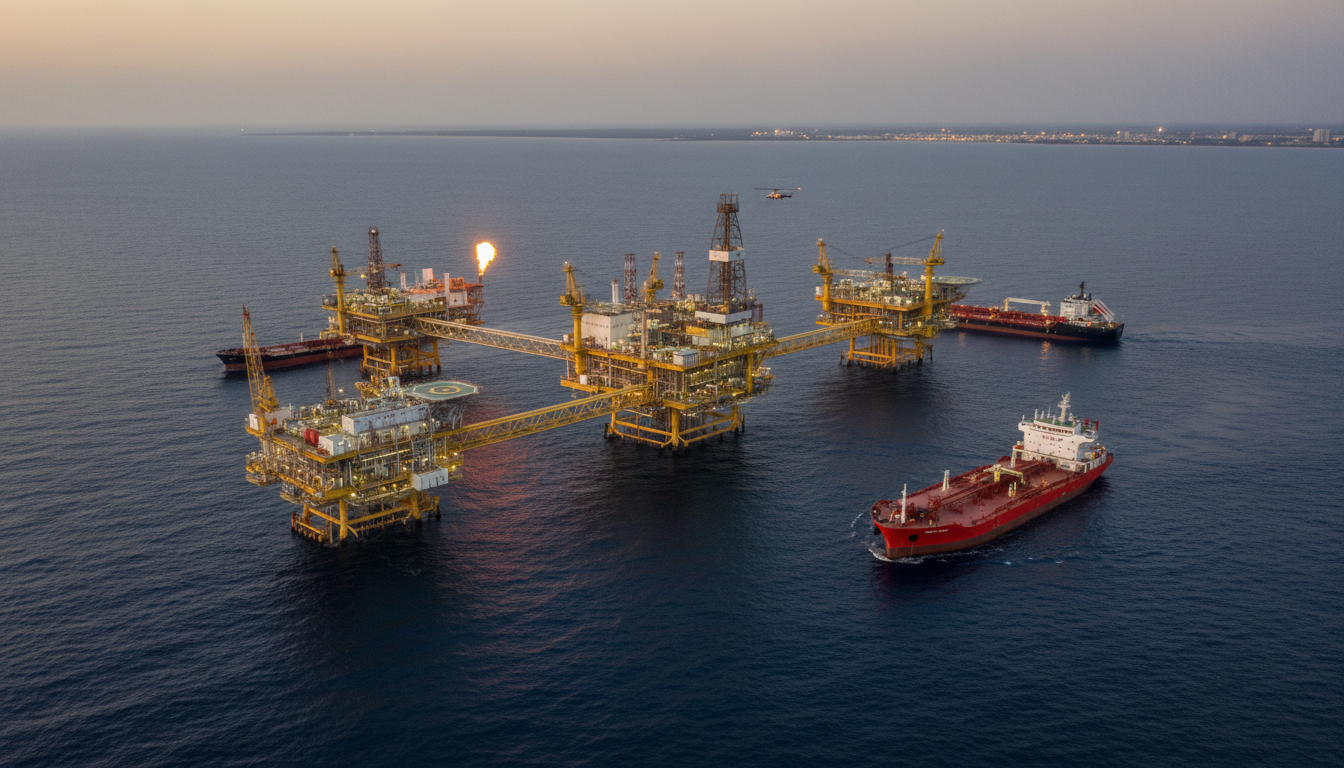
Ghana is making a decisive move to solidify its position in the global energy landscape, announcing a significant $3.5 billion investment drive aimed at bolstering its offshore hydrocarbon production. This strategic initiative, spearheaded by Minister for Energy & Green Transition John Adbulai Jinapor, signals a clear commitment to revitalizing upstream activity and attracting fresh capital into key offshore blocks. For investors closely watching the evolving dynamics of African energy markets, Ghana’s dual strategy—pursuing both hydrocarbon expansion and a robust energy transition—presents a compelling, albeit complex, opportunity.
Ghana’s Upstream Push: A $3.5 Billion Bet on Offshore Potential
The core of Ghana’s immediate energy strategy centers on a substantial $3.5 billion investment targeting the prolific Jubilee/TEN and Offshore Cape Three Points (OCTP) fields. This capital injection, secured in early 2026 with existing partners, is designed to reverse production declines and expand proven reserves through coordinated development efforts. In a market where capital allocation to new upstream projects is increasingly scrutinized, Ghana’s ability to secure such a significant commitment underscores the perceived value and geological prospectivity of these assets.
This renewed focus on upstream development comes at a critical juncture for the global oil market. As of today, Brent Crude trades at $99.13, experiencing a marginal 0.22% decline within a daily range of $97.55 to $101.32. WTI Crude, meanwhile, sits at $94.4, down 1.51% today, trading between $92.68 and $97.85. While these prices remain robust, providing a healthy margin for offshore projects, the 14-day trend for Brent shows a notable shift, dropping from $109.27 on April 7th to $99.78 on April 24th – a nearly 8.7% decrease. This recent cooling in prices, following a period of elevated volatility, suggests that Ghana’s move to secure investment in early 2026 was well-timed, aiming to capitalize on strong sentiment before potential market shifts. Investors are now keenly observing whether this $3.5 billion commitment can deliver tangible production increases and enhance Ghana’s energy export capabilities, particularly given the recent softening in crude benchmarks.
Diversifying Beyond the Barrel: Ghana’s Green Transition and Nuclear Ambitions
While Ghana is aggressively pursuing upstream oil and gas growth, the government’s long-term vision extends far beyond hydrocarbons. Minister Jinapor is simultaneously championing a comprehensive energy transition agenda. This includes ambitious plans to procure 200 MW of battery energy storage systems (BESS) to enhance grid stability and better integrate renewable generation, thereby reducing reliance on thermal power during peak demand. Initiatives like the Scaling-Up Renewable Energy Program are also underway, aiming to electrify off-grid communities and expand clean energy access to underserved populations. This dual approach signals a pragmatic understanding of both current energy needs and future sustainability demands, a factor that can significantly de-risk long-term investments in the region.
Adding another layer of diversification, Ghana is actively exploring nuclear power as a foundational component of its future energy mix. The country has made significant progress in the early stages of nuclear planning, with the International Atomic Energy Agency (IAEA) completing a crucial safety review in 2025. This review identified both a primary and an alternative site for Ghana’s first nuclear power station, marking a major milestone towards eventual construction. For investors, this commitment to baseload diversification through zero-carbon sources illustrates a sophisticated long-term energy strategy, aiming for energy security and reduced emissions while hedging against the eventual decline of fossil fuel demand.
Investor Sentiment: Balancing Immediate Returns with Long-Term Shifts
Our proprietary data indicates that investors are grappling with several key questions that directly intersect with Ghana’s energy strategy. Queries regarding the potential for Brent to drop below $80 or surge above $120 highlight the persistent uncertainty surrounding oil price stability. Ghana’s $3.5 billion upstream investment suggests a belief in sustained demand and profitable operating margins within the current price bandwidth, even with Brent hovering just under $100. Furthermore, the question of “What’s the impact of EV adoption on long-term oil demand projections?” is front and center for many. This is precisely where Ghana’s diversified approach becomes particularly attractive. By simultaneously investing in offshore oil and gas while aggressively pursuing renewables and nuclear power, Ghana offers a nuanced play for investors. It caters to the immediate demand for hydrocarbons while strategically positioning itself for a future where EV adoption and broader decarbonization efforts reshape the energy landscape. This dual strategy helps mitigate the long-term demand risk associated with pure-play fossil fuel investments, offering a more resilient investment thesis.
Navigating Future Catalysts: Ghana’s Outlook Amidst Upcoming Market Events
Ghana’s ambitious energy plans will unfold within a dynamic global energy market, influenced by a series of upcoming events that investors should closely monitor. The API Weekly Crude Inventory report on April 28th and May 5th, alongside the EIA Weekly Petroleum Status Report on April 29th and May 6th, will provide critical insights into short-term supply-demand balances in major economies. Tightening inventories could bolster crude prices, making Ghana’s offshore projects even more attractive. Conversely, unexpected builds might temper enthusiasm. Similarly, the Baker Hughes Rig Count on May 1st and May 8th will offer a gauge of drilling activity, indicating future supply trends that could impact pricing for Ghana’s exports.
Crucially, the EIA Short-Term Energy Outlook, due on May 2nd, will provide updated demand and supply forecasts, offering a macro context for Ghana’s long-term investment decisions. Ghana’s commitment to a $3.5 billion expansion in its core producing assets, coupled with its forward-thinking approach to renewables and nuclear, positions the nation to navigate these market fluctuations. Investors will be looking for signs that Ghana’s strategic investments are yielding tangible results in terms of increased production and reserve growth, ensuring that the country remains a key player in West Africa’s energy future while progressively transitioning towards a more diversified and sustainable energy mix.


