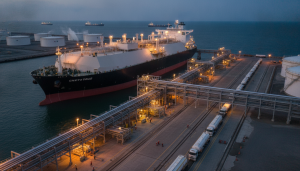
Geopolitical Risk and Europe’s Fragile Energy Grid
The recent power outage in Berlin, affecting tens of thousands of homes and businesses in near-freezing temperatures, serves as a stark reminder of the escalating and multi-faceted threats to global energy infrastructure. Attributed by local officials to an arson attack by the left-wing extremist group Vulkangruppe, the incident near the Lichterfelde power station over the Teltow Canal spotlights vulnerabilities far beyond traditional geopolitical flashpoints. While initial reports indicated around 45,000 households and 2,200 commercial entities were affected, with approximately 35,000 households and 1,900 businesses still awaiting full restoration, the disruption’s real significance lies in its implications for energy security and investor confidence across the European continent. This is not an isolated event; the same group previously claimed responsibility for a 2024 attack on the power supply to Tesla’s gigafactory near Berlin, forcing a temporary halt in production. Such incidents, characterized by Berlin’s interior affairs minister as “left-wing terrorism,” underscore a growing and insidious risk: that ideologically driven actors are increasingly capable of inflicting significant economic and social damage by targeting critical energy assets. For oil and gas investors, this emerging threat vector demands a re-evaluation of risk premiums, particularly for assets situated in regions with heightened social or political unrest, regardless of traditional supply-demand fundamentals.
Current Market Snapshot: Awaiting Geopolitical Reflection
Despite the concerning developments in Germany, the immediate reaction in the global crude markets has been relatively subdued, suggesting that broader macroeconomic factors and supply-demand balances currently hold more sway. As of today, Brent crude trades at $89.99 per barrel, showing a marginal dip of 0.49% within a day range of $93.87 to $95.69. Similarly, WTI crude is priced at $86.4, down 1.17%, with its daily range between $85.5 and $87.49. This current softness follows a more pronounced downtrend over the past two weeks, where Brent crude retreated significantly from $118.35 on March 31st to $94.86 by April 20th, representing a substantial decline of nearly 20%. Such a steep correction indicates that market participants have been more focused on broader concerns like global economic slowdowns, interest rate trajectories, and inventory builds rather than isolated infrastructure attacks, however impactful locally. Gasoline prices, currently at $3.03 per gallon, remain relatively stable, reflecting a market that, for now, is absorbing regional disruptions without a widespread panic. Investors are keenly observing these dynamics, with many asking about the near-term direction of WTI. While the Berlin incident reinforces the potential for supply disruptions, its localized nature means it’s not yet triggering a systemic risk premium across the entire energy complex, but it certainly adds to the tapestry of uncertainty.
Forward Catalysts: Navigating Upcoming Market-Moving Events
The next two weeks are packed with critical events that will undoubtedly shape the near-term trajectory of oil and gas prices, providing investors with much-needed clarity amidst the current geopolitical backdrop. Tomorrow, April 21st, the OPEC+ Joint Ministerial Monitoring Committee (JMMC) meeting is scheduled. This gathering will be closely watched for any signals regarding compliance with existing production cuts or potential adjustments to future output strategies. Any indication of further tightening, or conversely, a loosening of quotas, could significantly impact market sentiment and prices. Following closely, the EIA Weekly Petroleum Status Report on April 22nd, and again on April 29th, will offer crucial insights into U.S. crude oil and product inventories, refinery utilization, and demand indicators. These reports are often immediate market movers, providing a real-time pulse of the world’s largest consumer. Complementing these are the API Weekly Crude Inventory reports on April 28th and May 5th, which provide an early look at inventory trends. On the supply side, the Baker Hughes Rig Count reports on April 24th and May 1st will shed light on North American drilling activity, hinting at future production capabilities. Finally, the EIA Short-Term Energy Outlook on May 2nd will offer a more comprehensive forecast for supply, demand, and prices, providing a valuable macro perspective for investors seeking to understand where oil prices might settle by the end of 2026. These scheduled events, rather than the isolated Berlin incident, are expected to be the primary drivers of market direction in the immediate future.
Investment Implications and Portfolio Resilience
The incident in Berlin, while not a direct oil supply disruption, serves as a powerful illustration of the increasing complexity of risk in the energy sector. For investors, this necessitates a proactive approach to portfolio construction, emphasizing resilience and diversification. Companies with robust cybersecurity measures, geographically diversified assets, and strong community engagement in their operating regions may prove more resilient to targeted attacks, whether by state-sponsored actors or extremist groups. The Vulkangruppe’s stated motivation, citing the climate crisis and artificial intelligence infrastructure, also highlights the growing intersection of environmental activism and infrastructure vulnerability. This suggests that investments in renewable energy infrastructure, while critical for the energy transition, are not immune to such risks and require similar security considerations. Furthermore, the broader geopolitical landscape, exacerbated by these localized disruptions, underscores the continued importance of natural gas as a transition fuel, particularly in Europe, where the imperative for energy security clashes with decarbonization goals. Investors asking about the long-term price of oil or the performance of specific companies like Repsol in this volatile environment should consider not just traditional supply-demand models but also the increasing “risk premium” associated with infrastructure vulnerability and geopolitical instability. Diversification across traditional oil and gas, LNG, and strategically secured renewable assets, coupled with a focus on companies with strong ESG credentials and operational security, will be paramount for navigating this evolving energy investment landscape. The future of energy investing is less about predicting a single price point and more about building a portfolio capable of withstanding a multitude of unforeseen disruptions.