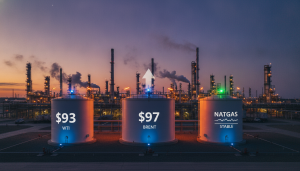
The global oil and gas market currently navigates a complex confluence of geopolitical machinations and evolving macroeconomic indicators. Investors are closely scrutinizing diplomatic developments that could reshape global energy flows, alongside critical economic data points influencing demand projections. This dynamic environment demands a nuanced understanding of both immediate market reactions and forward-looking catalysts, particularly given the recent volatility observed in crude benchmarks.
Geopolitical Maneuvers and Their Impact on Oil Stability
Recent diplomatic engagements underscore the significant role geopolitics plays in shaping crude oil market stability. Discussions involving Ukrainian President Volodymyr Zelenskiy, US President Donald Trump, and European allies at the White House are particularly noteworthy. The prospect of bilateral and trilateral meetings, potentially including Russian President Vladimir Putin, introduces a new dimension to the conflict. A key takeaway is Trump’s commitment to US security guarantees for Ukraine within any peace agreement, alongside a strategic pivot towards immediate negotiation rather than traditional cease-and-desist approaches, arguing ceasefires can be counterproductive.
From an oil market perspective, the implications are profound. Russia, as the world’s third-largest oil producer, exerts substantial influence on global supply dynamics. A successful peace resolution could inject a much-needed dose of stability into the market, potentially easing fears of sustained supply disruptions. Conversely, a failure to secure a deal could trigger expanded sanctions on Russian oil buyers, leading to increased market volatility and a potential upward pressure on prices due to constrained supply options and heightened risk premiums. Investors are keenly aware that these diplomatic outcomes will directly translate into either reduced or elevated geopolitical risk in the coming months.
Current Market Dynamics and Investor Sentiment
The crude oil market has experienced notable shifts, reflecting a mix of geopolitical uncertainty and broader economic sentiment. As of today, April 18, 2026, Brent crude is trading at $90.38 per barrel, marking a significant 9.07% decline within the day’s range of $86.08 to $98.97. Similarly, West Texas Intermediate (WTI) crude has seen a sharp downturn, falling 9.41% to $82.59, moving within a daily range of $78.97 to $90.34. This aggressive daily correction follows a broader trend; Brent crude has depreciated by 18.5% over the past two weeks, dropping from $112.78 on March 30 to $91.87 just yesterday.
This rapid depreciation suggests that market participants are either unwinding previous risk premiums or reacting to emerging signals of weakening demand or increased supply confidence. The steep daily drop could be attributed to a number of factors, including profit-taking after recent peaks, a perceived de-escalation of certain geopolitical tensions, or growing concerns over global economic slowdowns impacting future demand. The recent price action clearly demonstrates the market’s heightened sensitivity to even subtle shifts in the supply-demand balance and geopolitical outlook, challenging any short-term upward momentum observed earlier in the week.
Upcoming Supply Decisions and Long-Term Price Outlook
A critical focus for oil and gas investors this week is the upcoming series of OPEC+ meetings. The Joint Ministerial Monitoring Committee (JMMC) convenes on April 18th, followed by the Full Ministerial Meeting on April 19th. These gatherings are paramount as investors are actively asking about “OPEC+ current production quotas” and seeking clarity on the cartel’s strategy for the remainder of 2026. Any reaffirmation of current production cuts, or even a surprise adjustment, will send strong signals regarding global supply intentions.
These decisions will directly influence the supply side of the equation and are a major variable in answering the common investor query: “What do you predict the price of oil per barrel will be by end of 2026?” While a definitive forecast is challenging, a continuation of tight supply management by OPEC+ would likely provide a floor for prices, potentially mitigating further significant downturns. Conversely, any indication of increased output could accelerate the recent price declines, especially if global demand growth appears sluggish. The outcomes of these meetings will set the tone for market expectations through the second quarter and beyond, making them indispensable calendar events for all energy sector participants.
Economic Indicators and Demand Projections
Beyond the geopolitical stage, macroeconomic data continues to play a vital role in shaping the demand outlook for crude oil. While the source mentions Canadian CPI inflation data as being “in focus,” its specific impact on global oil prices is typically indirect, influencing central bank policies and, consequently, economic growth. However, the broader picture of global inflation and interest rate trajectories is crucial for assessing industrial activity and consumer spending, which are direct drivers of oil demand.
Investors will be closely monitoring a series of upcoming reports that offer more direct insights into petroleum demand and inventory levels. The API Weekly Crude Inventory report on April 21st (and again on April 28th) and the EIA Weekly Petroleum Status Report on April 22nd (and April 29th) will provide critical short-term data points on U.S. crude stocks, gasoline consumption, and refinery activity. These reports are key indicators of real-time demand strength and supply-side adjustments. Furthermore, the Baker Hughes Rig Count, scheduled for April 24th and May 1st, offers a forward look into North American drilling activity, providing crucial context for future domestic supply capacity and serving as a proxy for the confidence of exploration and production companies in the current price environment.