

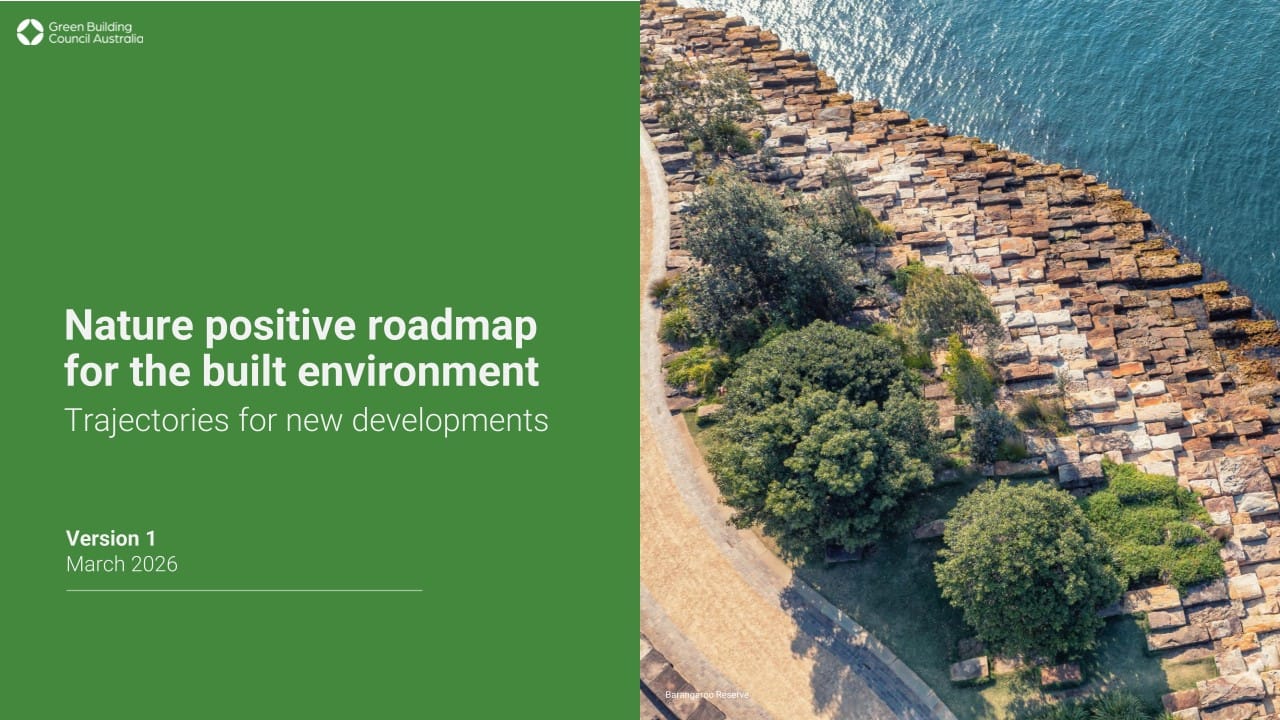
New roadmap aligns Australia’s built environment with the Kunming–Montreal Global Biodiversity Framework, setting milestones through 2050
Introduces time-bound targets across 2028, 2030, and 2035 to guide developers, investors, and planners
Embeds circularity, low-impact materials, and ecosystem restoration into future project expectations
The Green Building Council of Australia has released a comprehensive nature roadmap that reframes how the built environment engages with biodiversity, shifting the sector from harm reduction to active restoration and regeneration.
The roadmap sets out clear principles, targets, and timelines designed to guide planning, design, and construction decisions as expectations around nature intensify across policy, finance, and development.
“Nature is playing a much more central role in how developments are planned, delivered and assessed,” said GBCA Chief Executive Officer Davina Rooney. “This roadmap sets out a level of detail and commitment we have not seen before, with clear targets and timeframes that show what needs to change and allow progress to be tracked.”

The framework responds to mounting global and domestic pressure for the property sector to address biodiversity loss alongside carbon reduction, positioning nature as a core design and investment consideration rather than a secondary compliance issue.
Translating Global Biodiversity Policy Into Practice
At its core, the roadmap operationalises the Kunming–Montreal Global Biodiversity Framework for the Australian built environment, converting high-level global commitments into project-level guidance.
GBCA Chief Impact Officer Jorge Chapa described the roadmap as a bridge between ambition and execution. “This roadmap provides a clear direction of travel for the sector and translates global biodiversity ambitions into practical guidance for the built environment,” Mr Chapa said. “It shows how industry can start acting today while also preparing for the standards that will evolve over time, including through future updates to Green Star.”
The roadmap identifies five systemic challenges shaping nature outcomes: fragmented policy settings, development pressure in biodiverse areas, low circularity, resource-intensive construction practices, and chronic underinvestment in nature.
In response, it sets out five core principles to guide all new developments. These include preventing further nature loss, restoring ecosystems, increasing circularity and urban infill, prioritising lower-impact materials, and scaling investment in nature restoration.
Each principle is tied to measurable targets across near, medium, and long-term horizons, with defined milestones in 2028, 2030, and 2035, and a longer-term trajectory extending to 2050.
Circularity And Resource Efficiency Move To The Fore
A central pillar of the roadmap is the integration of circular economy principles into the built environment, aimed at reducing pressure on natural systems through smarter material use and waste reduction.
“One of the key insights is the need to reduce pressure on nature by increasing circularity across the built environment – reusing materials, reducing waste and supporting more compact urban development,” Mr Chapa said. “These priorities are already being embedded in Green Star, including new circularity credits in Green Star Buildings v1.1 that support better use of materials and resources.”
This alignment with Green Star signals a tightening of sustainability benchmarks across Australia’s property sector, with implications for developers, supply chains, and financiers assessing long-term asset performance.
RELATED ARTICLE: Siemens Reports Strong Progress Toward 2030 Sustainability Goals
Finance And Global Alignment Gain Traction
The roadmap has been developed over four years, incorporating input from industry, government, finance institutions, and First Nations stakeholders, alongside guidance from GBCA’s Nature Advisory Panel.
Its structure and alignment with global frameworks have already drawn attention from international and finance-aligned organisations.
“GBCA’s Nature Positive Roadmap is a strong example of how global biodiversity ambitions can be translated into clear, practical guidance for industry,” said Cristina Gamboa, CEO of the World Green Building Council. “By setting specific, time-bound targets across five areas recognising the multiple ways developments interact with nature, this work offers a valuable reference point for Australia’s built environment — and contributes to the growing body of leadership emerging across Green Building Councils globally.”

From a capital markets perspective, the roadmap also provides a clearer reference point for integrating nature into investment decisions.
“It provides a useful reference point for investors with a particular interest in nature-related considerations and supports current finance sector practice,” said Nicole Yazbek-Martin, Executive Manager at the Australian Sustainable Finance Institute.

What Executives And Investors Should Watch
For developers, the roadmap introduces a forward-looking compliance trajectory, allowing projects to be planned against evolving expectations rather than reacting to regulatory shifts.
For investors, it strengthens the case for integrating biodiversity risk and opportunity into asset valuation, particularly as disclosure frameworks and sustainable finance taxonomies expand.
For policymakers, it offers a structured pathway to align planning systems with global biodiversity targets, reducing fragmentation across jurisdictions.
A Long-Term Shift In How Cities Are Built
The roadmap positions nature as a defining factor in the next phase of urban development, alongside decarbonisation and resilience. Its emphasis on measurable targets, circularity, and ecosystem restoration reflects a broader shift in how the built environment is expected to contribute to global sustainability goals.
“This will continue to evolve as we learn from delivery and work together to improve outcomes across the sector,” Ms Rooney said.
As biodiversity climbs the global policy and finance agenda, frameworks like GBCA’s are likely to shape not just Australian development standards, but the international convergence of nature-positive building practices.
Follow ESG News on LinkedIn
