

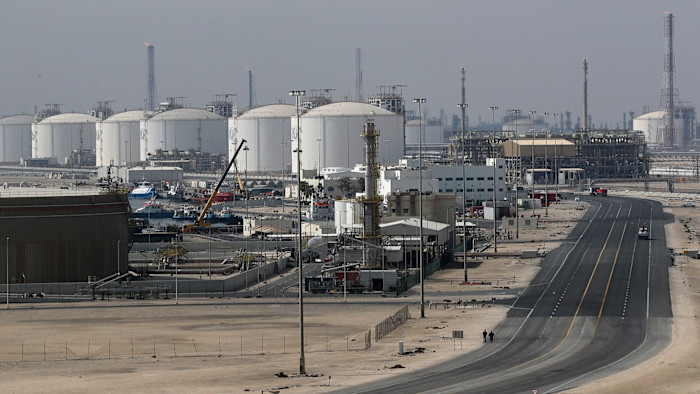
The threat of a new natural gas crisis sent prices soaring by almost 50 per cent on Monday after Qatar was forced to halt production following attacks from Iran.
The unprecedented move by QatarEnergy, the world’s largest LNG company, alarmed traders in Europe and Asia and poses the first concrete threat to the global economy from the widening conflict in the Middle East.
The shutdown, which followed Iran targeting Qatar’s facilities with drone strikes, means the loss of almost 20 per cent of global LNG supplies at a time when the market is still recovering from the Russia-inflicted energy crisis in 2022.
The European gas benchmark, TTF, surged nearly 50 per cent to €47.80 per MWh, the biggest daily move in more than four years. It was later trading around €44.70 per MWh
Oil prices rose about 8 per cent to $78.30 a barrel because of a near-complete halt of shipments through the Strait of Hormuz. Asian gas prices also surged, while the rise in the US was more limited owing to domestic production.
Though European prices remain well below their peak in 2022, when they soared almost 10-fold after Russian President Vladimir Putin shut off the majority of Russian supplies, the pace of the jump will nevertheless unnerve politicians and central bankers.
Consumers and investors are still reeling from the inflationary shock that began four years ago, which led to the first prolonged rise in interest rates since the 2008 financial crisis.

“Global gas markets could face a crisis well beyond the scale of oil markets,” said Saul Kavonic, an analyst at MST Financial.
“Europe is facing unusually low stocks post winter, and much of the new US supply growth has yet to come online,” he added.
Analysts warned that a prolonged loss of natural gas supplies from the Middle East could reach 120bn cubic metres a year, greater than the total that Europe lost when Russia shut off pipelines in the wake of its full-scale invasion of Ukraine. Israel has also shut down two major gasfields.
“The drop in Russia gas pipeline supplies in 2022 was around 80bn cubic metres,” said Anne-Sophie Corbeau, at Columbia University’s Center on Global Energy Policy. “This is a bigger volume, but crucially it obviously depends on how long this lasts.”
Qatar relies on hydrocarbon sales, primarily LNG, for about 60 per cent of its GDP. Shell, ExxonMobil, TotalEnergies and ConocoPhillips are all investors in Qatar’s LNG facilities.
“A production halt would endanger every region, as QatarEnergy provides critical energy to over 120 countries,” said one person close to Qatar’s decision, adding that there would be a “cascade of economic harm”.
India relies on Qatar for more than 45 per cent of its LNG supply, while 30 per cent of China’s imports come from the Gulf state, according to energy data company Kpler.
The loss of Qatari supplies will force Asian buyers into competition with Europe for the LNG cargoes on which both regions have become increasingly reliant as a means of replacing Russian supplies.
Recommended

Traders and analysts warned that Tehran was increasingly targeting energy infrastructure across the Gulf, while the conflict spread to additional countries including Lebanon and even Cyprus, where a UK RAF air base was targeted with drones.
“The implications of this conflict for the world economy depend on the flow of oil and gas through the Strait of Hormuz,” said Norbert Rücker, head of economics at Julius Baer. “The most feared scenario is not its closure, but serious damage to the region’s key oil and gas infrastructure.”
On Monday, Saudi Arabia also shut its oil-refining facility of Ras Tanura following an Iranian attack.
Ali Shihabi, a Saudi commentator close to the royal court, warned it was a “huge escalation”.
“Saudi Arabia, which wanted to stay out of the war, will have to decide how to respond,” Shihabi said.
In a sign of investors’ fears over the deepening conflict, the gold price rose and global stocks fell, with the S&P 500 and the tech-heavy Nasdaq both dropping 0.6 per cent in early trading on Wall Street.
The Stoxx Europe 600, Europe’s benchmark index, fell 1.8 per cent, led by declines in airlines, hotel groups and carmakers.
Gold was up 0.2 per cent to $5,283 a troy ounce, having jumped 2.5 per cent in earlier trading as investors sought haven assets. The dollar rose 1.1 per cent against a basket of other major currencies.
The turmoil in energy markets came as the war entered its third day, with hostilities escalating across the region. US-Israeli strikes on Iran continued, while Israel began targeting Hizbollah across Lebanon.
Oil and LNG tankers waited at the mouth of the Strait of Hormuz, the narrow waterway at the mouth of the Gulf through which a fifth of the world’s oil and gas flows.
Shipping through the strait has slowed to a standstill after insurers began withdrawing coverage and a number of vessels were attacked on Sunday, including a tanker chartered by oil company Saudi Aramco that was carrying 500,000 barrels of gasoline.
