

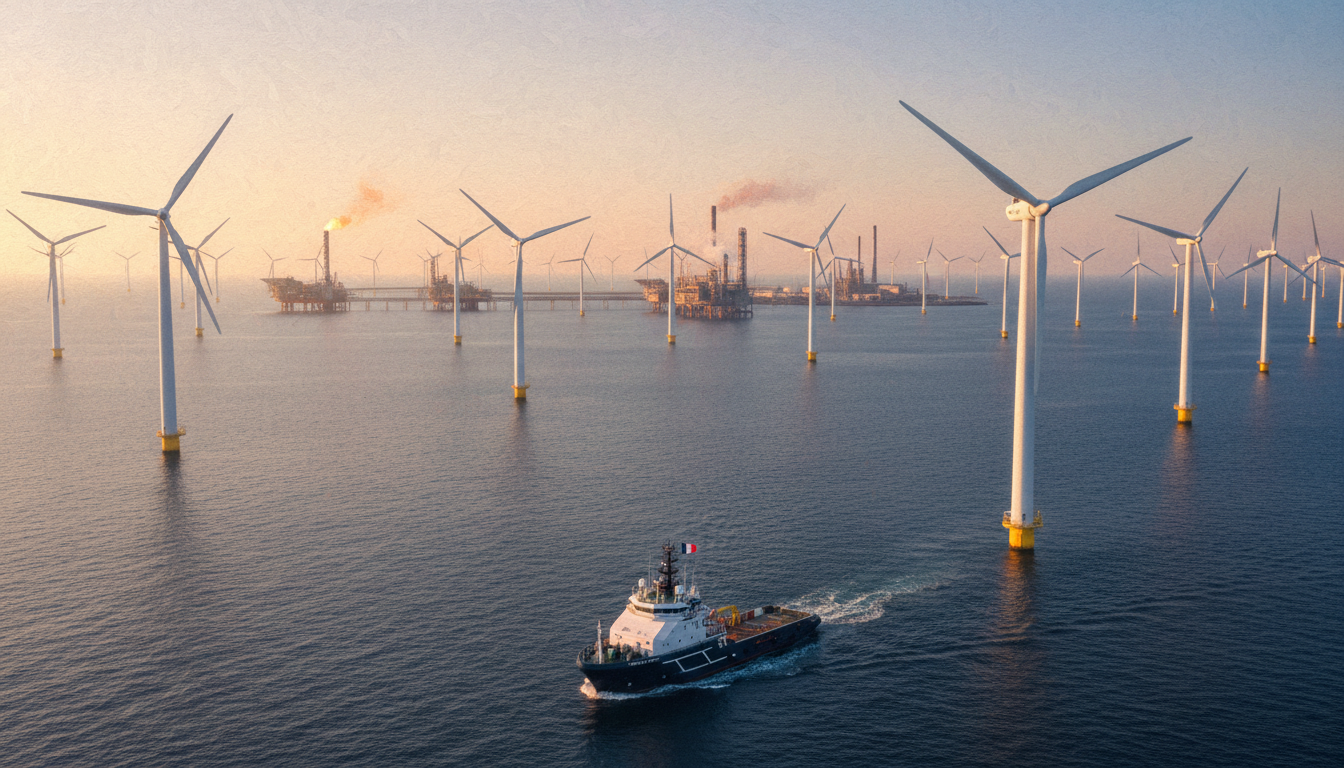
France Accelerates Green Energy Push: A Strategic Shift to Bolster Sovereignty and Industry
Paris is making a bold play to redefine its energy future, launching an ambitious 12-gigawatt renewable energy tender program designed to dramatically cut reliance on volatile fossil fuel imports and cement national energy independence. This substantial investment, encompassing offshore wind, solar, and onshore wind projects, signals a decisive strategic pivot that merges decarbonization goals with robust industrial policy, resonating deeply within the global energy investment landscape.
The comprehensive initiative includes seven significant offshore wind projects, slated to deliver a formidable 10 GW of capacity. Complementing this, 1.2 GW of solar and 0.8 GW of onshore wind capacity are also on the table. This move comes after a two-year hiatus, during which political disagreements over renewable financing had stalled progress. The renewed push highlights a powerful resolve to overcome fiscal hurdles and accelerate climate commitments in Europe’s second-largest economy.
The timing of these tenders is acutely strategic. Ongoing global geopolitical tensions, including critical disruptions to key energy shipping lanes such as the Strait of Hormuz, continue to exert upward pressure on international energy prices. European markets, already grappling with supply uncertainties, are bracing for heightened volatility in the coming months. For investors closely tracking the fossil fuel sector, France’s proactive stance offers a glimpse into how major economies are actively de-risking their exposure to these traditional energy market dynamics.
Geopolitical Resilience: France’s New Energy Doctrine
Finance Minister Roland Lescure underscored the tenders as integral to a broader, long-term strategic shift. He articulated France’s unique position, stating, “Thanks to the energy policies France has adopted over the past 50 years, notably developing our nuclear fleet, we entered the current crisis better prepared and less exposed than Japan. The idea now is to continue on this path and accelerate.” This statement frames the current renewable drive not just as an environmental imperative, but as a critical extension of France’s decades-long commitment to energy self-sufficiency.
For an oil and gas market accustomed to geopolitical shocks influencing price swings and supply chain stability, France’s calculated move to diversify its energy mix represents a direct challenge to the traditional energy paradigm. By front-loading renewable capacity, the nation aims to insulate its economy and consumers from external shocks that routinely destabilize global fossil fuel markets, thereby enhancing its energy security and mitigating price volatility.
Forging a “Made in Europe” Energy Supply Chain
Beyond the sheer scale of capacity expansion, these tenders are deeply embedded with a clear, assertive industrial strategy. France is explicitly prioritizing the cultivation of domestic and broader European manufacturing capabilities, aiming to significantly reduce its reliance on foreign supply chains, particularly those originating from China. This directive represents a crucial realignment for energy developers and equipment manufacturers alike.
Minister Lescure emphasized this commitment, asserting, “We want these bids to be done as much as possible with our technologies, our factories, our employees.” This vision translates into tangible “resilience criteria” that will directly influence bid evaluations. For large-scale offshore wind projects, a stringent rule dictates that no more than four out of nine designated strategic components can be sourced from China. Furthermore, the share of Chinese permanent magnets used in turbines will be capped at 50%. Solar tenders will also incorporate more rigorous requirements concerning photovoltaic cells and modules, aiming to bolster local production capacity and foster a resilient, indigenous industry.
This forward-looking framework proactively aligns with the European Union’s anticipated Industrial Accelerator Act, which is set to formalize a “Made in Europe” approach starting in 2030. France’s early adoption of such stringent criteria signals a significant ideological shift, integrating climate policy inextricably with industrial competitiveness and the paramount objective of supply chain security. For global investors, this signals a potential recalibration of manufacturing investment flows within the renewable energy sector, favoring European-based production hubs.
Charting a Course to 2035 Offshore Wind Targets
These current tenders are a pivotal milestone on France’s path to achieving its ambitious long-term energy planning law, enacted earlier this year. The legislation sets a formidable target of 15 GW of offshore wind capacity by 2035. With current installed offshore wind capacity still hovering below 2 GW, the scale of this impending expansion is immense. This rapid acceleration of project pipelines is designed not only to close this significant gap but also to uphold France’s advantage of relatively low electricity prices compared to its European counterparts.
Minister Lescure highlighted this benefit, noting that French households currently enjoy electricity prices “30% to 35% lower than our Italian neighbors,” attributing this stability in part to the enduring role of the country’s robust nuclear fleet, even as the nation aggressively diversifies into renewables. Investors in energy infrastructure should note that future tender rounds are poised to integrate additional sustainability and cybersecurity criteria, further tightening governance standards around these critical assets, adding layers of due diligence and operational complexity.
Strategic Supply Chains: Fuelling Regional Industry and Innovation
The French government has explicitly identified key domestic players and sectors poised to reap substantial benefits from this policy transformation. This encompasses the entire renewable value chain, including advanced photovoltaic manufacturing, specialized cable production, critical rare earth processing, and cutting-edge turbine assembly. This holistic approach is designed to fortify regional industrial ecosystems and foster innovation, creating new economic opportunities beyond traditional energy sectors.
Lescure reaffirmed the long-term vision, stating, “This is a long-term strategy to secure our industrial supply chains.” This comprehensive approach mirrors a broader, continent-wide trend within Europe, where energy transition policies are increasingly intertwined with national economic security, job creation initiatives, and the pursuit of technological sovereignty. For those accustomed to the concentrated risks and rewards of oil and gas, this dispersed and integrated industrial strategy in renewables presents a different, yet compelling, investment thesis.
Implications for Global Energy Executives and Investors
For energy developers, infrastructure funds, and institutional investors, France’s expansive tender pipeline presents significant, albeit complex, opportunities, particularly within the burgeoning European offshore wind sector. The introduction of stricter local content and “resilience criteria” will necessitate a fundamental reassessment of procurement strategies, potentially increasing upfront project costs and requiring deeper engagement with European manufacturing bases. Project developers will need to carefully navigate these requirements, balancing cost efficiencies with strategic alignment.
Conversely, for manufacturers of renewable energy components, particularly those within Europe, this policy creates a powerful demand signal for localized production. It offers a strategic advantage to European suppliers in high-value components, a segment historically dominated by Asian competitors. Companies capable of meeting these stringent localized content requirements stand to gain a competitive edge and secure long-term contracts within a rapidly expanding market, potentially spurring significant capital expenditures in European manufacturing facilities.
From a governance and risk management perspective, the explicit integration of resilience, sustainability, and cybersecurity criteria into project evaluations signals a tightening regulatory environment for all energy infrastructure investments. Due diligence will need to extend beyond financial metrics to encompass a thorough assessment of supply chain origins, environmental impact, and digital security protocols, demanding a more holistic approach to investment analysis.
France’s strategic maneuver underscores a profound evolution in global energy markets. The pursuit of decarbonization is no longer a standalone objective; it is now inextricably linked with managing geopolitical risks, driving industrial policy, and building economic resilience. As Europe navigates an increasingly fragmented and volatile energy landscape, France’s 12 GW renewable tender program offers a compelling blueprint for aligning climate ambition with strategic autonomy, creating a new paradigm for energy investment that warrants close attention from all corners of the global energy industry.
