

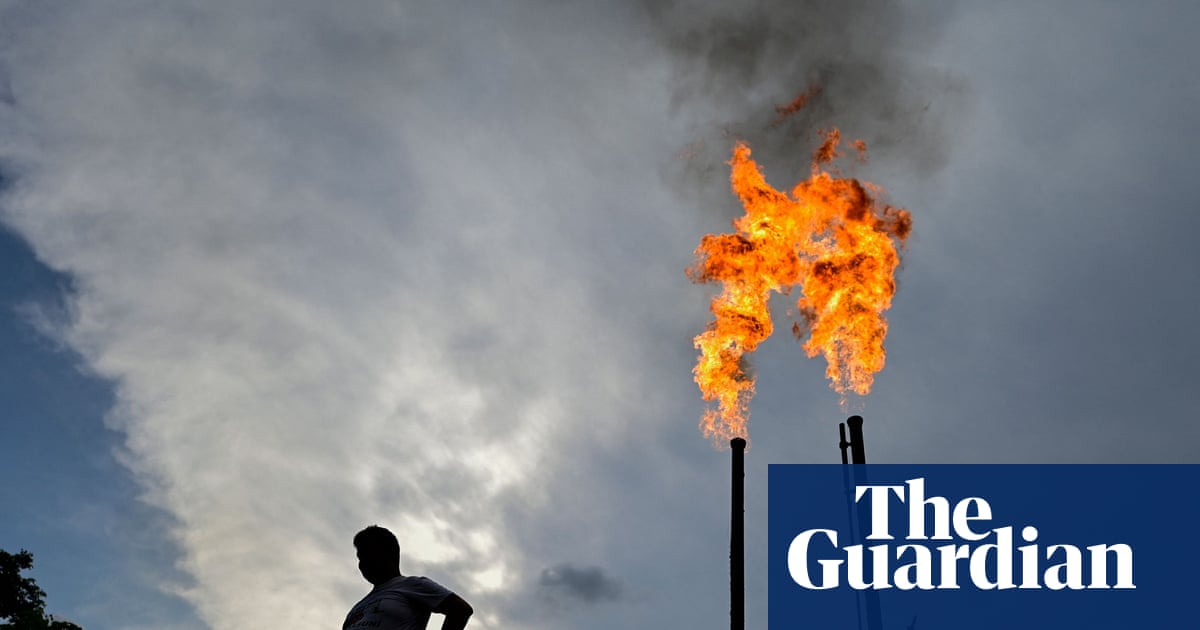
A quarter of the world’s population lives within three miles (5km) of operational fossil fuel projects, potentially threatening the health of more than 2 billion people as well as critical ecosystems, according to first-of-its-kind research.
A damning new report by Amnesty International, shared exclusively with the Guardian, found that more than 18,300 oil, gas and coal sites are currently distributed across 170 countries worldwide, occupying a vast area of the Earth’s surface.
Proximity to drilling wells, processing plants, pipelines and other fossil fuel facilities elevates the risk of cancer, respiratory conditions, heart disease, premature birth and death, as well as posing grave threats to water supplies and air quality, and degrades land.
Almost half a billion (463 million) people, including 124 million children, now live within 0.6 miles (1km) of fossil fuels sites, while another 3,500 or so new sites are currently proposed or under development that could force 135 million more people to endure fumes, flares and spills, according to Extraction Extinction: Why the Lifecycle of Fossil Fuels Threatens Life, Nature, and Human Rights.
Most active projects have created pollution hotspots, turning nearby communities and critical ecosystems into so-called sacrifice zones – heavily contaminated areas where low-income and marginalized groups bear the disproportionate burden of exposure to pollution and toxins.
The report details the devastating health toll from extraction, processing and transportation, as well as demonstrating how leaks, flares and construction destroy irreplaceable natural ecosystems and undermine human rights – particularly of those living near oil, gas and coal infrastructure.
It comes as world leaders, excluding the US – the largest historical emitter of greenhouse gases – gather in Belém, Brazil, for the 30th annual climate negotiations amid growing frustration at the lack of progress in phasing out fossil fuels, which are driving planetary collapse and human rights violations.
“The fossil fuel industry and its state sponsors have argued for decades that human development requires fossil fuels. But we know that under the guise of economic growth, they have instead served greed and profits without red lines, violated rights with near-complete impunity, and destroyed the atmosphere, biosphere and oceans,” said Agnès Callamard, secretary general of Amnesty International.
“Cop30 leaders must keep people, and not profits and power, at the heart of negotiations by committing to a full, fast, fair and funded fossil-fuel phase-out and just transition to sustainable energy for all.”
Cop30 takes place as the Philippines, Mexico and Jamaica are reeling from superstorms that were intensified by warmer atmospheric and ocean temperatures, with states under growing pressure to take decisive action to regulate fossil fuel companies and end extraction, subsidies, licenses and consumption in order to comply with the landmark ruling by the international court of justice.
Last week, the Guardian revealed how more than 5,350 fossil fuel industry lobbyists have been given access to the UN climate talks in the past four years, blocking climate action while their paymasters drill for record quantities of oil and gas.
The quantitative analysis is based on a first-of-its-kind mapping exercise by researchers at Better Planet Laboratory (BPL) at the University of Colorado Boulder, who compared data on the known locations of fossil fuel infrastructure sites with census data, and datasets on critical ecosystems, greenhouse gas emissions and Indigenous peoples’ land.
A third of all operational oil, coal and gas sites overlap with one or more critical ecosystems such as a wetland, forest or river system that is rich in biodiversity and critical for carbon sequestration or where environmental degradation or disaster could lead to ecosystem collapse, researchers found.
The true global scale is probably higher due to gaps in the documentation of fossil fuel projects and limited census data across countries.
The report also includes testimonies from Indigenous land defenders in Canada and coastal communities in Senegal, as well as fishers in Colombia and Brazil and Amazonian leaders in Ecuador fighting against gas flaring, that were conducted in partnership with Columbia Law School’s Smith Family Human Rights Clinic.
The planet’s most important stories. Get all the week’s environment news – the good, the bad and the essential
Privacy Notice: Newsletters may contain information about charities, online ads, and content funded by outside parties. If you do not have an account, we will create a guest account for you on theguardian.com to send you this newsletter. You can complete full registration at any time. For more information about how we use your data see our Privacy Policy. We use Google reCaptcha to protect our website and the Google Privacy Policy and Terms of Service apply.
after newsletter promotion
The findings reveal deep-seated environmental injustice and racism in exposure to oil, gas and coal industries.
Indigenous peoples, who account for 5% of the world’s population, are disproportionately exposed to life-shortening fossil fuel infrastructure, with one in six sites located on Indigenous territories.
“We’re experiencing intergenerational battle fatigue … We physically won’t survive [this]. We were never the instigators but we have taken the brunt of all the violence,” said Wet’suwet’en land defender Tsakë ze’ Sleydo’ (Molly Wickham), describing the imminent construction of new compressors for a fossil gas pipeline on Indigenous lands in British Columbia, Canada.
“When we rise up to defend the Yin’tah [Wet’suwet’en territory], we are criminalized.”
The expansion of fossil fuels has also been linked with land grabs, cultural pillage, community division and loss of livelihoods, as well as violence, online threats and lawsuits, both criminal and civil, against community leaders peacefully opposing the construction of pipelines, drilling projects and other infrastructure.
“We are not after money; we only want what is ours. We just want to fish in Guanabara Bay, it’s our right. And they are taking our rights,” said Bruno Alves de Vega, an urban artisanal fisher from Rio de Janeiro, Brazil.
Fossil fuels affect every part of the human body, posing especially severe risks for children, older people and pregnant people that risk harm to the health of future generations, according to the UN special rapporteur on climate change who has called for criminal penalties against those peddling disinformation about the climate crisis and a total ban on fossil fuel industry lobbying and advertising.
“The climate crisis is a manifestation and catalyst of deep-rooted injustices,” added Callamard from Amnesty. “The age of fossil fuels must end now.”
