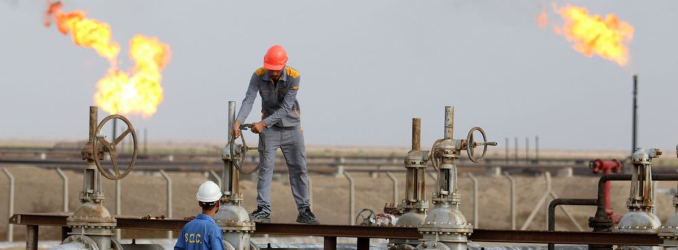
ExxonMobil’s recent agreements to explore Iraq’s giant Majnoon oil field mark a significant strategic maneuver, re-establishing the energy major’s footprint in one of the world’s most critical crude-producing nations. After exiting its primary investment in the West Qurna-1 field in early 2024, citing challenging contractual terms and political instability, this return signals a calculated long-term bet on Iraq’s vast untapped reserves. For investors, this move presents a complex interplay of geopolitical risk, substantial resource potential, and the ever-present volatility of global energy markets. Our analysis delves into the strategic rationale, market context, and potential hurdles ExxonMobil faces as it embarks on this renewed commitment.
ExxonMobil’s Strategic Recalibration in Iraq
The decision by ExxonMobil to re-engage with Iraq, specifically eyeing the Majnoon field, underscores a recalibration of its global portfolio. While the company was an early Western explorer in Iraq post-2010, its departure from West Qurna-1 highlighted the difficulties of operating in a region prone to political shifts and stringent contractual demands. However, the allure of Iraq’s prodigious oil wealth remains undeniable. Prime Minister Mohammed Shia Al-Sudani announced that ExxonMobil has signed heads of agreements with Basra Oil Co. and SOMO, Iraq’s oil marketing company, targeting the development of the Majnoon field and bolstering export infrastructure. This includes a joint cooperation with SOMO to explore marketing opportunities, indicating a more integrated approach than previous ventures. For ExxonMobil, optimizing its “advantaged portfolio” likely means prioritizing fields with significant resource potential, even if they come with a higher degree of operational complexity and a longer development timeline. Majnoon, recognized as one of Iraq’s largest fields, fits this profile perfectly, offering substantial future production capacity that aligns with a supermajor’s scale.
Navigating Market Volatility and Investor Sentiment
ExxonMobil’s long-term commitment in Iraq comes at a particularly dynamic time for global energy markets. As of today, Brent Crude trades at $90.38, reflecting a sharp 9.07% daily decline, while WTI Crude sits at $82.59, down 9.41%. This significant correction follows a broader trend where Brent has shed nearly 20% over the past 14 days, falling from $112.78 on March 30th. Such price swings naturally trigger investor questions, with many asking what the price of oil per barrel will be by the end of 2026. While short-term volatility can impact sentiment, ExxonMobil’s Majnoon play is inherently a multi-year endeavor, meaning its success hinges less on daily price fluctuations and more on sustained demand and favorable long-term price floors. The current dip, alongside a 5.18% drop in gasoline prices to $2.93, might ease immediate inflationary pressures, but the underlying demand for crude remains robust, anchoring the long-term rationale for developing mega-fields like Majnoon. Investors are keenly observing if this price correction is transient or indicative of deeper market shifts.
The Majnoon Opportunity: Hurdles and Upside
Majnoon’s potential is immense, but its history is also fraught with challenges. Shell Plc, for instance, exited the field in 2017 due to conflicts over profit-sharing terms with the Iraqi government – a common friction point in the country. Beyond fiscal disagreements, operational hurdles like water supply for reservoir pressure maintenance have historically been a concern for many of Iraq’s wells. ExxonMobil’s return suggests a renewed confidence in overcoming these issues, perhaps through more favorable contractual frameworks or innovative technical solutions. However, it’s crucial to understand that this is not an immediate production play. The company will need to complete a series of comprehensive commercial and technical studies and then agree to a full operating contract with the Iraqi government. This entire process, from initial agreements to significant oil production, could realistically take several years. For investors, the upside is substantial once production commences, but the pathway there is long and subject to execution risks and ongoing negotiations.
Upcoming Events and Geopolitical Undercurrents
The broader energy landscape will heavily influence the context of ExxonMobil’s Majnoon development. A critical upcoming event is the OPEC+ Ministerial Meeting scheduled for April 19th. Investor interest in this meeting is high, with many readers asking about OPEC+’s current production quotas. The decisions made by the cartel will directly impact global supply levels and, consequently, crude prices, setting the backdrop for ExxonMobil’s future output from Iraq. Any tightening or loosening of quotas could significantly alter the economic calculus of developing a field like Majnoon. Furthermore, regular market indicators such as the API Weekly Crude Inventory (April 21st, 28th), EIA Weekly Petroleum Status Reports (April 22nd, 29th), and the Baker Hughes Rig Count (April 24th, May 1st) will provide continuous insights into supply, demand, and drilling activity. These data points collectively paint a picture of the market conditions ExxonMobil is betting on for its long-term investment. Beyond market fundamentals, the persistent political instability in Iraq remains a geopolitical undercurrent that ExxonMobil, having previously exited West Qurna-1 partly due to such issues, must navigate with extreme caution.


