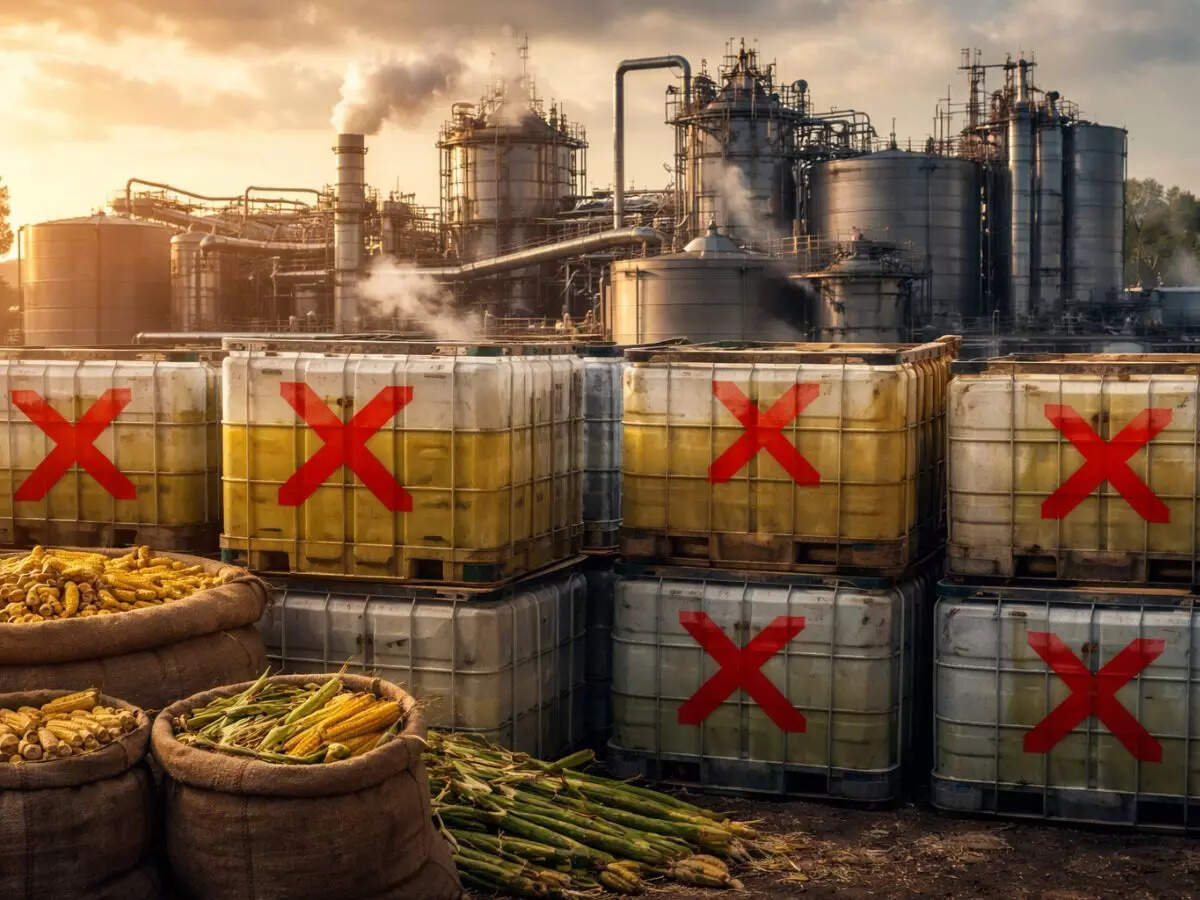
India’s ethanol industry is facing a supply glut, threatening to impact livelihoods and large-scale investments in the sector once considered the torchbearer of the country’s green energy transition. Policymakers and ethanol producers are currently staring at an uncomfortable statistic—nearly 20 billion litres of installed capacity, with another 4 billion slated to come onstream soon.
Against that, the requirement for mandatory 20per cent ethanol blending with petrol (E20) is estimated at just about 11 billion litres in the current ethanol year that began last November. In effect, more than 50per cent excess capacity is building up in the system, the unintended consequence of a policy push that raced ahead of a clearly articulated long-term road map.
Ethanol is a green fuel produced by fermenting sugar or foodgrain. It is widely recognised as a cleaner and renewable alternative to pure fossil fuels.
Distilleries, said industry officials, are utilising just 25–30per cent of capacity while fresh approvals for new plants have been halted.
Impact across value chain
The strain of excess capacity and ensuing demand and regulatory uncertainty is visible across the value chain—from sugar mills and grain processors to farmers earlier encouraged to see ethanol as a stable revenue alternative.
According to the All India Distillers’ Association (AIDA), ethanol has evolved into a ₹ 50,000 crore industry, propelled by the government’s ambitious plans for the sector. Over the years, distilleries set up about 20 billion litres capacity for supplying to oil marketing companies. However, the lower-than-expected offtake has since resulted in underutilised capacity and excess inventory.
“Many distilleries were put up, thinking that ethanol consumption would gradually increase,” said Deepak Ballani, director general of the Indian Sugar & Bio Energy Manufacturers Association. “The government needs to step up blending. No fresh permissions are being given to set up distilleries till the government gives clarity.”
Raising the blending target from the current 20per cent could be an uphill task as discussions among policymakers on the issue stalled last year after a social media backlash over potential damage to vehicles not designed to run on higher ethanol blends. While the government dismissed the criticism as motivated, it hasn’t taken any concrete steps since to raise the blending threshold.
Drivers have also sought a price discount for ethanol-blended fuel, citing its lower energy content — about a third less than pure petrol. A 20per cent blend is estimated to lessen fuel efficiency by more than 3per cent. The oil ministry however rejected the demand in August, saying ethanol was costlier than petrol.
According to AIDA, during 2024-2025, around 100 new distilleries started operations and a few more are still getting commissioned. However, demand growth has not kept pace, as ethanol offtake remains largely dependent on existing blending targets.
The industry is currently awaiting government mandate for a further increase in the blending percentage beyond the current 20per cent to ensure optimal utilisation of installed capacities and maintain the financial viability of investments.
India’s ethanol blending programme was conceived as a multipronged solution—boost farmer incomes, curb costly crude oil imports, and lower vehicular emissions.
The early momentum was strong. Oil marketing companies contracted aggressively, mills borrowed and expanded, and new grain-based distilleries mushroomed.
However, with the current blending ceiling at E20, the next milestone remains less defined. There is no clarity from the government toward higher blends such as E27, E85, or E100. Neither is there any clarity on timelines for expanding blending into diesel, a far larger and more complex market, said Ballani.
Diesel: The bigger, riskier prize
If petrol blending has currently plateaued at E20, diesel is the obvious next frontier though it’s also the more delicate one.
“Unlike petrol, ethanol doesn’t mix with diesel,” said an oil marketing company official, asking not to be named. “Two separate layers are formed. So, one needs a coupler chemical to keep them mixed,” the official explained.
“Both Indian Oil Corporation (IOCL) and Bharat Petroleum Corporation (BPCL) are understood to be at advanced stages of evaluating ethanol-blended diesel formulations,” the official said.
Mixing diesel with ethanol would also likely lead to stability issues, engine compatibility, cold-start behaviour, and long-term durability – requiring rigorous testing.
Also, domestic diesel consumption far exceeds petrol. Diesel is used to power freight corridors, tractors, buses, and a large share of passenger vehicles. Any large-scale rollout carries reputational and economic risk if performance issues emerge.
Talks of ethanol-blended diesel are very much alive though it is likely to become a high-stakes matter. A misstep could trigger backlash from transporters, farmers, and fleet operators.
Automakers in wait mode
Carmakers argue that there is no firm direction on meaningfully moving beyond E20 toward high-ethanol blends, which would require widespread adoption of flex-fuel vehicles (FFVs).
A key recommendation of AIDA is the promotion of flex-fuel vehicles (FFVs)—those running on higher ethanol blends—to significantly grow domestic ethanol consumption. To accelerate their adoption, AIDA has sought a reduction in GST on FFVs to make them more affordable and accessible to consumers.
“It’s not a constraining factor for OEMs to make flex-fuel vehicles,” said a senior car company official, requesting anonymity. “We need clarity and there should be a clear direction.”
Privately, automakers also voice a reverse concern. If they launch E85- or E100-compliant cars, would there be sufficient ethanol supply and distribution infrastructure across the country.
So far, none of India’s top carmakers have introduced a mass-market flex-fuel vehicle. Most remain at prototype or development stages, awaiting policy support and commercial viability.
Market leader Maruti Suzuki is seen as one of the more proactive, with industry officials indicating that flex-fuel concept versions of Wagon R and Fronx models capable of running on higher ethanol blends could see a near-term commercial rollout.
Tata Motors also showcased a flex-fuel version of its Punch micro SUV. Toyota Kirloskar Motor has demonstrated flex-fuel capability in a hybrid format of the Innova HyCross prototype. Mahindra & Mahindra, too, has displayed flex-fuel prototypes such as the XUV 3XO, and is working on engines capable of handling higher ethanol blends.
Queries sent to the companies remained unanswered.
Manufacturers argue that fiscal incentives could tilt the equation. A lower goods and services tax (GST) rate, similar to the 5per cent applied on electric vehicles, or specific production-linked benefits, could accelerate commercial launches.
Flex-fuel compatibility also helps companies meet tightening Corporate Average Fuel Efficiency (CAFE) norms, which reward cleaner-burning fuel pathways.
There is also a technical trade-off. Ethanol contains less energy per litre than petrol or diesel, which can reduce fuel efficiency marginally.
The government appears mindful of both the economic and political sensitivities. It doesn’t want stranded investments in distilleries. Nor does it want consumer backlash from poorly calibrated fuel transitions.
For now, India’s ethanol story is at the crossroads.
While capacity has surged ahead, demand, capped by policy caution, hasn’t kept pace, while oil companies are testing ground and automakers are prototyping amid largescale distilling capacities go idle.