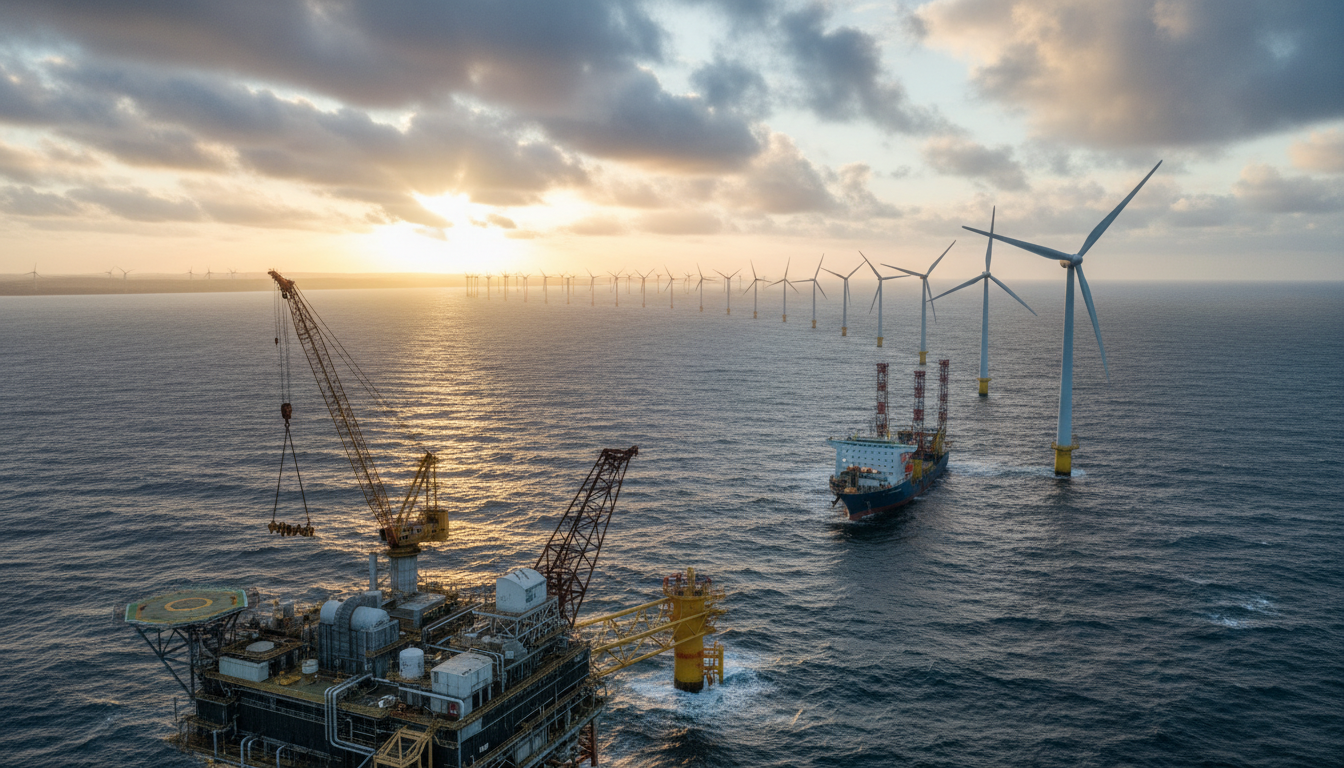
The European Union’s recent approval of a substantial €5 billion Danish state support package for offshore wind development marks a pivotal moment in the continent’s aggressive energy transition. Operating under the EU’s forward-looking Clean Industrial Deal State Aid Framework, this decision not only accelerates Denmark’s ambitious renewable energy agenda but also sends a clear signal to global energy investors: the structural shift away from fossil fuels is gaining significant momentum, backed by substantial public capital. For stakeholders in the traditional oil and gas sector, this move solidifies offshore wind as a deeply entrenched cornerstone of Europe’s future energy mix, compelling a re-evaluation of long-term investment strategies and market expectations. The financial architecture underpinning this push, notably through sophisticated two-way Contracts for Difference (CfDs), aims to de-risk these massive projects, making them increasingly attractive to private capital and amplifying pressure on incumbent energy sources.
Europe’s Green Ambition Intensifies Pressure on Fossil Fuels
This landmark Danish initiative, supporting the Hesselø and North Sea I Mid offshore wind farms, is far more than a localized development; it’s a strategic pillar in the EU’s broader objective to curtail reliance on imported fossil fuels and fortify regional energy stability. The Hesselø project alone is engineered to contribute a minimum of 800 megawatts (MW), projected to generate approximately 3.2 terawatt-hours (TWh) annually. Complementing this, the North Sea I Mid project will add at least 1 gigawatt (GW) of capacity, with an estimated yearly production of 4.6 TWh. Combined, these two colossal wind farms are forecast to produce roughly 7.8 TWh each year, a volume equivalent to approximately one-quarter of Denmark’s total electricity consumption. This impressive scale not only enhances Denmark’s national energy independence but also reinforces its strategic role as a pivotal North Sea energy hub. For investors, this trajectory signifies a fundamental re-weighting of energy infrastructure, where state-backed, large-scale renewable assets are increasingly seen as long-term value propositions, potentially diverting capital and demand from traditional oil and gas exploration and production.
Current Market Dynamics: Short-Term Volatility vs. Long-Term Structural Shifts
While the long-term implications of Europe’s green energy push are undeniable, the daily gyrations of the fossil fuel market continue to demand investor attention. As of today, Brent crude trades at $92.37, reflecting a -0.93% dip within a day range of $91.39 to $94.21. WTI crude also saw a decline, settling at $88.75, down -1.03% for the session. This recent downward pressure continues a trend observed over the past two weeks, with Brent having shed approximately $7.07, or 7%, from its $101.16 peak on April 1st to $94.09 on April 21st. Gasoline prices, at $3.1, are also down -0.96% today. This short-term volatility, often driven by inventory reports, geopolitical shifts, or broader macroeconomic sentiment, stands in stark contrast to the steady, structural commitment to renewables evidenced by the Danish wind deal. Savvy investors must therefore navigate this complex landscape, distinguishing between transient market noise and profound, government-backed energy transitions that will reshape demand fundamentals for decades to come.
Navigating the Future: Upcoming Events and Strategic Re-evaluation
The immediate future presents a series of key data releases that will offer insights into the near-term supply-demand balance of traditional energy markets. The EIA Weekly Petroleum Status Reports, scheduled for April 22nd, April 29th, and May 6th, will provide critical data on crude oil and product inventories. Similarly, the API Weekly Crude Inventory reports on April 28th and May 5th will offer an early look at these trends. The Baker Hughes Rig Count, due on April 24th and May 1st, will indicate the pace of upstream activity. However, it is the EIA Short-Term Energy Outlook on May 2nd that warrants particular attention, as it may begin to incorporate the accelerating impact of policies like the EU’s Clean Industrial Deal. For investors, these events provide important tactical trading signals, but the strategic imperative remains unchanged: understanding how the ongoing European shift, exemplified by the Danish offshore wind package, will increasingly factor into global energy demand projections, potentially capping long-term price upside for fossil fuels even amid short-term supply disruptions.
Investor Sentiment and the De-Risking of Renewable Capital
Our proprietary market intelligence reveals that investors are actively grappling with the implications of these converging forces. Queries from our readership, such as “what do you predict the price of oil per barrel will be by end of 2026?” and “is wti going up or down?”, underscore a deep uncertainty about the future trajectory of oil prices amidst these structural shifts. The Danish scheme’s sophisticated two-way Contract for Difference (CfD) model directly addresses this investor apprehension within the renewables space. By offering developers a variable premium based on the differential between a strike price and the market price, CfDs provide both downside protection and upside limitation. This mechanism significantly de-risks large-scale renewable projects, attracting private capital by ensuring predictable revenue streams and mitigating exposure to volatile electricity prices. Such state-backed de-risking mechanisms, now a cornerstone of EU energy policy, make renewable investments increasingly competitive and financially attractive, further intensifying the capital flow away from more volatile and politically scrutinized fossil fuel ventures. For oil and gas investors, this signifies a growing need to diversify or adapt portfolios to capture opportunities in the rapidly expanding clean energy landscape.


