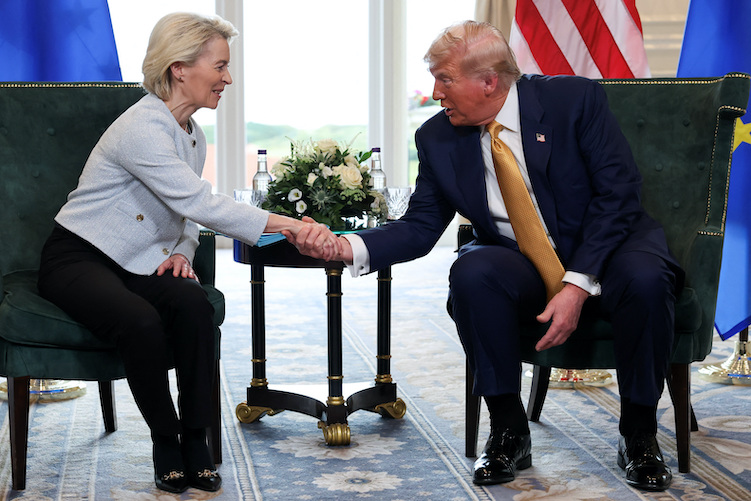
A significant trade agreement has been reached between the United States and the European Union, effectively defusing escalating transatlantic trade tensions. This landmark framework deal sees the European bloc committing to substantial investments in the U.S. economy, including a dramatic increase in purchases of American energy and defense equipment. For European exporters, the agreement means a manageable 15% tariff on most goods entering the U.S. market, a rate significantly lower than the punitive measures initially threatened by the U.S. administration.
The announcement came from U.S. President Donald Trump and European Commission President Ursula von der Leyen following a meeting in western Scotland. President Trump hailed the accord as the “biggest deal ever made,” emphasizing the EU’s pledge to inject $600 billion into the U.S. economy. This figure surpasses the $550 billion agreement recently concluded with Japan, signaling a concerted effort to deepen economic ties and address what the U.S. leader described as past imbalances in trade relations.
For investors tracking global energy markets, the implications are particularly noteworthy. The deal explicitly calls for an anticipated $750 billion in EU purchases of U.S. energy resources over the coming years. This commitment is a powerful tailwind for American energy producers and exporters, especially in the liquefied natural gas (LNG) and crude oil sectors. Increased European demand for U.S. LNG will bolster export capacity utilization, support ongoing infrastructure development, and strengthen the strategic energy partnership between the two regions, enhancing European energy security.
Transatlantic Energy Flows Set to Surge
The pledge for increased U.S. energy purchases offers a clear directional signal for the oil and gas industry. European nations, many of whom are actively seeking to diversify their energy supply chains, will now have a formalized pathway to access more American crude oil and natural gas. This could translate into more stable, long-term contracts and increased shipping activity across the Atlantic, benefiting tanker operators and energy logistics providers.
From an oil and gas investing perspective, this sustained demand pipeline could underpin investment decisions in U.S. upstream production, midstream infrastructure, and export terminals. While the specifics of the energy commodities are not fully detailed, the overarching commitment to “greater amounts of US energy” suggests a broad-based increase across the spectrum, from crude to refined products and natural gas. This provides a degree of predictability for energy companies planning future capital expenditures and market strategies.
European Commission President von der Leyen acknowledged the challenging nature of the negotiations, characterizing President Trump as a tough counterpart. Despite the 15% tariff, which she described as applying “across the board,” von der Leyen concluded that it represented “the best we could get,” emphasizing the importance of stability and predictability for the world’s two largest economies. The agreement, while substantial, leaves several details pending, including specific tariff rates on certain sensitive goods like spirits, indicating that further discussions will be necessary to finalize all aspects.
Averting a Wider Trade Conflict: Stability for Oil Demand
The primary win for Brussels, and indeed for global markets, is the successful avoidance of a full-blown trade war between these two economic powerhouses, which collectively account for nearly one-third of global commerce. Such a conflict would have introduced significant uncertainty, dampened economic growth projections, and consequently, suppressed the global oil demand outlook. By reaching an agreement, a critical layer of geopolitical risk has been removed, fostering a more stable environment for international trade and investment.
Averting a trade conflict provides a more robust foundation for global economic activity, which is intrinsically linked to energy consumption. Investor confidence often correlates with geopolitical stability, and this deal contributes positively to that sentiment. While a 15% tariff may still feel elevated compared to initial European aspirations for a zero-for-zero tariff arrangement, it represents a substantial reduction from the more severe duties that were on the table, preventing a potentially deeper economic slowdown that would have inevitably impacted crude oil prices and the energy sector at large.
German Chancellor Friedrich Merz welcomed the agreement, highlighting its role in safeguarding Germany’s export-oriented economy, particularly its crucial automotive sector. German car manufacturers, including Volkswagen, Mercedes, and BMW, had been particularly vulnerable to the existing 27.5% U.S. tariff on imported cars and parts. While the new 15% baseline tariff remains a cost, it signifies a reduction in the potential economic damage that a protracted trade dispute could have inflicted on a key global manufacturing hub and significant energy consumer.
Lingering Uncertainties and Investor Prudence
Despite the positive aspects, investors should remain cognizant of the lingering uncertainties. The initial 15% tariff rate, while an improvement, still represents a cost for European exporters. Bernd Lange, a prominent German Social Democrat heading the European Parliament’s trade committee, voiced concerns that the tariffs remain imbalanced and that the substantial EU investment earmarked for the U.S. might come at the expense of domestic European initiatives.
Furthermore, the deal’s long-term stability is not entirely guaranteed. President Trump retains the authority to adjust or increase tariffs in the future, introducing a degree of policy risk that market participants must factor into their analyses. This executive power means that while the immediate threat of a trade war has receded, the potential for future policy shifts remains a consideration for long-term investment strategies.
In conclusion, this transatlantic trade agreement is a pivotal development for global commerce and, by extension, for the oil and gas sector. The EU’s commitment to significantly increase its purchases of U.S. energy offers a tangible boost for American exporters and supports the long-term demand outlook. While some details remain to be ironed out and future tariff adjustments are a possibility, the immediate impact is one of de-escalation and enhanced economic stability, providing a more favorable environment for energy market growth and investor confidence in the months and years ahead.