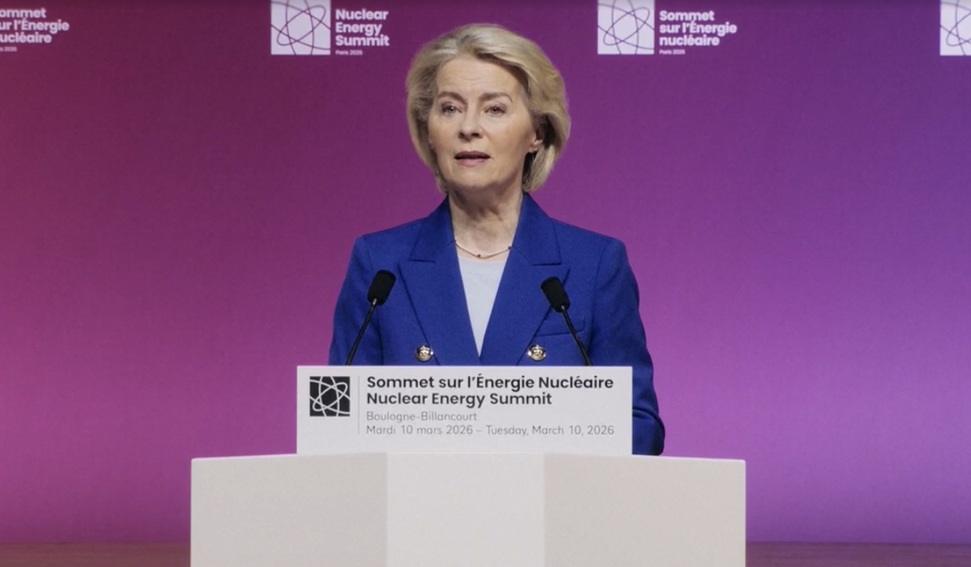
The European Union has signaled a profound shift in its long-term energy strategy, with European Commission President Ursula von der Leyen declaring the bloc’s historical move away from nuclear power a “strategic mistake.” This pivotal announcement, made at the Nuclear Energy Summit in Paris, underscores a renewed commitment to nuclear energy, particularly Small Modular Reactors (SMRs), as a cornerstone of future energy security and decarbonization efforts. For oil and gas investors, this represents a critical development, potentially reshaping the demand landscape for fossil fuels in Europe over the coming decades. While the immediate impact on crude prices may be limited, the long-term implications for natural gas consumption and the broader energy transition narrative are substantial, demanding close attention as the EU embarks on this ambitious journey to bolster its “homegrown, low-carbon energy sources.”
The EU’s Strategic Reversal: A Nuclear Renaissance for Energy Security
Ursula von der Leyen’s recent address marked a definitive turning point for Europe’s energy policy. She lamented the decline of nuclear power’s contribution to Europe’s electricity mix, which has fallen from approximately one-third in the 1990s to just 15% today. This reduction was a deliberate choice by several member states, exemplified by Italy’s plant closures after a 1987 referendum, Austria’s complete ban, and Germany’s full nuclear phase-out in 2023 following the Fukushima disaster. Von der Leyen now frames this as a “strategic mistake” that left the EU vulnerable to volatile and uncertain fossil fuel imports.
In response, the EU is launching a new European Strategy for Small Modular Reactors, aiming for operational SMR technology in Europe by the early 2030s. This strategy is multifaceted, involving the creation of “regulatory sandboxes” for technology testing, efforts to align cross-border regulations for Europe-wide deployment, and a significant financial commitment: a €200 million guarantee mechanism. Funded through the EU’s Emissions Trading System (ETS), this mechanism is designed to de-risk and support private investment in these innovative nuclear technologies. This strategic pivot highlights Europe’s determination to lead the “nuclear tech race,” leveraging its “half a million highly skilled workers” and existing innovation in modular reactors to become a global hub for next-generation nuclear energy.
Market Snapshot: Crude Prices Under Scrutiny Amid Shifting Energy Narratives
While the EU’s nuclear pivot is a long-term play, it enters an energy market already grappling with significant volatility. As of today, Brent Crude trades at $92.86, down 0.41% within a day range of $92.57-$94.21. Similarly, WTI Crude stands at $89.29, reflecting a 0.42% decline and moving within an $88.76-$90.71 range. This recent softness follows a broader trend; our proprietary data pipelines show Brent crude has shed approximately 7% over the last two weeks, dropping from $101.16 on April 1st to $94.09 by April 21st.
This market backdrop amplifies investor anxiety. Our first-party reader intent data reveals a sharp focus on crude oil price trajectories, with investors consistently asking about the immediate direction of WTI and broader oil price predictions for the end of 2026. Beyond macro trends, specific company performance, such as that of Repsol, is also top of mind for our users, indicating a granular approach to sector analysis. The inherent tension between immediate supply-demand fundamentals and the longer-term signals from initiatives like the EU’s nuclear strategy creates a complex environment for energy investors. While new nuclear capacity won’t displace significant fossil fuel volumes overnight, the strategic direction indicates a clear intent to reduce reliance on imported hydrocarbons, a factor that will increasingly be priced into forward curves.
SMRs: A New Horizon for Energy Independence and Investment Opportunities
The emphasis on Small Modular Reactors is particularly significant for investors monitoring the energy transition. SMRs offer several compelling advantages over traditional nuclear plants: they are substantially smaller, enabling faster construction times, and can be deployed closer to demand centers, enhancing grid stability. Crucially, they produce carbon-free energy, aligning perfectly with the EU’s decarbonization goals. This technology is seen as a rapid deployment solution to bolster energy security and reduce reliance on natural gas for power generation, which has been a pain point for Europe, especially in recent years.
The EU’s investment strategy, including the €200 million guarantee mechanism funded via the ETS, is a powerful signal to private capital. By de-risking innovative nuclear technologies, the EU is actively inviting investment into a sector that has historically been capital-intensive and subject to regulatory hurdles. For forward-thinking investors, this opens new avenues in nuclear technology companies, engineering and construction firms specializing in SMR deployment, and even utilities looking to diversify their generation mix. Europe’s strong foundation in nuclear expertise – boasting half a million skilled workers – positions it well to capitalize on this renewed strategic focus, potentially creating a robust domestic industry and reducing future demand for imported fossil fuels.
Forward Outlook: Navigating Key Data Points and Geopolitical Undercurrents
Looking ahead, the interplay between immediate market catalysts and long-term strategic shifts will dictate the investment landscape. Oil and gas investors must closely monitor upcoming energy events for short-term market direction. The EIA Weekly Petroleum Status Reports, scheduled for April 22nd, April 29th, and May 6th, will provide crucial insights into U.S. crude and product inventories, refinery activity, and demand indicators. These reports often trigger immediate price reactions. Similarly, the Baker Hughes Rig Count on April 24th and May 1st will offer a pulse check on North American drilling activity, influencing future supply expectations. API Weekly Crude Inventory data, due April 28th and May 5th, will also factor into the market’s assessment of supply-demand balances.
A particularly important forward-looking event is the EIA Short-Term Energy Outlook on May 2nd. This report provides updated projections for global and domestic energy markets, offering a valuable reference point for investors making medium-term strategic decisions. While these data releases focus on the immediate to near-term, the EU’s nuclear pivot introduces a new layer of long-term strategic consideration. The push for “homegrown” energy sources, driven by the desire to reduce vulnerability to geopolitical instability and volatile fossil fuel prices, suggests a structural shift in Europe’s energy mix. Investors must therefore balance the tactical trading opportunities presented by weekly data with the strategic implications of Europe’s renewed commitment to nuclear power, which promises to steadily chip away at the continent’s dependence on imported oil and natural gas over the coming decades.


