

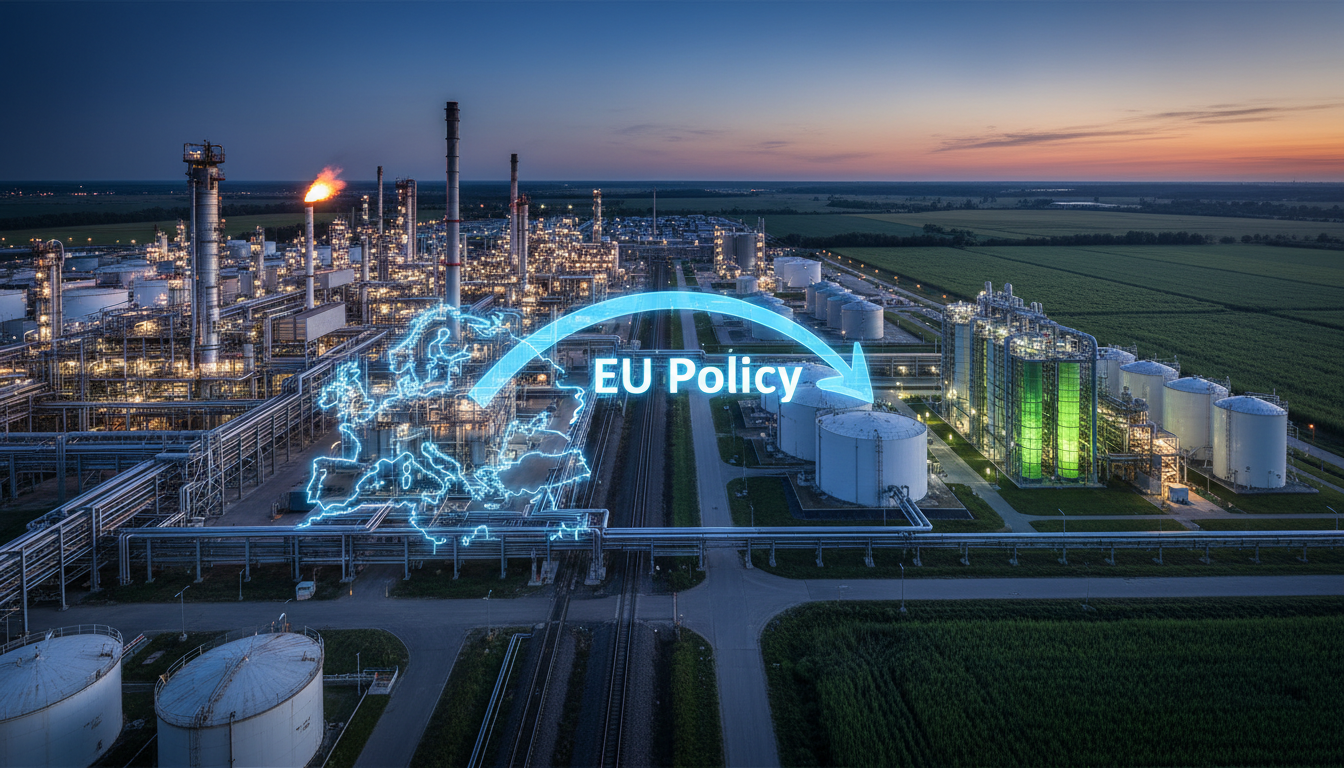
The geopolitical landscape continues to exert significant pressure on global energy markets, prompting swift responses from major economic blocs. The European Commission has recently issued directives to its member states, urging refinery operators across the European Union to postpone any “non-emergency maintenance” schedules. This strategic move aims to bolster refining capacity and ensure a steady flow of petroleum products amidst ongoing market disruptions stemming from the volatile Middle East conflict. Concurrently, the Commission is advocating for an increased adoption of biofuels, positioning them as a vital substitute for conventional fossil petroleum products to alleviate market strain.
Investor attention should remain fixed on the EU’s proactive stance. The Commission has explicitly called upon EU nations to undertake “timely and coordinated preparations” to safeguard the supply of both crude oil and its refined derivatives. Brussels maintains a strong position of preparedness, largely attributed to the stringent obligations on member states to uphold strategic oil stocks and implement robust contingency plans designed to address potential supply security incidents. Furthermore, EU countries are actively contributing approximately 20 percent to a larger, International Energy Agency (IEA)-coordinated release of over 400 million barrels of emergency oil stocks. Notably, data from the IEA on March 19 revealed that the bulk of these EU-contributed releases consisted of refined products, underscoring the immediate focus on downstream supply resilience.
Navigating Persistent Market Disruption
European Commissioner for Energy and Housing, Dan Jørgensen, underscored the gravity of the situation, stating that while the European Union’s energy supply security currently remains robust, preparedness for a “potentially prolonged disruption of international energy trade” is paramount. This acknowledgement signals a longer-term outlook on market volatility, prompting investors to consider the sustained impact on global energy commodity prices and supply chains.
In parallel efforts, the Commission is spearheading initiatives to replenish the bloc’s natural gas storage facilities. As of Tuesday, these facilities stood at 28.05 percent full, representing a volume of 320.49 terawatt hours, according to the Aggregated Gas Storage Inventory published by Gas Infrastructure Europe. The strategic importance of gas supply was further highlighted when European Commission Director-General for Energy, Ditte Juul-Jorgensen, held discussions with Qatar’s energy minister on March 10. This meeting followed Qatar’s declaration of force majeure on its liquefied natural gas (LNG) production, citing “military attacks” on its facilities, a development with significant implications for global LNG flows given Qatar’s role as a major EU supplier.
Soaring Import Bills and Product Market Tightness
The financial repercussions of the Middle East conflict are already palpable within the EU. Commissioner Jørgensen informed energy ministers that since the outbreak of hostilities, gas prices in the EU have surged by approximately 70 percent, while oil prices have climbed by about 60 percent. The economic toll is substantial: a mere 30 days of conflict have already added an estimated EUR 14 billion ($16.24 billion) to the Union’s fossil fuel import bill. This escalating cost represents a significant drain on economic resources and reinforces the urgency of the EU’s energy strategy.
Jørgensen articulated a stark assessment, noting that as the crisis enters its second month, the situation is “very serious.” While immediate shortages of oil and gas have not materialized across the EU, the Commissioner pointed to “tightening in certain product markets, notably diesel and jet fuel,” alongside growing constraints in the global gas market. These pressures inevitably lead to spill-over effects on electricity prices, impacting businesses and consumers alike.
Investors should heed Jørgensen’s unequivocal warning: “We should be under no illusion that the consequences of this crisis for the energy markets will be short-lived. Because they won’t.” This implies a sustained period of elevated energy prices and market uncertainty, necessitating careful risk management and strategic positioning in energy-related portfolios. The Commissioner emphasized the critical need for coordinated action, urging member states to avoid fragmented national responses and disruptive market signals. Measures, he stressed, must be “targeted, temporary and avoid worsening supply and demand conditions.”
The Imperative of Long-Term Energy Independence
Beyond immediate supply management, the European Commission is actively developing a “toolbox of measures” designed to support member states in shielding families and businesses from the energy crisis’s impact. However, Jørgensen made it clear that while providing support, the bloc must remain steadfast on its long-term energy strategy. “This crisis shows us once again that Europe faces a fundamental vulnerability to external energy shocks,” he explained, directly linking this vulnerability to the EU’s inherent dependence on imported fossil fuels.
The path forward, as articulated by the Commissioner, is unequivocally “energy independence.” He framed this not just as an environmental goal but as a “strategic imperative: economically and from a security point of view.” This vision for a self-sufficient energy future is predicated on a multi-pronged approach: fostering “homegrown clean energy, electrification, modernized interconnections and energy efficiency.” For investors, this trajectory signals continued, robust support for renewable energy projects, smart grid infrastructure, and energy efficiency solutions across the continent. The EU’s strategic pivot away from imported fossil fuels and towards a diversified, indigenous energy mix presents significant long-term growth opportunities in the green energy sector, even as the short-term focus remains on managing conventional energy market volatility.
