

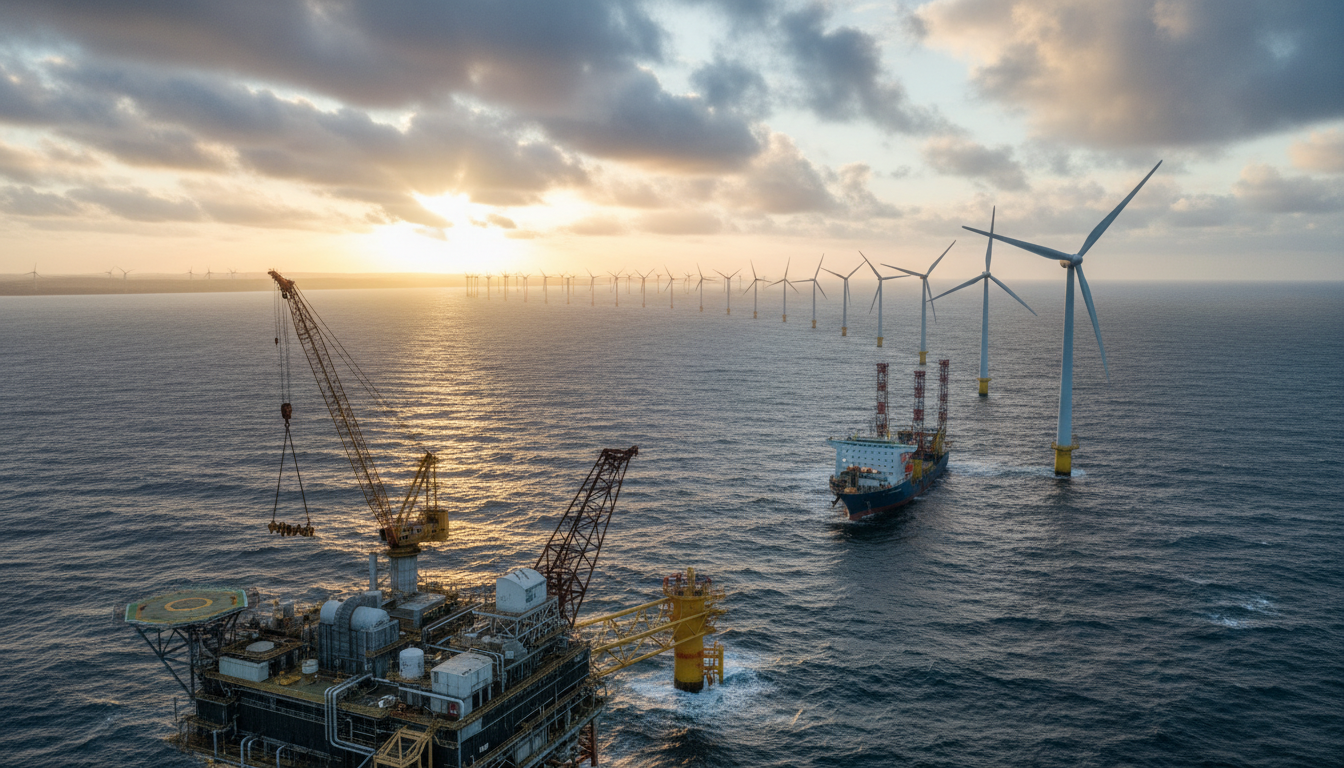
A significant €5 billion ($5.7 billion) Danish state support package has secured European Commission approval, accelerating the nation’s ambitious offshore wind development agenda. This landmark decision, operating under the European Union’s forward-looking Clean Industrial Deal State Aid Framework, signals a robust commitment to expediting renewable energy deployment across the continent, directly impacting investment strategies in the broader energy sector.
For financial stakeholders and energy companies, this move solidifies offshore wind as a cornerstone of Europe’s energy transition, backed by substantial state capital. The approved scheme enables Denmark to advance two critical offshore wind projects, Hesselø and North Sea I Mid, through a comprehensive 20-year support mechanism. This strategic clearance, enacted within a framework established in June 2025, underscores a strengthened alignment between industrial policy objectives and aggressive climate targets, leveraging public funding to attract and de-risk private capital while maintaining essential market discipline.
Massive Scale Projects Bolster European Energy Security
These initiatives represent Denmark’s next frontier in renewable energy deployment, poised to deliver substantial new capacity to the grid. The Hesselø offshore wind farm alone is engineered to contribute a minimum of 800 megawatts (MW), projected to generate approximately 3.2 terawatt-hours (TWh) annually. Complementing this, the North Sea I Mid project will add at least 1 gigawatt (GW) of capacity, with an estimated yearly production of 4.6 TWh.
Combined, these two colossal wind farms are forecast to produce roughly 7.8 TWh each year, a volume equivalent to approximately one-quarter of Denmark’s total electricity consumption based on recent national output figures. This impressive scale positions these developments among the most impactful additions to the country’s renewable portfolio in recent history, significantly enhancing national energy independence.
Furthermore, this expansion reinforces Denmark’s strategic role as a pivotal North Sea energy hub. Such large-scale infrastructure investments are critical for the EU’s broader objective to curtail reliance on imported fossil fuels and to fortify regional energy system stability amidst evolving geopolitical landscapes. Investors tracking the shift in energy infrastructure will recognize the long-term value proposition inherent in such strategically important, state-backed assets.
Sophisticated Financing Structure Balances Investor Certainty with Fiscal Prudence
The financial architecture underpinning this Danish scheme is centered on a two-way contract for difference (CfD) model, a mechanism increasingly favored across Europe for financing large-scale renewable energy projects due to its balanced risk-reward profile.
Under this sophisticated structure, developers secure a variable premium. This premium is calculated based on the differential between their successful bid price and a dynamic reference market price, which undergoes monthly recalibration. When prevailing market electricity prices dip below the predetermined agreed level, the state intervenes to compensate the project operators, safeguarding their revenue streams and offering crucial downside protection. Conversely, when market prices surge above the agreed threshold, operators are mandated to return excess revenues to the government. This mechanism prevents developers from realizing windfall profits during periods of exceptionally high electricity prices, effectively managing public expenditure and ensuring fairness.
A crucial aspect of the European Commission’s approval highlights that the scheme is meticulously designed to avoid subsidizing production during periods of negative electricity prices. This ensures that financial support remains intrinsically linked to the potential economic value of output, rather than simply actual generation under unfavorable market conditions, thereby upholding market integrity and incentivizing efficient operation. For investors, this structure offers a compelling blend of predictable, long-term returns with built-in risk mitigation against volatile energy markets.
Regulatory Alignment and Standardized Investment Environment
The European Commission’s regulatory approval hinged on strict compliance with the Clean Industrial Deal State Aid Framework. This framework, designed to streamline and standardize public funding for strategic clean energy infrastructure, imposes stringent requirements for competitive bidding processes and robust market integration.
The Commission’s review concluded that Denmark’s scheme fully adheres to these principles. This ensures that the financial support is awarded through transparent, competitive mechanisms and remains fully consistent with broader European electricity market design rules. For corporate stakeholders and institutional investors, this validation signifies a more predictable and harmonized regulatory environment across EU member states. This standardization is vital for reducing fragmentation in how large-scale renewable projects are financed and approved, potentially easing cross-border capital deployment.
A key European executive underscored the operational significance of this approval, stating that the scheme would enable Denmark to accelerate the deployment of its offshore wind capacities, directly in line with the objectives of the Clean Industrial Deal. This emphasis on actionable progress reinforces the commitment to aggressive decarbonization targets.
Implications for Investors and Energy Sector Leaders
For investors focused on the evolving energy landscape, this approval further solidifies offshore wind as a robust and attractive asset class within Europe’s energy transition. The deployment benefits from long-term policy certainty and increasingly sophisticated risk-sharing mechanisms.
The two-way CfD model continues to mature as a preferred instrument for de-risking significant capital-intensive projects. It provides essential downside protection while allowing for exposure to market upside within clearly defined parameters. This balance is critical, especially as large-scale capital projects across the energy spectrum face mounting costs and tighter financing conditions globally.
Energy companies and utilities, including traditional oil and gas majors diversifying their portfolios, should note the EU’s clear emphasis on scale. Multi-gigawatt projects are becoming central to national energy strategies, favoring developers with proven capabilities to execute complex offshore developments and adeptly navigate intricate regulatory frameworks. This trend presents both opportunities and challenges for firms looking to pivot into or expand their presence within the renewable energy sector.
A Blueprint for Europe’s Industrial Energy Transition
Denmark’s approved offshore wind scheme serves as a compelling blueprint, illustrating how strategic public funding, regulatory harmonization, and market-based mechanisms are converging to accelerate renewable energy deployment at scale across Europe. As EU member states intensify their efforts to achieve ambitious 2030 climate targets, similar frameworks are highly likely to be adopted and replicated. This is particularly true for offshore wind, where the sheer capital requirements and lengthy project timelines necessitate robust state backing and a predictable investment environment.
The broader implication for financial markets and the energy industry is clear: Europe is not merely expanding its renewable energy capacity; it is fundamentally reshaping the financial and governance models that underpin its entire energy system. This represents a significant shift in capital allocation, risk management, and long-term strategic planning for all participants in the global energy market.
