

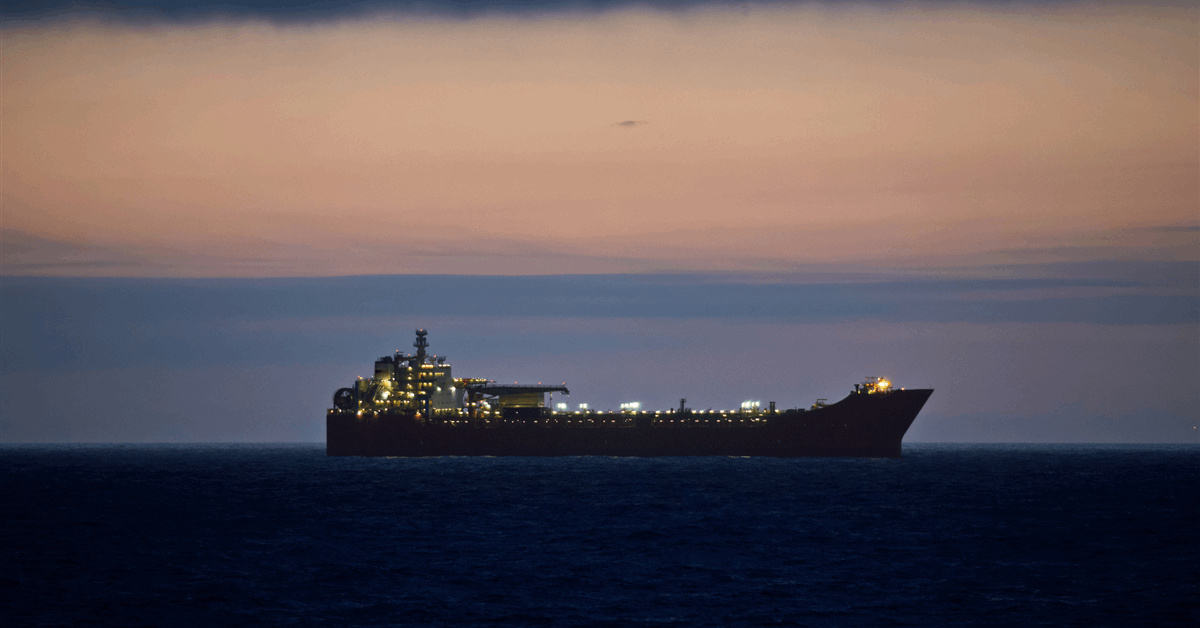
Equinor ASA on Tuesday announced another oil discovery around the Johan Castberg field on Norway’s side of the Barents Sea, with preliminary estimated recoverable resources of 24 million barrels of oil equivalent.
The Norwegian majority state-owned explorer and producer said in an online statement the Polynya Tubåen discovery, made in well 7220/7-5 of production license (PL) 532, would be tied back to Johan Castberg infrastructure. Johan Castberg is under the same license.
“The volume basis in Johan Castberg was originally estimated at 500-700 million barrels, and Equinor has an ambition to increase this by an additional 200-500 million barrels”, the operator said.
Johan Castberg, the Nordic country’s northernmost oilfield, started production in the first quarter of 2025 and reached its capacity of 220,000 barrels per day in June 2025, according to Equinor.
“With Johan Castberg, we opened a new oil province in the Barents Sea one year ago”, said Grete Birgitte Haaland, Equinor director for Exploration and Production North. “It is encouraging that we are now making new discoveries in the area. We plan to drill one to two exploration wells annually in this region going forward to increase the resource base and maintain plateau production for a longer period”.
Johan Castberg is only the third hydrocarbon development to have been put into production in the Norwegian Barents Sea, after Equinor-operated Snøhvit, which went online 2007, and Vår Energi ASA-operated Goliat, which began production 2016, according to data from government website Norskpetroleum.no. According to an Equinor statement June 20, 2025 announcing full production at the field, Johan Castberg raised deliveries from the Barents Sea by 150 percent.
The approved development plan consists of the Skrugard, Havis and Drivis discoveries, proven between 2011 and 2013, according to Norskpetroleum.no.
On June 30, 2025 Equinor announced the Drivis Tubåen discovery, in the same license as Polynya Tubåen. Equinor put preliminary estimates for Drivis Tubåen at 9-15 million barrels of oil. Equinor also plans to develop the discovery as a Johan Castberg tieback.
On December 11, 2025 Equinor made a final investment decision to proceed with Isflak, the first discovery to be connected to Johan Castberg.
“Recoverable oil in the new subsea development [Isflak] is estimated at 46 million barrels, and start-up is planned as early as the fourth quarter of 2028”, Equinor said.
The field, discovered 2021, is estimated to cost over NOK 4 billion, according to Equinor.
Construction for Isflak began March 2026, Equinor said Tuesday.
With the Polynya Tubåen discovery, 17 wells have now been drilled in PL 532, the Norwegian Offshore Directorate said separately.
Equinor operates the license, awarded 2009, with a 46.3 percent stake through Equinor Energy AS. Eni SpA-backed Vår Energi owns 30 percent. Norway’s state-owned Petoro AS has 23.7 percent.
To contact the author, email jov.onsat@rigzone.com
What do you think? We’d love to hear from you, join the conversation on the
Rigzone Energy Network.
The Rigzone Energy Network is a new social experience created for you and all energy professionals to Speak Up about our industry, share knowledge, connect with peers and industry insiders and engage in a professional community that will empower your career in energy.
element
var scriptTag = document.createElement(‘script’);
scriptTag.src = url;
scriptTag.async = true;
scriptTag.onload = implementationCode;
scriptTag.onreadystatechange = implementationCode;
location.appendChild(scriptTag);
};
var div = document.getElementById(‘rigzonelogo’);
div.innerHTML += ” +
‘ ‘ +
‘ +
”;
var initJobSearch = function () {
////console.log(“call back”);
}
var addMetaPixel = function () {
if (-1 > -1 || -1 > -1) {
/*Meta Pixel Code*/
!function(f,b,e,v,n,t,s)
{if(f.fbq)return;n=f.fbq=function(){n.callMethod?
n.callMethod.apply(n,arguments):n.queue.push(arguments)};
if(!f._fbq)f._fbq=n;n.push=n;n.loaded=!0;n.version=’2.0′;
n.queue=[];t=b.createElement(e);t.async=!0;
t.src=v;s=b.getElementsByTagName(e)[0];
s.parentNode.insertBefore(t,s)}(window, document,’script’,
‘https://connect.facebook.net/en_US/fbevents.js’);
fbq(‘init’, ‘1517407191885185’);
fbq(‘track’, ‘PageView’);
/*End Meta Pixel Code*/
} else if (0 > -1 && 69 > -1)
{
/*Meta Pixel Code*/
!function(f,b,e,v,n,t,s)
{if(f.fbq)return;n=f.fbq=function(){n.callMethod?
n.callMethod.apply(n,arguments):n.queue.push(arguments)};
if(!f._fbq)f._fbq=n;n.push=n;n.loaded=!0;n.version=’2.0′;
n.queue=[];t=b.createElement(e);t.async=!0;
t.src=v;s=b.getElementsByTagName(e)[0];
s.parentNode.insertBefore(t,s)}(window, document,’script’,
‘https://connect.facebook.net/en_US/fbevents.js’);
fbq(‘init’, ‘1517407191885185’);
fbq(‘track’, ‘PageView’);
/*End Meta Pixel Code*/
}
}
// function gtmFunctionForLayout()
// {
//loadJS(“https://www.googletagmanager.com/gtag/js?id=G-K6ZDLWV6VX”, initJobSearch, document.body);
//}
// window.onload = (e => {
// setTimeout(
// function () {
// document.addEventListener(“DOMContentLoaded”, function () {
// // Select all anchor elements with class ‘ui-tabs-anchor’
// const anchors = document.querySelectorAll(‘a .ui-tabs-anchor’);
// // Loop through each anchor and remove the role attribute if it is set to “presentation”
// anchors.forEach(anchor => {
// if (anchor.getAttribute(‘role’) === ‘presentation’) {
// anchor.removeAttribute(‘role’);
// }
// });
// });
// }
// , 200);
//});
