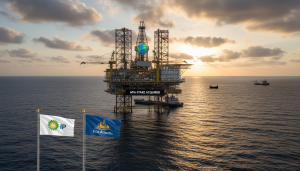
Equinor, a dominant force on the Norwegian Continental Shelf (NCS), has just signaled a powerful commitment to its long-term production strategy, awarding a series of framework agreements valued at over $9 billion (NOK 100 billion). These substantial contracts, spanning maintenance, modifications, and large project work, are not merely operational expenditures; they represent a strategic anchor for Equinor’s ambition to sustain high production levels well into the next decade. For investors, this move underscores the critical importance of predictable, long-term operational stability in an energy market often swayed by short-term volatility and geopolitical shifts. As global energy demand continues its upward trajectory, Equinor’s proactive investment in its core assets provides a compelling case for the resilience and enduring value of established oil and gas producers.
Strategic Commitment Amidst Market Volatility
In an environment where energy prices can swing dramatically, Equinor’s decision to commit NOK 100 billion ($9+ billion) to long-term operational stability offers a clear signal of confidence in the enduring value of its NCS assets. As of today, Brent Crude trades at $90.34, down slightly by 0.1% within a day range of $93.87-$95.69, while WTI Crude sits at $86.97, reflecting a 0.51% dip. This snapshot, however, belies a more significant trend: Brent has seen a notable decline of nearly 20% over the past 14 days, falling from $118.35 to $94.86. Such pronounced price movements naturally spark investor questions, with many asking about the future trajectory of WTI or the broader oil price outlook by the end of 2026. Equinor’s massive contract awards, scheduled to begin in the first half of 2026 and extending for five years with options for an additional five, effectively de-risk a significant portion of their operational costs and secure critical services irrespective of short-term market gyrations. This long-term visibility provides a stable foundation, indicating that Equinor is betting on sustained demand and the strategic imperative of continuous production, rather than reacting to daily price fluctuations.
Anchoring the Norwegian Continental Shelf’s Future Production
The core of Equinor’s strategy is to maintain production near 1.2 million barrels of oil equivalent per day (MMboed) through 2035 on the Norwegian Continental Shelf. This is an ambitious target, especially as the NCS enters a more mature phase, demanding intensified recovery efforts and infrastructure upkeep. The newly awarded framework agreements are designed precisely to meet this challenge. The scope of work is immense: Equinor plans annual investments of NOK 60–70 billion in increased recovery and new field developments, approximately 250 exploration wells, 600 recovery wells, and 300 well interventions. Furthermore, around 2,500 modification projects are slated, alongside the maturation of more than 75 subsea tie-back developments to existing infrastructure. These efforts will span major offshore fields like Johan Sverdrup, Troll, Åsgard, Heidrun, Gullfaks, Oseberg, Snøhvit, and Johan Castberg, as well as critical onshore facilities including Hammerfest LNG, Mongstad, Kårstø, and Kollsnes. For investors, this detailed roadmap provides tangible evidence of Equinor’s commitment to maximizing value from its existing resource base, ensuring that these prolific assets remain productive contributors to the company’s financials for decades to come.
Implications for the Oilfield Services Sector and Beyond
The allocation of these twelve framework agreements to seven supplier companies is a significant boon for the Norwegian oilfield services sector, promising long-term stability and growth. Notably, three of these suppliers are new entrants to Equinor’s maintenance and modification portfolio, suggesting a healthy competitive landscape and potentially innovative approaches to efficiency and technology adoption. The contracts are estimated to generate roughly 4,000 man-years of employment, providing substantial economic ripple effects across the industry. Beyond direct employment, the agreements inherently support broader efforts to improve safety standards, enhance operational efficiency, and reduce emissions performance – critical considerations for investors increasingly focused on ESG metrics. This long-term commitment, with annual values estimated at NOK 10 billion, offers unparalleled visibility for the supplier industry, allowing these companies to invest in talent, technology, and infrastructure with greater certainty. For investors tracking the broader energy supply chain, these contracts represent a robust order book and a vote of confidence in the capabilities of the Norwegian service providers, signaling a potentially positive outlook for their respective financial performance.
Forward-Looking Outlook: Equinor’s Resilience and Global Supply Dynamics
Equinor’s long-term strategic investments arrive amidst a flurry of near-term market catalysts that could shape global oil supply and demand narratives. The upcoming OPEC+ JMMC Meeting on April 21st, followed by the EIA Weekly Petroleum Status Reports on April 22nd and 29th, and the Baker Hughes Rig Count on April 24th and May 1st, will all offer fresh insights into the immediate supply-demand balance. Further guidance will come from the EIA Short-Term Energy Outlook on May 2nd. While these events focus on the short to medium term, Equinor’s commitment to maintaining 1.2 MMboed production through 2035 provides a crucial long-term counterweight. This steady output from a major producer on the NCS contributes significantly to global energy security, helping to stabilize overall supply against potential disruptions or production cuts from other regions. For investors seeking clarity on the “price of oil per barrel by end of 2026,” Equinor’s proactive strategy suggests a belief in sustained demand fundamentals, irrespective of short-term market noise. Their multi-billion-dollar bet on the NCS signals resilience and a pragmatic approach to ensuring consistent energy delivery, positioning the company as a stable anchor in a dynamic global energy landscape.