

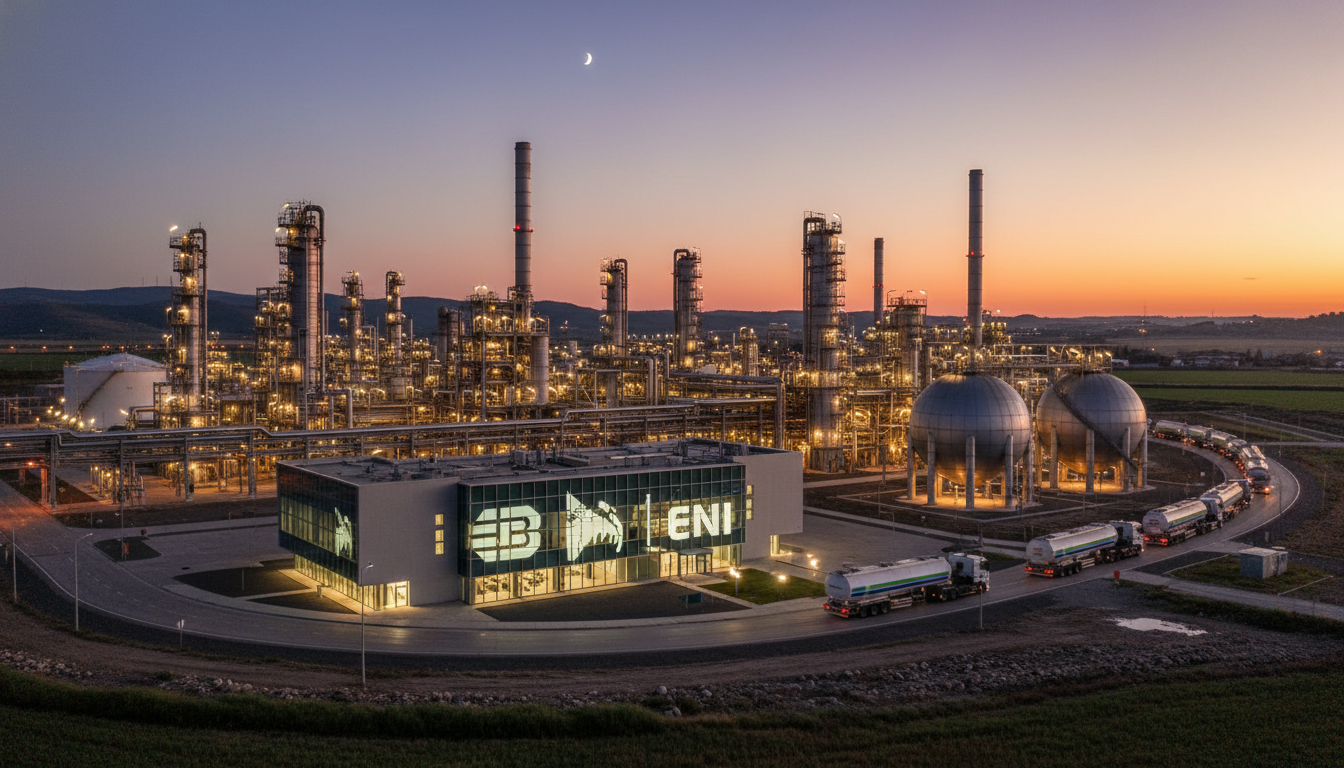
Eni Secures EIB Backing for Major Biorefinery Expansion, Bolstering European Biofuels Leadership
Italian energy titan Eni SpA recently solidified its position at the forefront of Europe’s sustainable fuels revolution by finalizing a significant 15-year, EUR 500 million ($575.62 million) loan from the European Investment Bank (EIB). This substantial financial injection is earmarked for accelerating biofuels production at Eni’s Sannazzaro de’ Burgondi refinery, located in Pavia, Lombardy. The strategic funding underscores the growing institutional confidence in advanced biofuels as a crucial component of the energy transition, offering investors a clear signal of Eni’s commitment and execution in this high-growth sector.
This latest EIB commitment marks the second major biorefining initiative undertaken by Eni with the bank’s support. Previously, the EIB pledged another EUR 500 million in July 2025 for the conversion of Eni’s Livorno refinery, a project the company anticipates completing this year. These consecutive large-scale financings highlight the strategic synergy between Eni’s industrial vision and the EIB’s mandate to foster sustainable development and strengthen Europe’s capacity for advanced fuel production.
Sannazzaro Conversion: A Strategic Leap in Biofuels Capacity
Eni’s final investment decision for the Sannazzaro de’ Burgondi biorefinery was announced on February 25, marking a definitive step forward for this ambitious project. While the facility will continue its traditional refining operations, it is set to incorporate a new, dedicated processing capacity of 550,000 metric tons annually for biofuel feedstock. This capacity will primarily utilize waste materials and residues, emphasizing a circular economy approach to fuel production. Operations at the converted biorefinery are projected to commence in 2028, showcasing Eni’s long-term planning and investment horizon.
The Sannazzaro facility’s design prioritizes flexibility, enabling the production of both hydrogenated vegetable oil (HVO) diesel and sustainable aviation fuel (SAF). This dual-production capability positions Eni to capitalize on diverse and rapidly evolving market demands. HVO biofuels are recognized for their immediate contribution to emissions reduction across the entire transport spectrum, including aviation, road, maritime, and rail, offering a tangible solution for decarbonization today. Meanwhile, demand for SAF is poised for exponential growth, particularly from 2030 onwards, driven by stringent blending mandates outlined in the European Union’s ReFuelEU Aviation Regulation. This regulatory tailwind provides a robust foundation for the technical and economic viability of the Sannazzaro project, ensuring its long-term sustainability and attractiveness for investors.
Driving Decarbonization and Value Creation
Eni’s leadership views biorefining and biofuels as indispensable for achieving meaningful decarbonization across the transport sector. Claudio Descalzi, Eni’s Chief Executive, emphasized the necessity of creating businesses that generate value while delivering impactful energy solutions with reduced environmental footprints. He highlighted the successful combination of advanced technology, industrial-scale project delivery, and an expanding customer base as key drivers. This perspective aligns directly with Eni’s broader strategy to enhance biofuel production in response to rising European and Italian demand, aiming to meet the ambitious emissions reduction targets stipulated by the Renewable Energy Directive and comply with national regulations concerning pure biofuels.
Eni is already Europe’s second-largest producer of biofuels, a testament to its proactive stance in the energy transition. Beyond Sannazzaro and Livorno, the company is actively pursuing three refinery conversions in Italy, building on the successful completion of two other biorefineries in Venice and Gela. These operational facilities already contribute significantly to supplying more environmentally sustainable fuels for the transport sector, demonstrating a proven track record of execution in this complex industrial space.
Expanding Eni’s Global Biorefining Footprint
Eni’s strategic expansion in biofuels extends beyond Italy’s borders. In a notable development on February 3, Eni announced a partnership with Kuwait Petroleum International Ltd to jointly develop another biorefinery in Priolo, Sicily. This collaborative venture aims to produce up to 500,000 metric tons per annum of HVO diesel and SAF. The Priolo project is slated to rise on the site of an existing Eni ethylene plant, which is set for decommissioning, showcasing a strategic repurposing of industrial assets. With a targeted completion date of 2028, this facility will similarly rely on sustainable feedstocks, including vegetable waste, oils, and animal fats.
Further demonstrating its global ambition, Eni, in collaboration with Euglena Co Ltd and Petroliam Nasional Bhd (Petronas), commenced construction on a new biorefinery in Pengerang, Johor, Malaysia, late last year. A joint statement issued on November 10, 2025, confirmed the facility’s impressive processing capacity of 650,000 metric tons per annum. Expected to be operational by 2028, this Malaysian plant is designed to produce bio-naphtha, HVO, and SAF, diversifying its product portfolio. Like its European counterparts, the Malaysian facility will utilize a range of wastes such as used vegetable oils, animal fats, and residues from processed vegetable oils as primary feedstocks.
Ambitious Capacity Targets Signal Future Growth
Eni’s current biofuels production network includes two Italian plants in Venice and Gela, alongside a facility in Louisiana, United States, operated through its 50 percent-owned joint venture, St Bernard Renewables LLC. Combined, these operations boast a robust production capacity of 1.65 million metric tons per annum (MMtpa). Looking ahead, Eni has set an ambitious target to significantly expand its biofuel production capacity to five MMtpa by 2030. Within this substantial increase, sustainable aviation fuel (SAF) is projected to account for over two MMtpa, underscoring Eni’s strategic focus on meeting the burgeoning demand from the aviation sector. These aggressive growth projections illustrate a compelling investment thesis, positioning Eni as a dominant force in the rapidly evolving landscape of advanced sustainable fuels.
