

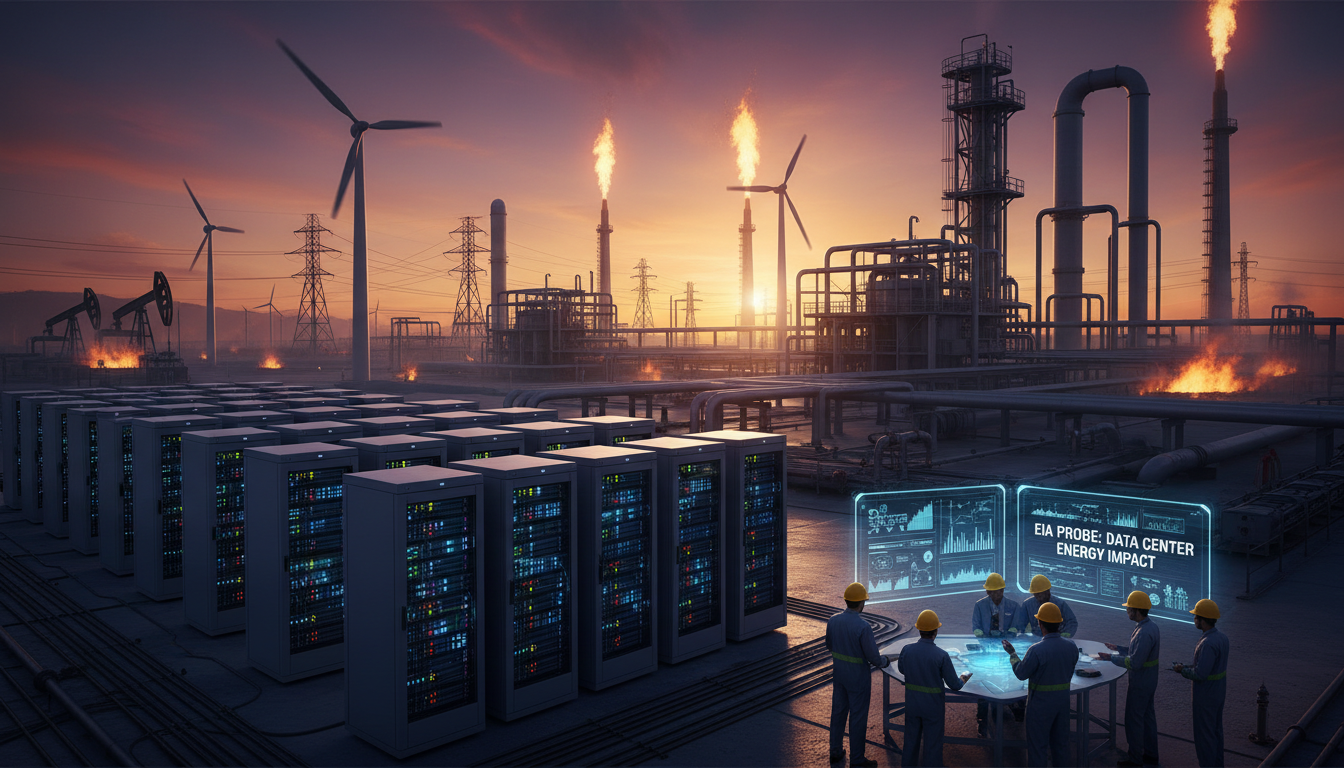
AI’s Energy Appetite: Data Centers Drive Unprecedented Demand for Natural Gas and Electricity
The burgeoning artificial intelligence revolution is fundamentally reshaping the landscape of U.S. energy consumption, creating an unprecedented surge in electricity demand that positions natural gas as an indispensable fuel for investors. The U.S. Energy Information Administration (EIA) is actively responding to this shift, launching critical initiatives to better understand and forecast the energy footprint of the nation’s rapidly expanding data center infrastructure.
EIA Pioneers Granular Data Collection for a Dynamic Energy Sector
In a strategic move to modernize its data collection, the EIA has initiated three voluntary pilot field studies aimed at thoroughly evaluating energy consumption within data centers. These studies represent a significant step towards providing more timely and detailed insights into a sector quickly becoming a primary driver of power demand. The agency has commenced web-based pilot surveys in key growth regions: Texas and Washington state, alongside in-person interviews conducted in Northern Virginia and Washington, D.C. The EIA has identified 196 companies operating data centers across these targeted areas, with each organization requested to report on the energy usage of at least one facility.
The data collection goes beyond basic consumption figures. The comprehensive questionnaire delves into crucial details, including energy sources utilized, specific electricity consumption metrics, site characteristics, server performance data, and the efficiency of cooling systems. This granular approach underscores a commitment to precision. EIA Administrator Tristan Abbey emphasized the need for this evolution, stating that while retrospective surveys have provided excellent insights, the focus is now shifting towards “faster cycles and finer detail” to keep pace with the energy sector’s rapid transformation.
This concentrated effort on data centers is part of a broader strategy by Administrator Abbey to prioritize data collection across evolving energy landscapes. Earlier this year, the EIA also launched voluntary pilot studies to assess the feasibility of gathering data on critical minerals vital to the energy sector, specifically graphite, vanadium, and zirconium. Furthermore, the agency is in the preliminary planning stages for similar field studies targeting other crucial segments of the energy economy, including the nuclear sector, signaling a comprehensive overhaul of its information-gathering capabilities.
America’s Power Grid: Navigating an Unprecedented Demand Surge
The strategic importance of these data center studies becomes evident when examining recent EIA forecasts on U.S. electricity demand. Earlier projections indicated the nation is poised for its strongest four-year growth in electricity demand since the year 2000, primarily fueled by the proliferation of data centers. The EIA anticipates U.S. electricity consumption will increase by one percent this year and a further three percent in 2027. Should these projections materialize, it would mark the first instance since 2007 that power demand has risen for four consecutive years, signaling an unprecedented period of sustained growth driven overwhelmingly by the expanding requirements of large computing facilities.
Administrator Abbey highlighted the critical interplay between energy production and this rising demand, noting that “U.S. energy production remains strong, and natural gas output is expected to grow to nearly 109 billion cubic feet per day this year.” He further underscored that robust natural gas supply is “critical as we forecast that U.S. liquefied natural gas exports expand and electricity demand rises through 2027, driven largely by increasing demand from large computing facilities, including data centers.” This outlook paints a clear picture for energy investors: natural gas is the foundational fuel enabling the digital economy’s expansion.
The EIA’s latest Short-Term Energy Outlook (STEO) released earlier this month reinforced these trends, projecting U.S. electricity generation to expand by 1.2 percent in 2026 and accelerate to 3.1 percent in 2027. This growth is predominantly led by the Electric Reliability Council of Texas (ERCOT) region, a hotbed for data center development. Since 2021, U.S. electricity generation has been climbing by an average of two percent annually, marking a significant departure from the decade of flat demand growth experienced between 2010 and 2019. While renewable sources are increasing their contribution, the forecast also indicates a seven percent decline in U.S. coal generation by 2026, accompanied by the retirement of approximately four percent of coal-fired generating capacity within the electric power sector.
Natural Gas: The Indispensable Powerhouse for Digital Growth
The critical role of natural gas in this energy paradigm is further solidified by the EIA’s natural gas production forecasts. The latest STEO projects that higher crude oil production will lead to increased associated natural gas production. Marketed natural gas production is expected to average 121 billion cubic feet per day (Bcfpd) this year, marking a two percent increase from 2025 levels. This robust growth trajectory continues into 2027, with production anticipated to rise by an additional three percent to reach 124 Bcfpd – a figure almost two Bcfpd higher than the previous month’s outlook. For investors, these numbers highlight sustained demand for natural gas, underpinning strong fundamentals for the sector.
IEA Validates Exponential Data Center Energy Growth and Natural Gas Dominance
Independent analysis from the International Energy Agency (IEA) provides compelling corroboration for these trends, projecting a staggering surge in U.S. data center electricity consumption. The IEA estimates that U.S. data center electricity use is set to more than triple between 2021, the last full year before the widespread adoption of advanced AI models like ChatGPT, and 2030. This exponential growth offers the closest available proxy for the energy consumption driven by artificial intelligence.
According to IEA data, U.S. data center electricity demand stood at 108.41 Terawatt hours (TWh) in 2020, rising to 120.65 TWh in 2021. This accelerated to 134.07 TWh in 2022, reached 154.07 TWh in 2023, and is estimated at 182.61 TWh for 2024. The IEA’s “Energy and AI” report further forecasts this consumption will exceed 200 TWh in 2025, surpass 250 TWh in 2026, climb beyond 300 TWh in 2027, approach 350 TWh in 2028, and nearly reach 400 TWh by 2029, ultimately soaring to well over 400 TWh in 2030 under its base case scenario.
Crucially, an IEA chart detailing electricity generation for U.S. data centers by fuel type from 2020 to 2035 consistently demonstrates natural gas’s dominant and expanding role. In 2020, natural gas generated approximately 50 TWh of electricity for data centers. This figure showed a slight increase in 2021 and 2022, approaching 100 TWh in 2024. The IEA projects natural gas generation for data centers to slightly exceed 100 TWh this year, significantly surpass 100 TWh in 2026, reach around 150 TWh in 2027, and continue its upward trajectory towards 200 TWh by 2028. By 2029, this figure is expected to surpass 200 TWh, with projections indicating it will climb well above this mark by 2030.
These comprehensive forecasts from both the EIA and IEA provide a clear signal for investors: the relentless demand from data centers, fueled by the AI revolution, is establishing a robust and long-term growth driver for natural gas. Companies positioned in natural gas production, power generation, and associated energy infrastructure are uniquely poised to capitalize on this transformative shift in the global energy landscape.
