

It’s a mind-blowing idea: an economic model of the world in which every company is individually represented, making realistic decisions that change as the economy changes. From this astonishing complexity would emerge forecasts of unprecedented clarity. These would be transformative: no more flying blind into global financial crashes, no more climate policies that fail to shift the dial.
This super simulator could be built for what Prof Doyne Farmer calls the bargain price of $100m, thanks to advances in complexity science and computing power.
If you are thinking this sounds crazily far-fetched, then you’re betting against a man who, with friends, beat the casino at roulette in the 1970s using the first wearable digital computer and beat Wall Street in the 1990s with an automated rapid-trading computer company that was later sold to the bank UBS.
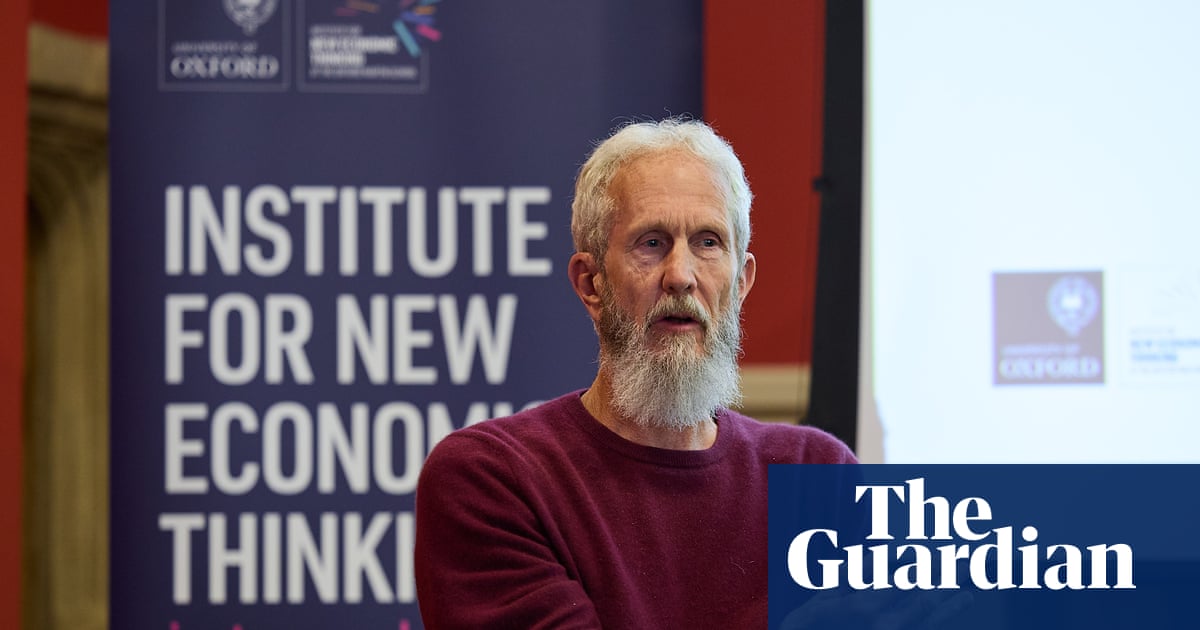
Farmer, now at Oxford University, is a softly spoken polymath, whose academic adventures have taken him from cosmology to chaos theory to theoretical biology. Now, his 50-year career has brought him to his biggest challenge yet: “We want to do for economic planning what Google maps did for traffic planning, so we can give anybody who has an economic question an intelligent and useful answer.”
Traditional economic models are either too simple to give useful forecasts or too complex for even today’s computers to handle. Complexity economics offers a path through, says Farmer, and wouldn’t even need to be that much better to be a good investment.
The global financial crash in 2008, sparked by a real estate collapse in the US, cost the world about $10tn. “If in 2006 the US central bank had the model we could build now, they would have said: ‘Wow, this is really going to be a disaster – we’ve got to act now and save the world a lot of pain’.”
If the $100m model had given enough foresight to cut just 1% of the losses, it would have paid back the investment 1,000 times over.
This isn’t just talk: Farmer and colleagues built a retrospective model of US real estate transactions based on a vast data trove that would have given crucial insights. More recently, they built a complex model of how the UK economy reacted to the Covid pandemic, which they say would have indicated the best compromise between protecting health and protecting the economy.
But Farmer, who is 73, has now set his sights on the climate crisis: “In my old age, I want to do good things for the world and I think this is the biggest problem we’re facing, maybe along with political polarisation, which unfortunately is itself making [the climate crisis] even harder to deal with. The world is going to experience a lot of pain due to not coping with climate change.
“Secondly, it’s an area where the failure of economic models is seen most dramatically,” he says. “I think the models we have are completely inadequate and even misleading. For example, the track record for these models in saying what renewable energy was going to do is genuinely terrible. They consistently predicted that it would be very slow to roll out and the cost would come down very slowly.” In reality, costs have plunged and the rollout has been rapid.
Driven by this, Farmer’s team’s first step towards a complexity model of the entire world economy is tackling the energy sector. The model encompasses all 30,000 companies and their 160,000 oil rigs, power stations and other assets, based on a rich, 25-year-long dataset of how they have operated.
“We’re literally modelling the decision-making of all the energy companies in the world,” he says, each represented by a separate digital agent in the model. “We can simulate the whole energy system of the world to see how much energy each company delivers and at what price.”
The model is still in development, but should be much better at laying out the best path to a green energy future than today’s economic models. That could be transformative – a data-led study by Farmer and colleagues in 2022 found that a rapid transition to clean energy could save the world trillions of dollars.
‘A complicated beast’
The new complexity models solve two fundamental problems with mainstream economic models. The first is that the existing models assume economic actors make perfect, rational decisions. For each agent to make perfect decisions, it has to know everything about the system and everything about what every other agent is doing.
In systems with only a handful of agents, it’s just about possible to keep track of everything. But with even a few dozen agents, let alone thousands or millions, it becomes an impossible computing task, even for the most powerful machines in the world today. “So the models are necessarily kept simple, which means that you can’t model the real world very well, as the economy is a pretty complicated beast,” says Farmer.
The new models are different: they allow the agents to make decisions based on simple rules: for example, imitating the best, or trial and error. Ironically, this is a better reflection of the real world, because people don’t make perfect decisions, as behavioural economics has long shown. This simplification hugely reduces the computing power required.
“Whereas the normal way of doing things is limited to five or at most 10 different agents, and that would be a lot, we can do millions of them,” says Farmer.
Distilling the simple rules the agents use from the analysis of large amounts of real-world data makes the models even more realistic and useful. But there’s another problem, called the Lucas critique, which is that people may change the way they make decisions as the world changes. Complexity science has a solution to this too: using machine learning to enable the agents to evolve their strategies.
“There are already some studies showing this in really simple settings,” says Farmer. “We’re going to be able to do that in more complicated settings – that’s a frontier problem we’re working on right now.”
The second fundamental problem with mainstream economic models is that they are assumed to be in equilibrium. That means supply and demand are balanced, or that every agent is acting perfectly. But the real world is far from in equilibrium – if it were, there would not be crashes. To explain these, mainstream economists have to introduce external shocks: they call it “kicking the rocking horse”.
In contrast, the way complexity models are set up means economic cycles emerge without any introduced shocks. “You get fads, booms and busts, all that stuff, happening internally, driven by the fact that the agents are changing their strategies over time. They’re learning in a dynamic world, where they are chasing each other’s tails and things don’t settle down.”
‘Deep academic rut’
So how did we end up with today’s ineffective economic models? Farmer points to several reasons. “We got stuck in a very deep academic rut back in the 1960s,” he says, when the big debate about how to do economics was won by the people who said agents were perfect rational actors. “So we’ve been doing it that way ever since. The academic establishment has let itself become too close-minded and has been very resistant to different ways of doing things.”
Another reason is computing power. “Back then, computers were a billionth as powerful as they are now, and the [economic] data wasn’t there, so it was much harder to do things the way we’re doing it now,” he says.
Lastly, he says: “Economics was colonised by mathematicians, not by physicists. Physicists have a much more practical viewpoint. Mathematician economists like to prove theorems and have highfalutin models. Physicists go, ‘Oh, this isn’t right, let’s just roll up our sleeves and simulate the world.’”
The target of developing the complexity model of the global economy has become an urgent task for Farmer: “I really want to realise this goal within 10 years – hopefully we can even get there in five years. I’m old enough that I feel a certain urgency. I’d like to see it happen before I die or I go senile.”
He believes it would be a revolutionary tool, enabling politicians and business leaders to far more confidently forecast the impact their decisions will have, grabbing opportunities and avoiding pitfalls. In the case of the climate crisis, that could accelerate the world down a cheaper path to ending emissions.
“It’s a very exciting endeavour – stay tuned,” he says. “Of course, if somebody wants to give us millions of dollars to help build these models, we’ve got our hat out.”
Doyne Farmer’s book, Making Sense of Chaos: A Better Economics for a Better World was published in 2024
