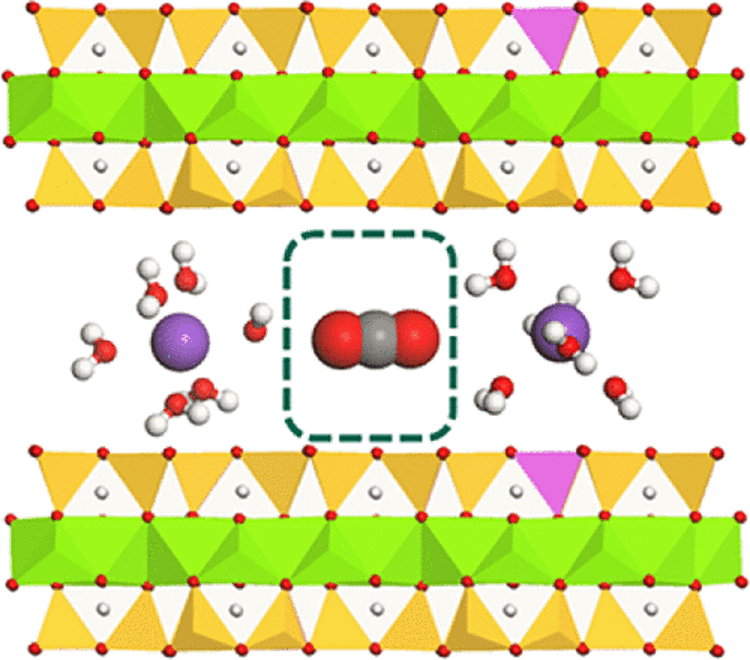
The global energy landscape is constantly evolving, demanding innovative solutions to reconcile energy security with environmental sustainability. Amidst this complex transition, a groundbreaking study from Purdue University and Sandia National Laboratories has unveiled a novel approach to carbon capture that could redefine the economics and scalability of CO2 removal. This research, recognized with a 2024 R&D 100 Award and backed by a patent application, centers on the unexpected potential of common clay minerals to simultaneously absorb carbon dioxide and water at ambient concentrations. For investors navigating the intricate currents of oil and gas markets, this development signals a significant opportunity, offering a potentially low-cost, abundant pathway to decarbonization that warrants close attention.
Clay Minerals: A Game Changer for Carbon Capture?
The core innovation lies in the discovery that certain clay minerals, specifically smectites, can effectively capture carbon dioxide from the air while also absorbing water. This dual-capture capability, observed at typical atmospheric CO2 levels, addresses a critical challenge in direct air capture (DAC) technologies. Historically, the high costs and energy intensity associated with traditional absorbents have hindered widespread deployment. Clays, however, offer a compelling alternative. Their inherent abundance and accessibility make them an exceptionally inexpensive resource. Furthermore, their unique physical properties, characterized by an exceptionally high internal surface area – one tablespoon can rival the size of an American football field – provide ample sites for molecular interactions. Researchers have spent decades understanding how these internal pores, with their distinct polar and nonpolar regions, selectively attract CO2 to nonpolar areas and water vapor to polar regions. This selective mechanism, coupled with the ability to optimize ionic structure, positions clays as a powerful, naturally occurring nanomaterial for large-scale environmental solutions.
Economic Viability in a Volatile Market
In an era where energy majors are increasingly pressured to decarbonize their operations and diversify their portfolios, the economic viability of carbon capture technologies is paramount. Traditional CCS projects often face significant capital expenditure and operational costs, limiting their widespread adoption. The prospect of utilizing abundant, affordable geosorbents like smectite clays fundamentally alters this equation. By reducing the material cost component, this research could pave the way for more economically attractive carbon capture and utilization (CCUS) projects. This is particularly relevant as integrated energy companies seek robust hedging strategies against future carbon pricing and regulatory shifts. A scalable, low-cost CO2 capture method could extend the operational life of existing assets and unlock new revenue streams from carbon credits or CO2-derived products, providing a strategic advantage in a market increasingly focused on environmental performance and long-term sustainability.
Navigating Current Market Dynamics and Future Trends
The potential of clay-based carbon capture emerges against a backdrop of dynamic and sometimes volatile crude markets. As of today, Brent Crude trades at $96.25, up 1.54%, with an intraday range of $91-$96.89. This follows a notable downward trend from $102.22 on March 25 to $93.22 just yesterday, reflecting an 8.8% decline over the past two weeks. Such fluctuations underscore the importance for investors of seeking long-term value propositions beyond immediate price movements. While the market closely watches upcoming events like the Baker Hughes Rig Count on April 17 and April 24, and the critical OPEC+ meetings – JMMC on April 18 and the Full Ministerial on April 20 – for short-term supply signals, the strategic imperative for decarbonization remains constant. Furthermore, the EIA Weekly Petroleum Status Reports on April 22 and April 29 will offer insights into current inventory levels, influencing near-term price sentiment. However, these immediate concerns do not diminish the long-term significance of innovations like clay-based carbon capture, which offer a hedge against future carbon liabilities and align with the broader energy transition. Investments in such technologies are increasingly seen as a vital component of a resilient energy portfolio, offering stability amidst the inherent volatility of commodity markets.
Addressing Investor Questions: Beyond the Daily Price Forecast
Our proprietary reader intent data reveals a consistent focus among investors on near-term crude price forecasts, with frequent queries about building a base-case Brent price forecast for the next quarter and the consensus 2026 Brent outlook. Investors are also keen on specific regional demand drivers, such as the activity of Chinese tea-pot refineries and Asian LNG spot prices. While these operational and market-specific questions are crucial for tactical trading and short-term planning, the clay-based carbon capture research speaks to a different, equally vital investment horizon. It shifts the focus from merely forecasting the price of carbon-intensive fuels to investing in the solutions that manage and mitigate carbon emissions. This technology represents a potential long-term play on the inevitable growth of the CCUS market, influencing future carbon credit values and the regulatory landscape for all energy companies. For investors looking beyond the daily price charts, understanding these fundamental shifts in carbon management can unlock significant strategic value, providing a counterbalance to the inherent volatility of traditional oil and gas assets and offering exposure to the burgeoning green energy economy within the broader energy sector.