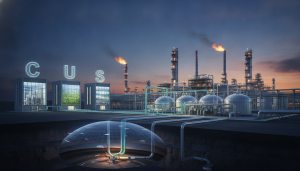
The global energy landscape continues its inexorable shift towards decarbonization, placing immense pressure on industries, particularly the traditional oil and gas sector, to innovate and adapt. In this challenging environment, a groundbreaking carbon capture technology is emerging from an unexpected subterranean source, promising to revolutionize industrial emissions management and present a compelling new avenue for green investment.
At the heart of this innovation lies the remarkable discovery made deep beneath the earth’s surface. Dr. Tanvi Govil, a distinguished biologist and assistant professor in the Karen M. Swindler Department of Chemical and Biological Engineering at South Dakota Mines, spearheaded a multidisciplinary research team that identified a unique consortium of microbes. These organisms, found flourishing 4,100 feet underground within the Sanford Underground Research Facility (SURF) – a repurposed gold mine in Lead, South Dakota – possess an extraordinary ability: they metabolize carbon dioxide gas, rapidly transforming it into stable mineral forms, essentially turning CO2 into rock.
The initial findings from this pioneering research indicated a dramatic leap in the efficiency of CO2 sequestration. Conventional underground storage methods often involve multi-year processes for mineralization. However, these newly identified microbes significantly accelerate this natural phenomenon, compressing the timeline from years down to a mere few weeks. Critically, Dr. Govil quickly recognized that this biological process offered a profound strategic advantage: it enabled the direct, on-site removal of greenhouse gas emissions, bypassing the complex and costly infrastructure typically associated with piping CO2 long distances for subterranean injection.
Engineering Nature’s Solution for Industrial Decarbonization
Building upon this foundational discovery, Dr. Govil is now leading an expansive initiative to curate a comprehensive library of microbes from diverse global environments. The objective is to isolate and identify strains exhibiting optimal characteristics for robust carbon capture. Researchers are meticulously combining the most effective traits from various microbes to engineer specialized enzymes. These enzymes are designed to efficiently convert CO2 found in industrial exhaust streams, such as those from coal-fired power plants, into calcium carbonate. This mineral byproduct holds significant commercial value, finding applications as an additive in concrete manufacturing or other industrial processes, thereby creating a dual benefit: emissions reduction coupled with a marketable commodity.
Validation of this innovative approach has already commenced. Dr. Govil’s team has conducted rigorous laboratory experiments utilizing actual flue gases and even residual coal ash obtained from local industrial partners. These tests have successfully confirmed the technology’s viability and effectiveness when exposed to real-world industrial emissions, laying a solid foundation for larger-scale implementation. The operational concept is elegantly simple: a substantial tank containing these specially engineered carbon dioxide-capturing enzymes would process emissions by bubbling exhaust gases from, for instance, a coal-fired power plant directly through the enzyme solution. This method effectively strips the CO2 from the exhaust stream, transforming it into the aforementioned valuable calcium carbonate.
Overcoming Historical Hurdles in Carbon Capture
While the concept of leveraging microbes for CO2 removal has long intrigued scientists, prior attempts faced significant practical hurdles. Industrial environments present extremely harsh conditions characterized by high temperatures, elevated pressures, and often high acidity – environments in which most biological agents simply cannot survive. This is precisely where the discovery at SURF provides a transformative advantage.
As Merle Symes, CEO of Carb-N0, the company established by Dr. Govil and her team to commercialize this technology, explains, these unique microbes evolved in extreme subterranean environments. Consequently, they not only tolerate but actually thrive under the very conditions that are typically lethal to other microorganisms found in factory and power plant flue gases. This inherent robustness makes the enzymatic solution highly adaptable and practical for widespread industrial deployment, addressing a critical weakness of earlier biological carbon capture strategies.
Carb-N0: Catalyzing Commercialization and Investor Value
The commercialization pathway for this technology is rapidly taking shape. Dr. Govil and Mr. Symes recently secured top honors in the prestigious South Dakota Governor’s Giant Vision Business Plan competition, validating both their innovative, patent-pending technology and their robust business model. Their immediate focus is refining the process and developing enzymes capable of maintaining their activity and integrity during shipping and deployment across various industrial sites globally.
The next critical phase involves pilot-scale testing. Dr. Govil’s team plans to construct a mobile, enzyme-based CO2 scrubber unit designed to be transportable on a truck bed. This versatile unit will enable on-site demonstration, directly connecting to industrial emission streams. Each of these mobile units will possess the capacity to capture nearly one ton of CO2 per day, providing concrete proof-of-concept for diverse industry partners and validating the commercial and operational viability of the technology. This strategy is crucial for building partnerships and securing future investment.
A Strategic Investment in the Decarbonized Future
The urgency surrounding climate solutions continues to intensify, driven by global environmental mandates and strong governmental support for carbon emissions reduction. Mr. Symes emphasizes the “win-win solution” presented by Carb-N0: a potent climate solution that also offers a pathway to economic benefit through byproduct monetization. For investors in the oil and gas sector and the broader energy market, this represents a significant opportunity to engage with next-generation decarbonization strategies.
The ambitious timeline underscores the commitment to bringing this technology to market expeditiously. With pilot testing slated for the current year, the goal is to initiate large-scale enzyme production by 2027. This trajectory means that a technology born from samples gathered 4,100 feet beneath the earth in a South Dakota gold mine could transition from scientific discovery to full commercial market launch in less than a decade. Such rapid development highlights the profound potential for this enzymatic carbon capture solution to become a cornerstone in industrial emissions reduction, offering a compelling investment thesis for those looking to capitalize on the energy transition and the burgeoning market for sustainable industrial technologies.