

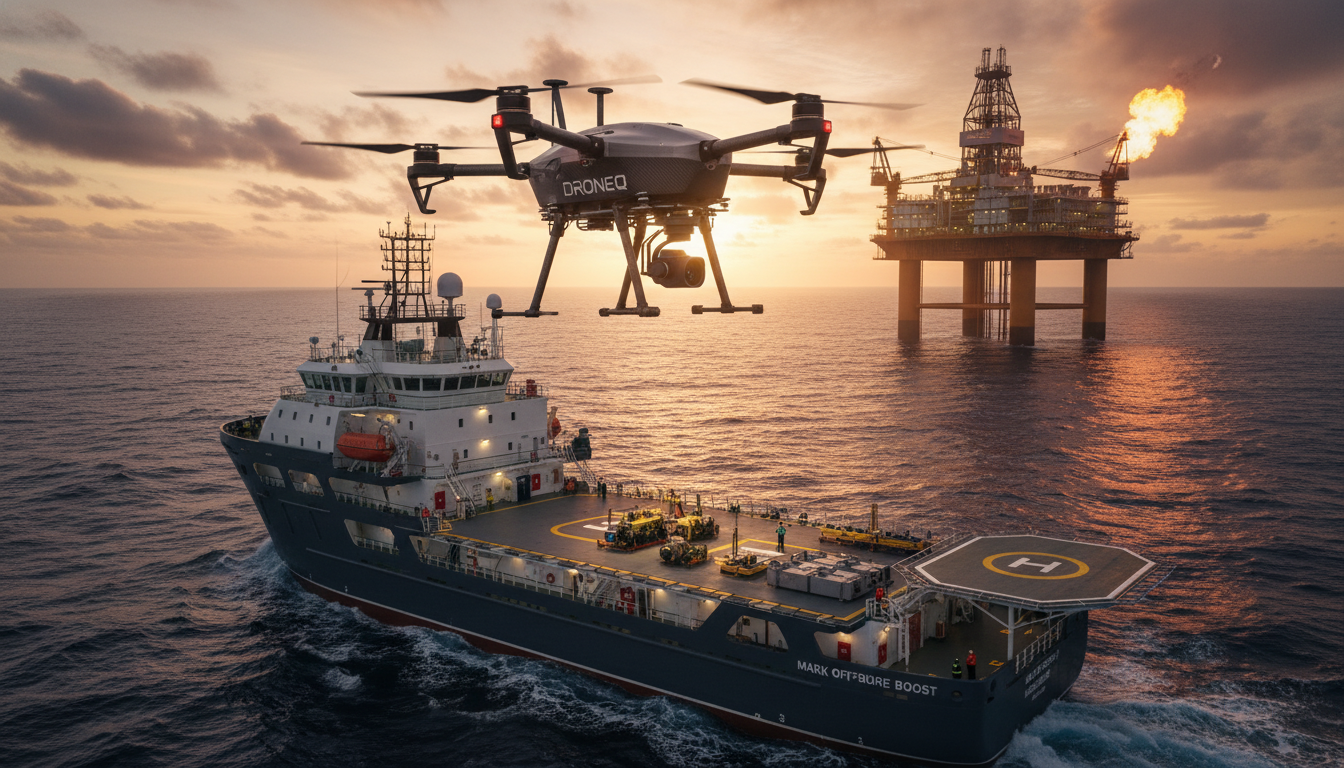
Offshore Robotics Revolution: DroneQ and Mark Offshore Deploy R/V Mintis for Advanced Subsea and Aerial Inspections
The offshore oil and gas sector, constantly seeking operational efficiencies and enhanced safety protocols, is witnessing a significant pivot towards advanced robotics and unmanned systems. In a strategic move set to redefine subsea and aerial inspection capabilities, DroneQ Robotics has forged an exclusive partnership with Mark Offshore for the deployment of the R/V Mintis. This dedicated vessel will serve as a cutting-edge platform for integrated inspection and survey operations, marking a substantial leap in the application of drone technologies and remotely operated vehicles (ROVs) within the energy industry.
This collaboration underscores a growing industry trend: leveraging specialized, technology-driven assets to deliver superior results more efficiently. The R/V Mintis, a DP1 ROV support and survey vessel, will be exclusively utilized by DroneQ Robotics. This grants the company unparalleled access to a powerful marine asset, enabling it to execute its own critical projects while also extending its advanced services to major third-party clients, including Intertek. The vessel’s primary mission focuses on supporting vital subsea inspection, offshore construction oversight, and comprehensive survey operations, crucial functions for maintaining the integrity and efficiency of global energy infrastructure.
Strategic Integration: Elevating Offshore Service Delivery
The alliance between DroneQ Robotics and Mark Offshore is not merely a new agreement; it represents an evolution of an existing working relationship, highlighting a shared vision for the future of offshore services. This partnership epitomizes the industry’s broader movement towards integrated service models, where the synergistic deployment of specialized vessels, advanced ROVs, and aerial drone systems creates a holistic and highly effective operational framework. For investors, this signals a commitment to optimizing capital expenditure through intelligent asset utilization and embracing innovation for competitive advantage.
Managed by Mark Offshore on behalf of Lithuania’s Klaipėda University, the R/V Mintis arrives with impressive capabilities designed for diverse maritime environments. Engineered for both shallow-water maneuvers and deepwater assignments, the vessel is a robust platform for demanding subsea tasks. Its onboard technology suite includes multiple state-of-the-art ROV systems, capable of descending to depths of up to 1,000 meters (approximately 3,280 feet). These ROVs are equipped with an array of high-resolution imaging devices, advanced sonar systems, and specialized inspection tools, providing unparalleled data acquisition for critical infrastructure.
Beyond its subsea prowess, the R/V Mintis is also configured for aerial reconnaissance, deploying sophisticated offshore-capable drones. These unmanned aerial vehicles (UAVs) conduct detailed aerial inspections of platforms, wind turbines, and other exposed marine assets, offering a comprehensive view that complements subsea data. This dual-capability approach ensures complete coverage and detailed insights, from the waterline to the seabed and above, supporting a wide range of applications critical to the oil and gas value chain.
Advanced Robotics: Precision for Pipeline, Subsea, and Environmental Stewardship
DroneQ Robotics confirms that the R/V Mintis will be instrumental in a variety of high-demand offshore tasks. These include meticulous pipeline and cable surveys, essential for maintaining the integrity of energy transport networks. Furthermore, the vessel will undertake critical subsea inspection and maintenance work, ensuring the longevity and operational safety of underwater infrastructure. Its capabilities also extend to vital environmental monitoring, supporting the industry’s commitment to sustainable operations and regulatory compliance.
John Troch, co-founder of DroneQ Robotics, articulated the strategic significance of this development: “The partnership with Mark Offshore and the dedicated deployment of this vessel represents a monumental leap forward in the growth trajectory of DroneQ Robotics, particularly for our Advanced Unmanned Robotics Services (AURS) offering in the offshore market.” Troch emphasized a fundamental shift in industry thinking, observing, “The market is increasingly recognizing that ‘Big, Bigger, Biggest’ is not invariably the optimal solution.” This insight points to the burgeoning demand for agile, precise, and cost-effective technological deployments over traditional, often more cumbersome, large-scale operations.
Tangible Returns and Revenue Generation from Day One
Mark Offshore has already reported immediate positive outcomes from this collaboration, with project activity commencing swiftly. Mark van der Star, managing director of Mark Offshore, highlighted the immediate impact, stating, “Thanks to our enduring relationship with John and our mutual drive for tangible results, our cooperation translated into a concrete project within the very first week of our commercial management of R/V Mintis.” This rapid deployment into active projects offers a compelling signal to investors about the immediate revenue-generating potential and efficiency of this partnership.
Van der Star further underscored his company’s commitment, asserting, “This experience reinforces our pledge: when shipowners entrust their vessels to Mark Offshore, we go beyond mere management; we actively transform them into revenue-generating assets from the initial day of engagement.” This proactive approach to asset utilization and commercial management demonstrates a clear focus on delivering shareholder value through operational excellence and strategic partnerships.
The deployment of R/V Mintis reflects a powerful overarching trend in the energy sector: the increasing adoption of smaller, highly advanced, and technology-driven offshore platforms. These intelligent systems are fundamentally improving efficiency in critical inspection and survey work across the vast spectrum of oil and gas operations. This paradigm shift not only promises reduced operational expenditures and enhanced safety but also delivers superior data quality, fostering better decision-making and contributing to the long-term sustainability and profitability of offshore energy investments.
